

3.1.2 Reaction Mechanism
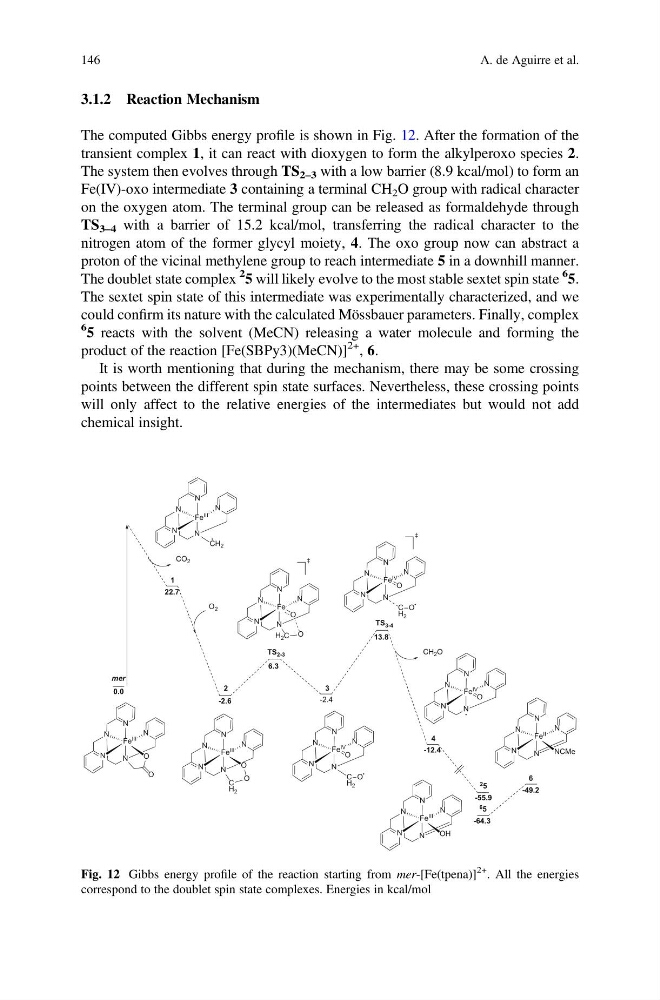
The computed Gibbs energy profile is shown in Fig. 12. After the formation of the
transient complex 1, it can react with dioxygen to form the alkylperoxo species 2.
The system then evolves through TS 2–3 with a low barrier (8.9 kcal/mol) to form an
Fe(IV)-oxo intermediate 3 containing a terminal CH 2 O group with radical character
on the oxygen atom. The terminal group can be released as formaldehyde through
TS 3–4 with a barrier of 15.2 kcal/mol, transferring the radical character to the
nitrogen atom of the former glycyl moiety, 4. The oxo group now can abstract a
proton of the vicinal methylene group to reach intermediate 5 in a downhill manner.
The doublet state complex
2 5 will likely evolve to the most stable sextet spin state
6 5.
The sextet spin state of this intermediate was experimentally characterized, and we
could confirm its nature with the calculated Mössbauer parameters. Finally, complex
6 5 reacts with the solvent (MeCN) releasing a water molecule and forming the
product of the reaction [Fe(SBPy3)(MeCN)]
2+ , 6.
It is worth mentioning that during the mechanism, there may be some crossing
points between the different spin state surfaces. Nevertheless, these crossing points
will only affect to the relative energies of the intermediates but would not add
chemical insight.
Fe III
O
N
N
N
N
N
O
Fe III
N
N
N
N
N
CH 2
Fe III
O
N
N
N
N
N
O
C
H 2
0.0
22.7
CO 2
-2.6
6.3
-2.4
13.8
Fe IV
N
N
N
N
N
C
H 2
O
O
TS 2-3
TS 3-4
-12.4
-55.9
-49.2
Fe III
OH
N
N
N
N
N
Fe IV
N
N
N
N
N
O
CH 2 O
Fe II
NCMe
N
N
N
N
N
O 2
Fe
O
N
N
N
N
N
O
H 2 C
Fe IV
N
N
N
N
N
C
H 2
O
O
1
2
3
4
2 5
6
mer
6 5
-64.3
Fig. 12 Gibbs energy profile of the reaction starting from mer-[Fe(tpena)]
2+ . All the energies
correspond to the doublet spin state complexes. Energies in kcal/mol
146
A. de Aguirre et al.
The computed Gibbs energy profile is shown in Fig. 12. After the formation of the
transient complex 1, it can react with dioxygen to form the alkylperoxo species 2.
The system then evolves through TS 2–3 with a low barrier (8.9 kcal/mol) to form an
Fe(IV)-oxo intermediate 3 containing a terminal CH 2 O group with radical character
on the oxygen atom. The terminal group can be released as formaldehyde through
TS 3–4 with a barrier of 15.2 kcal/mol, transferring the radical character to the
nitrogen atom of the former glycyl moiety, 4. The oxo group now can abstract a
proton of the vicinal methylene group to reach intermediate 5 in a downhill manner.
The doublet state complex
2 5 will likely evolve to the most stable sextet spin state
6 5.
The sextet spin state of this intermediate was experimentally characterized, and we
could confirm its nature with the calculated Mössbauer parameters. Finally, complex
6 5 reacts with the solvent (MeCN) releasing a water molecule and forming the
product of the reaction [Fe(SBPy3)(MeCN)]
2+ , 6.
It is worth mentioning that during the mechanism, there may be some crossing
points between the different spin state surfaces. Nevertheless, these crossing points
will only affect to the relative energies of the intermediates but would not add
chemical insight.
Fe III
O
N
N
N
N
N
O
Fe III
N
N
N
N
N
CH 2
Fe III
O
N
N
N
N
N
O
C
H 2
0.0
22.7
CO 2
-2.6
6.3
-2.4
13.8
Fe IV
N
N
N
N
N
C
H 2
O
O
TS 2-3
TS 3-4
-12.4
-55.9
-49.2
Fe III
OH
N
N
N
N
N
Fe IV
N
N
N
N
N
O
CH 2 O
Fe II
NCMe
N
N
N
N
N
O 2
Fe
O
N
N
N
N
N
O
H 2 C
Fe IV
N
N
N
N
N
C
H 2
O
O
1
2
3
4
2 5
6
mer
6 5
-64.3
Fig. 12 Gibbs energy profile of the reaction starting from mer-[Fe(tpena)]
2+ . All the energies
correspond to the doublet spin state complexes. Energies in kcal/mol
146
A. de Aguirre et al.