

3.1.1 Photoactivation Step
Experimental data indicate two potential starting points for the photoactivation step:
the high-spin sextet state mer-[Fe(tpena)]
2+ and the low-spin doublet fac-[Fe
(tpena)]
2+ . The calculations showed that both complexes have similar energies
which agree with the similarities for the Fe
III /Fe
II redox potentials found [72]. We
next ran TD-DFT calculations to evaluate the vertical absorptions of both fac and
mer complexes. The fac complex in its low-spin state did not show any active band
in the near UV or visible range. On the other hand, the mer isomer in the sextet spin
state show a ligand-to-metal charge transfer (LMCT) band with maximum absorption at 377 nm. Consequently, we concluded that the reaction advances through this
isomer.
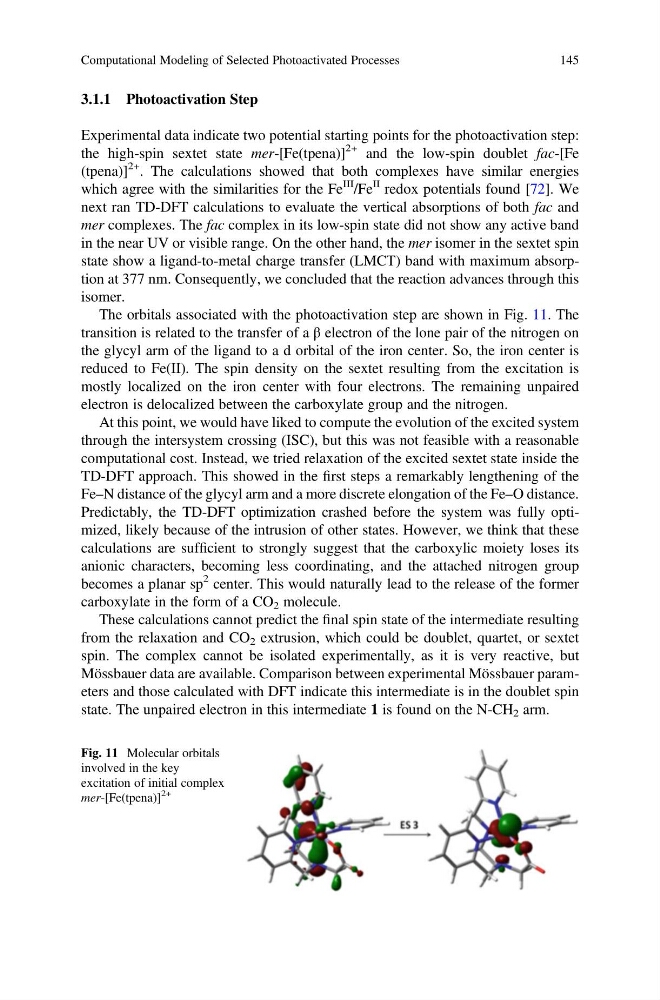
The orbitals associated with the photoactivation step are shown in Fig. 11. The
transition is related to the transfer of a β electron of the lone pair of the nitrogen on
the glycyl arm of the ligand to a d orbital of the iron center. So, the iron center is
reduced to Fe(II). The spin density on the sextet resulting from the excitation is
mostly localized on the iron center with four electrons. The remaining unpaired
electron is delocalized between the carboxylate group and the nitrogen.
At this point, we would have liked to compute the evolution of the excited system
through the intersystem crossing (ISC), but this was not feasible with a reasonable
computational cost. Instead, we tried relaxation of the excited sextet state inside the
TD-DFT approach. This showed in the first steps a remarkably lengthening of the
Fe–N distance of the glycyl arm and a more discrete elongation of the Fe–O distance.
Predictably, the TD-DFT optimization crashed before the system was fully optimized, likely because of the intrusion of other states. However, we think that these
calculations are sufficient to strongly suggest that the carboxylic moiety loses its
anionic characters, becoming less coordinating, and the attached nitrogen group
becomes a planar sp
2 center. This would naturally lead to the release of the former
carboxylate in the form of a CO 2 molecule.
These calculations cannot predict the final spin state of the intermediate resulting
from the relaxation and CO 2 extrusion, which could be doublet, quartet, or sextet
spin. The complex cannot be isolated experimentally, as it is very reactive, but
Mössbauer data are available. Comparison between experimental Mössbauer parameters and those calculated with DFT indicate this intermediate is in the doublet spin
state. The unpaired electron in this intermediate 1 is found on the N-CH 2 arm.
Fig. 11 Molecular orbitals
involved in the key
excitation of initial complex
mer-[Fe(tpena)]
2+
Computational Modeling of Selected Photoactivated Processes
145
Experimental data indicate two potential starting points for the photoactivation step:
the high-spin sextet state mer-[Fe(tpena)]
2+ and the low-spin doublet fac-[Fe
(tpena)]
2+ . The calculations showed that both complexes have similar energies
which agree with the similarities for the Fe
III /Fe
II redox potentials found [72]. We
next ran TD-DFT calculations to evaluate the vertical absorptions of both fac and
mer complexes. The fac complex in its low-spin state did not show any active band
in the near UV or visible range. On the other hand, the mer isomer in the sextet spin
state show a ligand-to-metal charge transfer (LMCT) band with maximum absorption at 377 nm. Consequently, we concluded that the reaction advances through this
isomer.
The orbitals associated with the photoactivation step are shown in Fig. 11. The
transition is related to the transfer of a β electron of the lone pair of the nitrogen on
the glycyl arm of the ligand to a d orbital of the iron center. So, the iron center is
reduced to Fe(II). The spin density on the sextet resulting from the excitation is
mostly localized on the iron center with four electrons. The remaining unpaired
electron is delocalized between the carboxylate group and the nitrogen.
At this point, we would have liked to compute the evolution of the excited system
through the intersystem crossing (ISC), but this was not feasible with a reasonable
computational cost. Instead, we tried relaxation of the excited sextet state inside the
TD-DFT approach. This showed in the first steps a remarkably lengthening of the
Fe–N distance of the glycyl arm and a more discrete elongation of the Fe–O distance.
Predictably, the TD-DFT optimization crashed before the system was fully optimized, likely because of the intrusion of other states. However, we think that these
calculations are sufficient to strongly suggest that the carboxylic moiety loses its
anionic characters, becoming less coordinating, and the attached nitrogen group
becomes a planar sp
2 center. This would naturally lead to the release of the former
carboxylate in the form of a CO 2 molecule.
These calculations cannot predict the final spin state of the intermediate resulting
from the relaxation and CO 2 extrusion, which could be doublet, quartet, or sextet
spin. The complex cannot be isolated experimentally, as it is very reactive, but
Mössbauer data are available. Comparison between experimental Mössbauer parameters and those calculated with DFT indicate this intermediate is in the doublet spin
state. The unpaired electron in this intermediate 1 is found on the N-CH 2 arm.
Fig. 11 Molecular orbitals
involved in the key
excitation of initial complex
mer-[Fe(tpena)]
2+
Computational Modeling of Selected Photoactivated Processes
145