

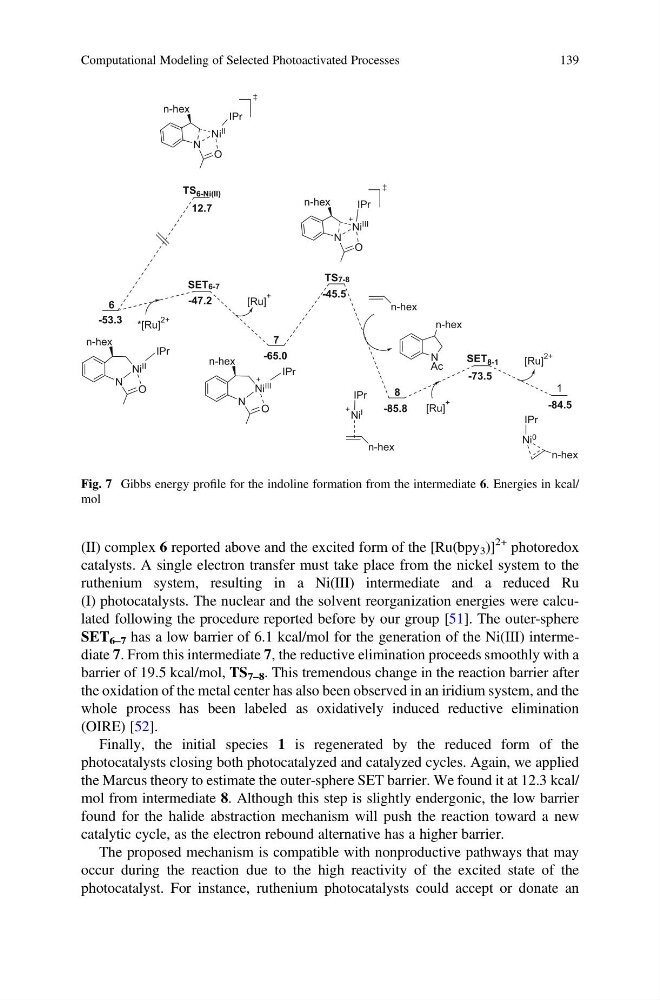
(II) complex 6 reported above and the excited form of the [Ru(bpy 3 )]
2+ photoredox
catalysts. A single electron transfer must take place from the nickel system to the
ruthenium system, resulting in a Ni(III) intermediate and a reduced Ru
(I) photocatalysts. The nuclear and the solvent reorganization energies were calculated following the procedure reported before by our group [51]. The outer-sphere
SET 6–7 has a low barrier of 6.1 kcal/mol for the generation of the Ni(III) intermediate 7. From this intermediate 7, the reductive elimination proceeds smoothly with a
barrier of 19.5 kcal/mol, TS 7–8 . This tremendous change in the reaction barrier after
the oxidation of the metal center has also been observed in an iridium system, and the
whole process has been labeled as oxidatively induced reductive elimination
(OIRE) [52].
Finally, the initial species 1 is regenerated by the reduced form of the
photocatalysts closing both photocatalyzed and catalyzed cycles. Again, we applied
the Marcus theory to estimate the outer-sphere SET barrier. We found it at 12.3 kcal/
mol from intermediate 8. Although this step is slightly endergonic, the low barrier
found for the halide abstraction mechanism will push the reaction toward a new
catalytic cycle, as the electron rebound alternative has a higher barrier.
The proposed mechanism is compatible with nonproductive pathways that may
occur during the reaction due to the high reactivity of the excited state of the
photocatalyst. For instance, ruthenium photocatalysts could accept or donate an
-53.3
-65.0
-45.5
12.7
6
N
Ni III
IPr
n-hex
O
N
Ni II
IPr
n-hex
O
N
Ni III
IPr
n-hex
O
N
Ni II
IPr
n-hex
O
N
Ac
n-hex
-47.2
SET6-7
[Ru]
+
*[Ru]
2+
-85.8
-84.5
8
1
[Ru]
+
[Ru]
2+
Ni 0
IPr
n-hex
Ni I
IPr
n-hex
SET 8-1
-73.5
7
TS7-8
TS 6-Ni(II)
n-hex
Fig. 7 Gibbs energy profile for the indoline formation from the intermediate 6. Energies in kcal/
mol
Computational Modeling of Selected Photoactivated Processes
139
2+ photoredox
catalysts. A single electron transfer must take place from the nickel system to the
ruthenium system, resulting in a Ni(III) intermediate and a reduced Ru
(I) photocatalysts. The nuclear and the solvent reorganization energies were calculated following the procedure reported before by our group [51]. The outer-sphere
SET 6–7 has a low barrier of 6.1 kcal/mol for the generation of the Ni(III) intermediate 7. From this intermediate 7, the reductive elimination proceeds smoothly with a
barrier of 19.5 kcal/mol, TS 7–8 . This tremendous change in the reaction barrier after
the oxidation of the metal center has also been observed in an iridium system, and the
whole process has been labeled as oxidatively induced reductive elimination
(OIRE) [52].
Finally, the initial species 1 is regenerated by the reduced form of the
photocatalysts closing both photocatalyzed and catalyzed cycles. Again, we applied
the Marcus theory to estimate the outer-sphere SET barrier. We found it at 12.3 kcal/
mol from intermediate 8. Although this step is slightly endergonic, the low barrier
found for the halide abstraction mechanism will push the reaction toward a new
catalytic cycle, as the electron rebound alternative has a higher barrier.
The proposed mechanism is compatible with nonproductive pathways that may
occur during the reaction due to the high reactivity of the excited state of the
photocatalyst. For instance, ruthenium photocatalysts could accept or donate an
-53.3
-65.0
-45.5
12.7
6
N
Ni III
IPr
n-hex
O
N
Ni II
IPr
n-hex
O
N
Ni III
IPr
n-hex
O
N
Ni II
IPr
n-hex
O
N
Ac
n-hex
-47.2
SET6-7
[Ru]
+
*[Ru]
2+
-85.8
-84.5
8
1
[Ru]
+
[Ru]
2+
Ni 0
IPr
n-hex
Ni I
IPr
n-hex
SET 8-1
-73.5
7
TS7-8
TS 6-Ni(II)
n-hex
Fig. 7 Gibbs energy profile for the indoline formation from the intermediate 6. Energies in kcal/
mol
Computational Modeling of Selected Photoactivated Processes
139