

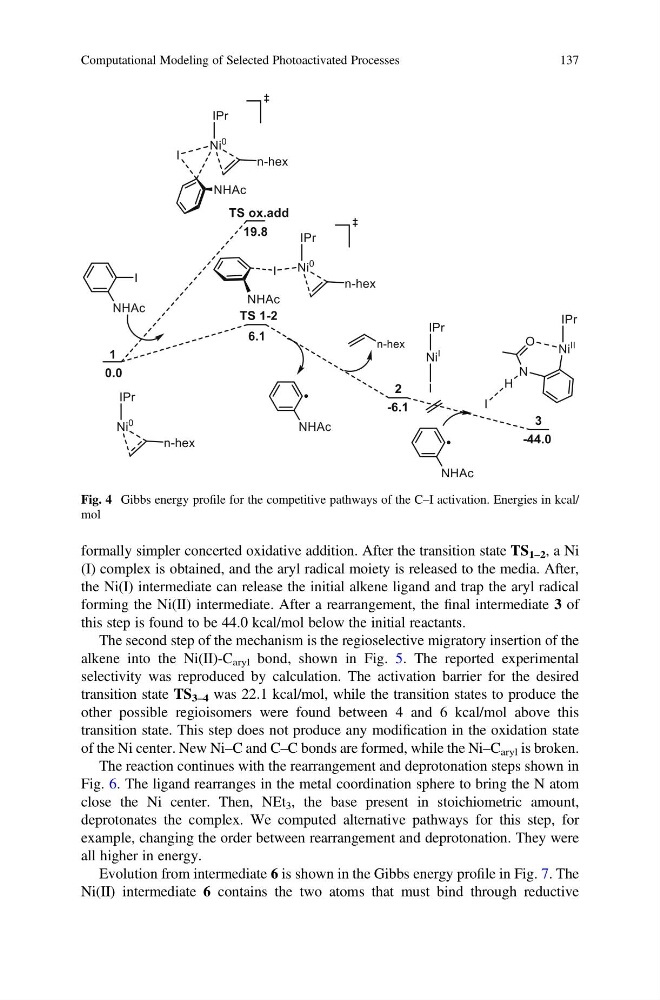
formally simpler concerted oxidative addition. After the transition state TS 1–2 , a Ni
(I) complex is obtained, and the aryl radical moiety is released to the media. After,
the Ni(I) intermediate can release the initial alkene ligand and trap the aryl radical
forming the Ni(II) intermediate. After a rearrangement, the final intermediate 3 of
this step is found to be 44.0 kcal/mol below the initial reactants.
The second step of the mechanism is the regioselective migratory insertion of the
alkene into the Ni(II)-C aryl bond, shown in Fig. 5. The reported experimental
selectivity was reproduced by calculation. The activation barrier for the desired
transition state TS 3–4 was 22.1 kcal/mol, while the transition states to produce the
other possible regioisomers were found between 4 and 6 kcal/mol above this
transition state. This step does not produce any modification in the oxidation state
of the Ni center. New Ni–C and C–C bonds are formed, while the Ni–C aryl is broken.
The reaction continues with the rearrangement and deprotonation steps shown in
Fig. 6. The ligand rearranges in the metal coordination sphere to bring the N atom
close the Ni center. Then, NEt 3 , the base present in stoichiometric amount,
deprotonates the complex. We computed alternative pathways for this step, for
example, changing the order between rearrangement and deprotonation. They were
all higher in energy.
Evolution from intermediate 6 is shown in the Gibbs energy profile in Fig. 7. The
Ni(II) intermediate 6 contains the two atoms that must bind through reductive
Fig. 4 Gibbs energy profile for the competitive pathways of the C–I activation. Energies in kcal/
mol
Computational Modeling of Selected Photoactivated Processes
137
(I) complex is obtained, and the aryl radical moiety is released to the media. After,
the Ni(I) intermediate can release the initial alkene ligand and trap the aryl radical
forming the Ni(II) intermediate. After a rearrangement, the final intermediate 3 of
this step is found to be 44.0 kcal/mol below the initial reactants.
The second step of the mechanism is the regioselective migratory insertion of the
alkene into the Ni(II)-C aryl bond, shown in Fig. 5. The reported experimental
selectivity was reproduced by calculation. The activation barrier for the desired
transition state TS 3–4 was 22.1 kcal/mol, while the transition states to produce the
other possible regioisomers were found between 4 and 6 kcal/mol above this
transition state. This step does not produce any modification in the oxidation state
of the Ni center. New Ni–C and C–C bonds are formed, while the Ni–C aryl is broken.
The reaction continues with the rearrangement and deprotonation steps shown in
Fig. 6. The ligand rearranges in the metal coordination sphere to bring the N atom
close the Ni center. Then, NEt 3 , the base present in stoichiometric amount,
deprotonates the complex. We computed alternative pathways for this step, for
example, changing the order between rearrangement and deprotonation. They were
all higher in energy.
Evolution from intermediate 6 is shown in the Gibbs energy profile in Fig. 7. The
Ni(II) intermediate 6 contains the two atoms that must bind through reductive
Fig. 4 Gibbs energy profile for the competitive pathways of the C–I activation. Energies in kcal/
mol
Computational Modeling of Selected Photoactivated Processes
137