

treatment of photoactivated processes [32–34]. Even without an accurate description
of state crossings in the excited state, useful information can be obtained on the
photocatalytic process. The nature of the photoexcitation, namely, the identity of the
orbitals involved, can be investigated via time-dependent DFT (TD-DFT) [35],
which allows the calculation of absorption spectra. Once the excited system relaxes
to a fluorescent or phosphorescent state, its subsequent evolution can be analyzed
with standard DFT techniques.
The main nuance to the application of DFT to these processes is the need to
describe single electron transfer (SET) between the two redox partners, which is
critical when the photosensitizers acts as a photoredox catalyst. These SET steps
have been found crucial for the course of many processes, such as dual Ni–
photoredox-catalyzed reactions [36–38]. A systematic procedure to compute and
estimate the barrier for these SET steps in outer-sphere processes is the application of
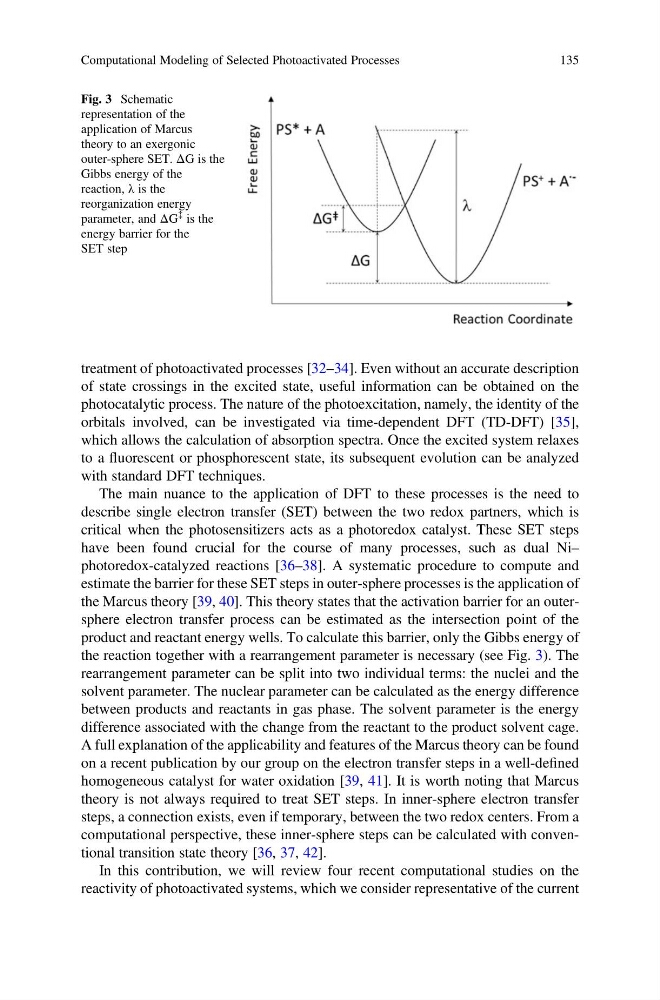
the Marcus theory [39, 40]. This theory states that the activation barrier for an outersphere electron transfer process can be estimated as the intersection point of the
product and reactant energy wells. To calculate this barrier, only the Gibbs energy of
the reaction together with a rearrangement parameter is necessary (see Fig. 3). The
rearrangement parameter can be split into two individual terms: the nuclei and the
solvent parameter. The nuclear parameter can be calculated as the energy difference
between products and reactants in gas phase. The solvent parameter is the energy
difference associated with the change from the reactant to the product solvent cage.
A full explanation of the applicability and features of the Marcus theory can be found
on a recent publication by our group on the electron transfer steps in a well-defined
homogeneous catalyst for water oxidation [39, 41]. It is worth noting that Marcus
theory is not always required to treat SET steps. In inner-sphere electron transfer
steps, a connection exists, even if temporary, between the two redox centers. From a
computational perspective, these inner-sphere steps can be calculated with conventional transition state theory [36, 37, 42].
In this contribution, we will review four recent computational studies on the
reactivity of photoactivated systems, which we consider representative of the current
Fig. 3 Schematic
representation of the
application of Marcus
theory to an exergonic
outer-sphere SET. ΔG is the
Gibbs energy of the
reaction, λ is the
reorganization energy
parameter, and ΔG
{ is the
energy barrier for the
SET step
Computational Modeling of Selected Photoactivated Processes
135
of state crossings in the excited state, useful information can be obtained on the
photocatalytic process. The nature of the photoexcitation, namely, the identity of the
orbitals involved, can be investigated via time-dependent DFT (TD-DFT) [35],
which allows the calculation of absorption spectra. Once the excited system relaxes
to a fluorescent or phosphorescent state, its subsequent evolution can be analyzed
with standard DFT techniques.
The main nuance to the application of DFT to these processes is the need to
describe single electron transfer (SET) between the two redox partners, which is
critical when the photosensitizers acts as a photoredox catalyst. These SET steps
have been found crucial for the course of many processes, such as dual Ni–
photoredox-catalyzed reactions [36–38]. A systematic procedure to compute and
estimate the barrier for these SET steps in outer-sphere processes is the application of
the Marcus theory [39, 40]. This theory states that the activation barrier for an outersphere electron transfer process can be estimated as the intersection point of the
product and reactant energy wells. To calculate this barrier, only the Gibbs energy of
the reaction together with a rearrangement parameter is necessary (see Fig. 3). The
rearrangement parameter can be split into two individual terms: the nuclei and the
solvent parameter. The nuclear parameter can be calculated as the energy difference
between products and reactants in gas phase. The solvent parameter is the energy
difference associated with the change from the reactant to the product solvent cage.
A full explanation of the applicability and features of the Marcus theory can be found
on a recent publication by our group on the electron transfer steps in a well-defined
homogeneous catalyst for water oxidation [39, 41]. It is worth noting that Marcus
theory is not always required to treat SET steps. In inner-sphere electron transfer
steps, a connection exists, even if temporary, between the two redox centers. From a
computational perspective, these inner-sphere steps can be calculated with conventional transition state theory [36, 37, 42].
In this contribution, we will review four recent computational studies on the
reactivity of photoactivated systems, which we consider representative of the current
Fig. 3 Schematic
representation of the
application of Marcus
theory to an exergonic
outer-sphere SET. ΔG is the
Gibbs energy of the
reaction, λ is the
reorganization energy
parameter, and ΔG
{ is the
energy barrier for the
SET step
Computational Modeling of Selected Photoactivated Processes
135