

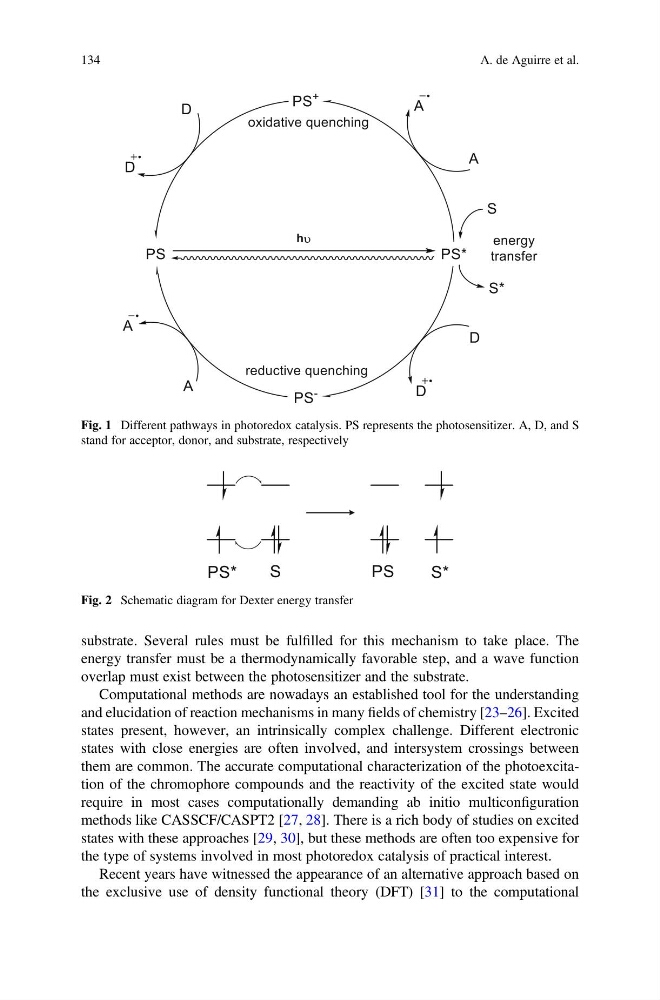
substrate. Several rules must be fulfilled for this mechanism to take place. The
energy transfer must be a thermodynamically favorable step, and a wave function
overlap must exist between the photosensitizer and the substrate.
Computational methods are nowadays an established tool for the understanding
and elucidation of reaction mechanisms in many fields of chemistry [23–26]. Excited
states present, however, an intrinsically complex challenge. Different electronic
states with close energies are often involved, and intersystem crossings between
them are common. The accurate computational characterization of the photoexcitation of the chromophore compounds and the reactivity of the excited state would
require in most cases computationally demanding ab initio multiconfiguration
methods like CASSCF/CASPT2 [27, 28]. There is a rich body of studies on excited
states with these approaches [29, 30], but these methods are often too expensive for
the type of systems involved in most photoredox catalysis of practical interest.
Recent years have witnessed the appearance of an alternative approach based on
the exclusive use of density functional theory (DFT) [31] to the computational
Fig. 1 Different pathways in photoredox catalysis. PS represents the photosensitizer. A, D, and S
stand for acceptor, donor, and substrate, respectively
Fig. 2 Schematic diagram for Dexter energy transfer
134
A. de Aguirre et al.
energy transfer must be a thermodynamically favorable step, and a wave function
overlap must exist between the photosensitizer and the substrate.
Computational methods are nowadays an established tool for the understanding
and elucidation of reaction mechanisms in many fields of chemistry [23–26]. Excited
states present, however, an intrinsically complex challenge. Different electronic
states with close energies are often involved, and intersystem crossings between
them are common. The accurate computational characterization of the photoexcitation of the chromophore compounds and the reactivity of the excited state would
require in most cases computationally demanding ab initio multiconfiguration
methods like CASSCF/CASPT2 [27, 28]. There is a rich body of studies on excited
states with these approaches [29, 30], but these methods are often too expensive for
the type of systems involved in most photoredox catalysis of practical interest.
Recent years have witnessed the appearance of an alternative approach based on
the exclusive use of density functional theory (DFT) [31] to the computational
Fig. 1 Different pathways in photoredox catalysis. PS represents the photosensitizer. A, D, and S
stand for acceptor, donor, and substrate, respectively
Fig. 2 Schematic diagram for Dexter energy transfer
134
A. de Aguirre et al.