

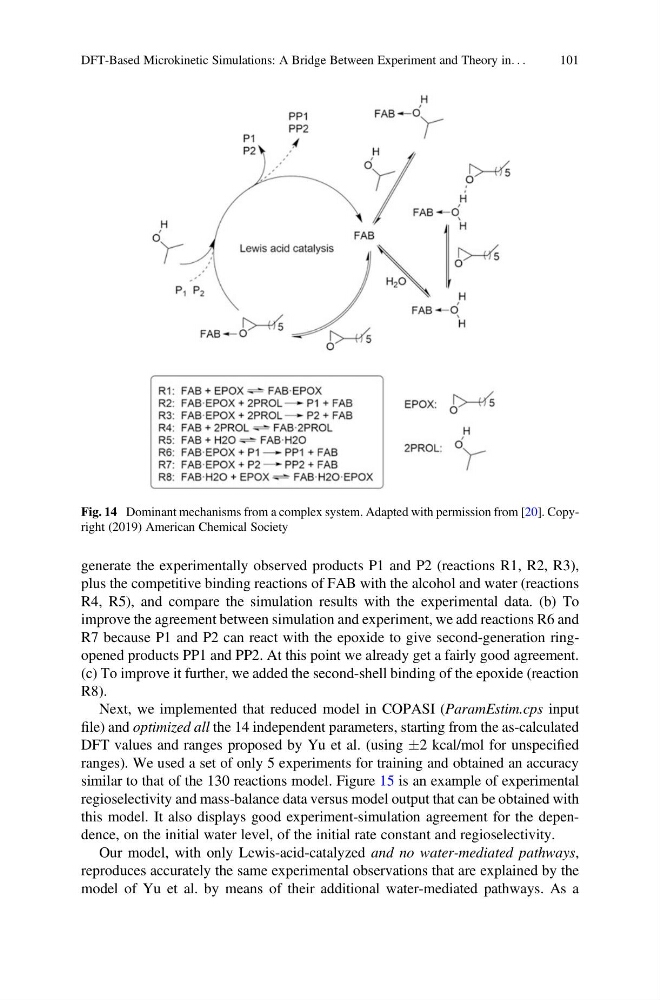
generate the experimentally observed products P1 and P2 (reactions R1, R2, R3),
plus the competitive binding reactions of FAB with the alcohol and water (reactions
R4, R5), and compare the simulation results with the experimental data. (b) To
improve the agreement between simulation and experiment, we add reactions R6 and
R7 because P1 and P2 can react with the epoxide to give second-generation ringopened products PP1 and PP2. At this point we already get a fairly good agreement.
(c) To improve it further, we added the second-shell binding of the epoxide (reaction
R8).
Next, we implemented that reduced model in COPASI (ParamEstim.cps input
file) and optimized all the 14 independent parameters, starting from the as-calculated
DFT values and ranges proposed by Yu et al. (using Æ2 kcal/mol for unspecified
ranges). We used a set of only 5 experiments for training and obtained an accuracy
similar to that of the 130 reactions model. Figure 15 is an example of experimental
regioselectivity and mass-balance data versus model output that can be obtained with
this model. It also displays good experiment-simulation agreement for the dependence, on the initial water level, of the initial rate constant and regioselectivity.
Our model, with only Lewis-acid-catalyzed and no water-mediated pathways,
reproduces accurately the same experimental observations that are explained by the
model of Yu et al. by means of their additional water-mediated pathways. As a
Fig. 14 Dominant mechanisms from a complex system. Adapted with permission from [20]. Copyright (2019) American Chemical Society
DFT-Based Microkinetic Simulations: A Bridge Between Experiment and Theory in. . .
101
plus the competitive binding reactions of FAB with the alcohol and water (reactions
R4, R5), and compare the simulation results with the experimental data. (b) To
improve the agreement between simulation and experiment, we add reactions R6 and
R7 because P1 and P2 can react with the epoxide to give second-generation ringopened products PP1 and PP2. At this point we already get a fairly good agreement.
(c) To improve it further, we added the second-shell binding of the epoxide (reaction
R8).
Next, we implemented that reduced model in COPASI (ParamEstim.cps input
file) and optimized all the 14 independent parameters, starting from the as-calculated
DFT values and ranges proposed by Yu et al. (using Æ2 kcal/mol for unspecified
ranges). We used a set of only 5 experiments for training and obtained an accuracy
similar to that of the 130 reactions model. Figure 15 is an example of experimental
regioselectivity and mass-balance data versus model output that can be obtained with
this model. It also displays good experiment-simulation agreement for the dependence, on the initial water level, of the initial rate constant and regioselectivity.
Our model, with only Lewis-acid-catalyzed and no water-mediated pathways,
reproduces accurately the same experimental observations that are explained by the
model of Yu et al. by means of their additional water-mediated pathways. As a
Fig. 14 Dominant mechanisms from a complex system. Adapted with permission from [20]. Copyright (2019) American Chemical Society
DFT-Based Microkinetic Simulations: A Bridge Between Experiment and Theory in. . .
101