

data points, it can be concluded that the DFT foundation of the model must be
playing a key role in the predictive character of this simulator.
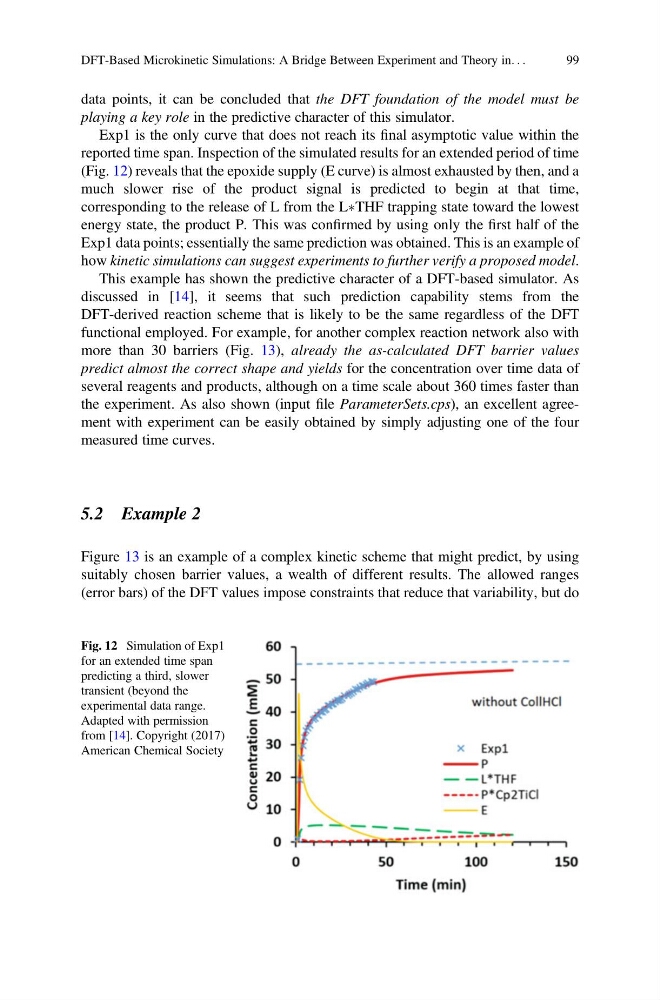
Exp1 is the only curve that does not reach its final asymptotic value within the
reported time span. Inspection of the simulated results for an extended period of time
(Fig. 12) reveals that the epoxide supply (E curve) is almost exhausted by then, and a
much slower rise of the product signal is predicted to begin at that time,
corresponding to the release of L from the LÃTHF trapping state toward the lowest
energy state, the product P. This was confirmed by using only the first half of the
Exp1 data points; essentially the same prediction was obtained. This is an example of
how kinetic simulations can suggest experiments to further verify a proposed model.
This example has shown the predictive character of a DFT-based simulator. As
discussed in [14], it seems that such prediction capability stems from the
DFT-derived reaction scheme that is likely to be the same regardless of the DFT
functional employed. For example, for another complex reaction network also with
more than 30 barriers (Fig. 13), already the as-calculated DFT barrier values
predict almost the correct shape and yields for the concentration over time data of
several reagents and products, although on a time scale about 360 times faster than
the experiment. As also shown (input file ParameterSets.cps), an excellent agreement with experiment can be easily obtained by simply adjusting one of the four
measured time curves.
5.2 Example 2
Figure 13 is an example of a complex kinetic scheme that might predict, by using
suitably chosen barrier values, a wealth of different results. The allowed ranges
(error bars) of the DFT values impose constraints that reduce that variability, but do
Fig. 12 Simulation of Exp1
for an extended time span
predicting a third, slower
transient (beyond the
experimental data range.
Adapted with permission
from [14]. Copyright (2017)
American Chemical Society
DFT-Based Microkinetic Simulations: A Bridge Between Experiment and Theory in. . .
99
playing a key role in the predictive character of this simulator.
Exp1 is the only curve that does not reach its final asymptotic value within the
reported time span. Inspection of the simulated results for an extended period of time
(Fig. 12) reveals that the epoxide supply (E curve) is almost exhausted by then, and a
much slower rise of the product signal is predicted to begin at that time,
corresponding to the release of L from the LÃTHF trapping state toward the lowest
energy state, the product P. This was confirmed by using only the first half of the
Exp1 data points; essentially the same prediction was obtained. This is an example of
how kinetic simulations can suggest experiments to further verify a proposed model.
This example has shown the predictive character of a DFT-based simulator. As
discussed in [14], it seems that such prediction capability stems from the
DFT-derived reaction scheme that is likely to be the same regardless of the DFT
functional employed. For example, for another complex reaction network also with
more than 30 barriers (Fig. 13), already the as-calculated DFT barrier values
predict almost the correct shape and yields for the concentration over time data of
several reagents and products, although on a time scale about 360 times faster than
the experiment. As also shown (input file ParameterSets.cps), an excellent agreement with experiment can be easily obtained by simply adjusting one of the four
measured time curves.
5.2 Example 2
Figure 13 is an example of a complex kinetic scheme that might predict, by using
suitably chosen barrier values, a wealth of different results. The allowed ranges
(error bars) of the DFT values impose constraints that reduce that variability, but do
Fig. 12 Simulation of Exp1
for an extended time span
predicting a third, slower
transient (beyond the
experimental data range.
Adapted with permission
from [14]. Copyright (2017)
American Chemical Society
DFT-Based Microkinetic Simulations: A Bridge Between Experiment and Theory in. . .
99