

74
11 Quantum Mechanics. Algebraic Structure and States
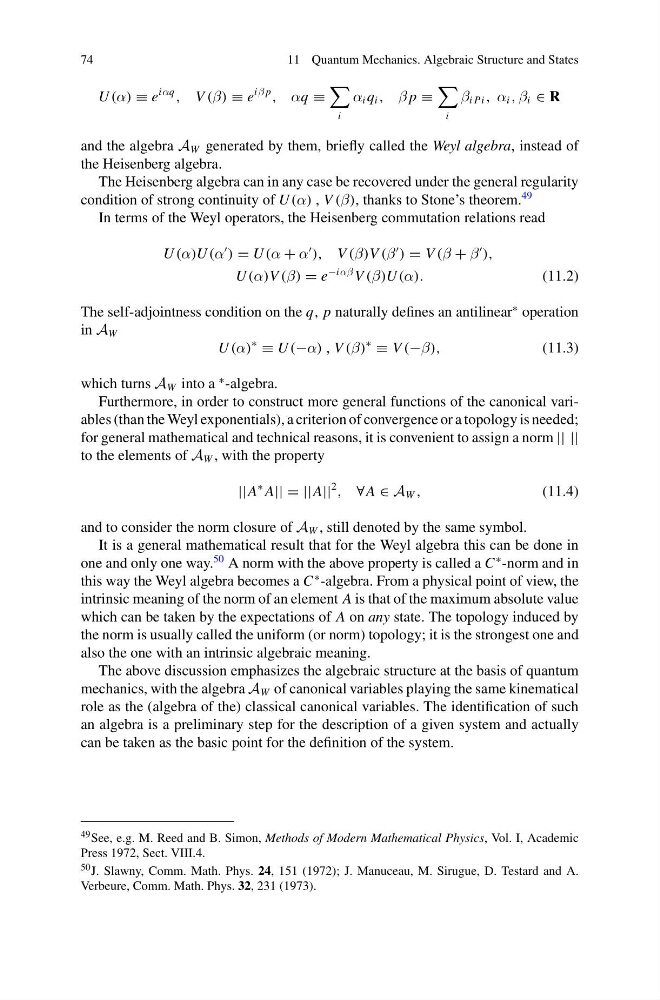
U (α) ≡ e
iαq
, V (β) ≡ e
iβ p
, αq ≡
i
α i q i , β p ≡
i
β i Pi , α i , β i ∈ R
and the algebra A W generated by them, briefly called the Weyl algebra, instead of
the Heisenberg algebra.
The Heisenberg algebra can in any case be recovered under the general regularity
condition of strong continuity of U (α) , V (β), thanks to Stone’s theorem.
49
In terms of the Weyl operators, the Heisenberg commutation relations read
U (α)U (α
) = U (α + α
), V (β)V (β
) = V (β + β
),
U (α)V (β) = e
−iαβ V (β)U (α).
(11.2)
The self-adjointness condition on the q, p naturally defines an antilinear
∗ operation
in A W
U (α)
∗
≡ U (−α) , V (β)
∗
≡ V (−β),
(11.3)
which turns A W into a
∗ -algebra.
Furthermore, in order to construct more general functions of the canonical variables (than the Weyl exponentials), a criterion of convergence or a topology is needed;
for general mathematical and technical reasons, it is convenient to assign a norm || ||
to the elements of A W , with the property
||A
∗ A|| = ||A||
2
, ∀A ∈ A W ,
(11.4)
and to consider the norm closure of A W , still denoted by the same symbol.
It is a general mathematical result that for the Weyl algebra this can be done in
one and only one way.
50 A norm with the above property is called a C
∗ -norm and in
this way the Weyl algebra becomes a C
∗ -algebra. From a physical point of view, the
intrinsic meaning of the norm of an element A is that of the maximum absolute value
which can be taken by the expectations of A on any state. The topology induced by
the norm is usually called the uniform (or norm) topology; it is the strongest one and
also the one with an intrinsic algebraic meaning.
The above discussion emphasizes the algebraic structure at the basis of quantum
mechanics, with the algebra A W of canonical variables playing the same kinematical
role as the (algebra of the) classical canonical variables. The identification of such
an algebra is a preliminary step for the description of a given system and actually
can be taken as the basic point for the definition of the system.
49 See, e.g. M. Reed and B. Simon, Methods of Modern Mathematical Physics, Vol. I, Academic
Press 1972, Sect. VIII.4.
50 J. Slawny, Comm. Math. Phys. 24, 151 (1972); J. Manuceau, M. Sirugue, D. Testard and A.
Verbeure, Comm. Math. Phys. 32, 231 (1973).
11 Quantum Mechanics. Algebraic Structure and States
U (α) ≡ e
iαq
, V (β) ≡ e
iβ p
, αq ≡
i
α i q i , β p ≡
i
β i Pi , α i , β i ∈ R
and the algebra A W generated by them, briefly called the Weyl algebra, instead of
the Heisenberg algebra.
The Heisenberg algebra can in any case be recovered under the general regularity
condition of strong continuity of U (α) , V (β), thanks to Stone’s theorem.
49
In terms of the Weyl operators, the Heisenberg commutation relations read
U (α)U (α
) = U (α + α
), V (β)V (β
) = V (β + β
),
U (α)V (β) = e
−iαβ V (β)U (α).
(11.2)
The self-adjointness condition on the q, p naturally defines an antilinear
∗ operation
in A W
U (α)
∗
≡ U (−α) , V (β)
∗
≡ V (−β),
(11.3)
which turns A W into a
∗ -algebra.
Furthermore, in order to construct more general functions of the canonical variables (than the Weyl exponentials), a criterion of convergence or a topology is needed;
for general mathematical and technical reasons, it is convenient to assign a norm || ||
to the elements of A W , with the property
||A
∗ A|| = ||A||
2
, ∀A ∈ A W ,
(11.4)
and to consider the norm closure of A W , still denoted by the same symbol.
It is a general mathematical result that for the Weyl algebra this can be done in
one and only one way.
50 A norm with the above property is called a C
∗ -norm and in
this way the Weyl algebra becomes a C
∗ -algebra. From a physical point of view, the
intrinsic meaning of the norm of an element A is that of the maximum absolute value
which can be taken by the expectations of A on any state. The topology induced by
the norm is usually called the uniform (or norm) topology; it is the strongest one and
also the one with an intrinsic algebraic meaning.
The above discussion emphasizes the algebraic structure at the basis of quantum
mechanics, with the algebra A W of canonical variables playing the same kinematical
role as the (algebra of the) classical canonical variables. The identification of such
an algebra is a preliminary step for the description of a given system and actually
can be taken as the basic point for the definition of the system.
49 See, e.g. M. Reed and B. Simon, Methods of Modern Mathematical Physics, Vol. I, Academic
Press 1972, Sect. VIII.4.
50 J. Slawny, Comm. Math. Phys. 24, 151 (1972); J. Manuceau, M. Sirugue, D. Testard and A.
Verbeure, Comm. Math. Phys. 32, 231 (1973).