

38
7 Noether Theorem and Symmetry Breaking
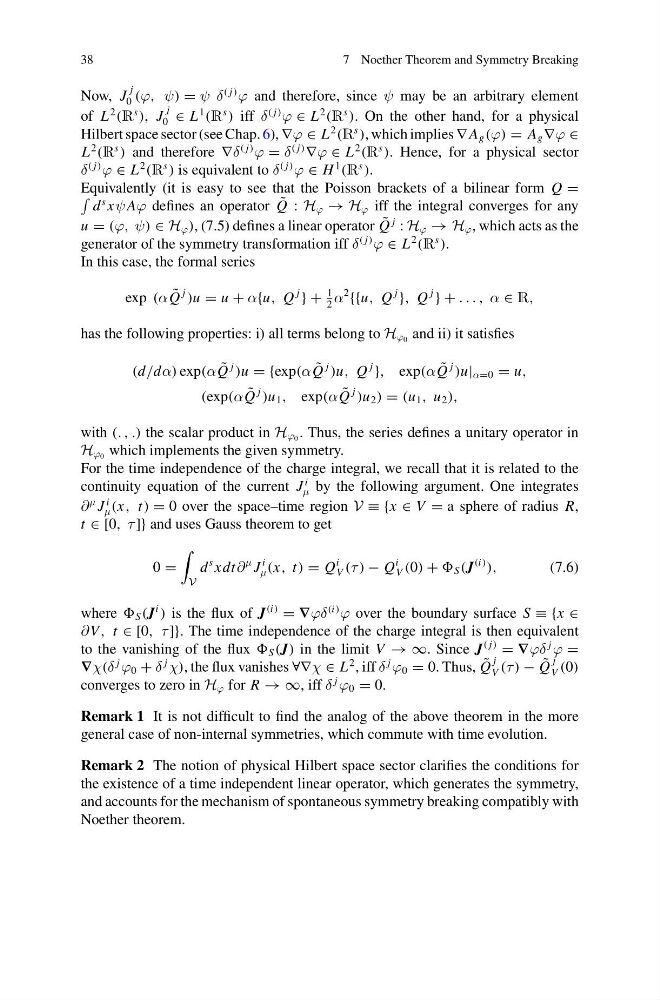
Now, J
j
0 (ϕ, ψ) = ψ δ
( j)
ϕ and therefore, since ψ may be an arbitrary element
of L
2
(R
s
), J
j
0 ∈ L
1
(R
s
) iff δ
( j)
ϕ ∈ L
2
(R
s
). On the other hand, for a physical
Hilbert space sector (see Chap. 6), ∇ϕ ∈ L
2
(R
s
), which implies ∇ A g (ϕ) = A g ∇ϕ ∈
L
2
(R
s
) and therefore ∇δ
( j)
ϕ = δ
( j)
∇ϕ ∈ L
2
(R
s
). Hence, for a physical sector
δ
( j)
ϕ ∈ L
2
(R
s
) is equivalent to δ
( j)
ϕ ∈ H
1
(R
s
).
Equivalently (it is easy to see that the Poisson brackets of a bilinear form Q =
d
s xψ Aϕ defines an operator ˜
Q : H ϕ → H ϕ iff the integral converges for any
u = (ϕ, ψ) ∈ H ϕ ), (7.5) defines a linear operator ˜
Q
j : H ϕ → H ϕ , which acts as the
generator of the symmetry transformation iff δ
( j)
ϕ ∈ L
2
(R
s
).
In this case, the formal series
exp (α ˜
Q
j
)u = u + α{u, Q
j
} +
1
2
α
2
{{u, Q
j
}, Q
j
} + . . . , α ∈ R,
has the following properties: i) all terms belong to H ϕ 0 and ii) it satisfies
(d/dα) exp(α ˜
Q
j
)u = {exp(α ˜
Q
j
)u, Q
j
}, exp(α ˜
Q
j
)u| α=0 = u,
(exp(α ˜
Q
j
)u 1 , exp(α ˜
Q
j
)u 2 ) = (u 1 , u 2 ),
with (. , .) the scalar product in H ϕ 0 . Thus, the series defines a unitary operator in
H ϕ 0 which implements the given symmetry.
For the time independence of the charge integral, we recall that it is related to the
continuity equation of the current J
i
μ by the following argument. One integrates
∂
μ J
i
μ (x, t) = 0 over the space–time region V ≡ {x ∈ V = a sphere of radius R,
t ∈ [0, τ ]} and uses Gauss theorem to get
0 =
V
d
s xdt∂
μ J
i
μ (x, t) = Q
i
V (τ ) − Q
i
V (0) + S (J
(i)
),
(7.6)
where S (J
i
) is the flux of J
(i)
= ∇ϕδ
(i)
ϕ over the boundary surface S ≡ {x ∈
∂V, t ∈ [0, τ ]}. The time independence of the charge integral is then equivalent
to the vanishing of the flux S (J) in the limit V → ∞. Since J
( j)
= ∇ϕδ
j
ϕ =
∇χ(δ
j
ϕ 0 + δ
j
χ), the flux vanishes ∀∇χ ∈ L
2 , iff δ
j
ϕ 0 = 0. Thus, ˜
Q
j
V (τ ) − ˜
Q
j
V (0)
converges to zero in H ϕ for R → ∞, iff δ
j
ϕ 0 = 0.
Remark 1 It is not difficult to find the analog of the above theorem in the more
general case of non-internal symmetries, which commute with time evolution.
Remark 2 The notion of physical Hilbert space sector clarifies the conditions for
the existence of a time independent linear operator, which generates the symmetry,
and accounts for the mechanism of spontaneous symmetry breaking compatibly with
Noether theorem.
7 Noether Theorem and Symmetry Breaking
Now, J
j
0 (ϕ, ψ) = ψ δ
( j)
ϕ and therefore, since ψ may be an arbitrary element
of L
2
(R
s
), J
j
0 ∈ L
1
(R
s
) iff δ
( j)
ϕ ∈ L
2
(R
s
). On the other hand, for a physical
Hilbert space sector (see Chap. 6), ∇ϕ ∈ L
2
(R
s
), which implies ∇ A g (ϕ) = A g ∇ϕ ∈
L
2
(R
s
) and therefore ∇δ
( j)
ϕ = δ
( j)
∇ϕ ∈ L
2
(R
s
). Hence, for a physical sector
δ
( j)
ϕ ∈ L
2
(R
s
) is equivalent to δ
( j)
ϕ ∈ H
1
(R
s
).
Equivalently (it is easy to see that the Poisson brackets of a bilinear form Q =
d
s xψ Aϕ defines an operator ˜
Q : H ϕ → H ϕ iff the integral converges for any
u = (ϕ, ψ) ∈ H ϕ ), (7.5) defines a linear operator ˜
Q
j : H ϕ → H ϕ , which acts as the
generator of the symmetry transformation iff δ
( j)
ϕ ∈ L
2
(R
s
).
In this case, the formal series
exp (α ˜
Q
j
)u = u + α{u, Q
j
} +
1
2
α
2
{{u, Q
j
}, Q
j
} + . . . , α ∈ R,
has the following properties: i) all terms belong to H ϕ 0 and ii) it satisfies
(d/dα) exp(α ˜
Q
j
)u = {exp(α ˜
Q
j
)u, Q
j
}, exp(α ˜
Q
j
)u| α=0 = u,
(exp(α ˜
Q
j
)u 1 , exp(α ˜
Q
j
)u 2 ) = (u 1 , u 2 ),
with (. , .) the scalar product in H ϕ 0 . Thus, the series defines a unitary operator in
H ϕ 0 which implements the given symmetry.
For the time independence of the charge integral, we recall that it is related to the
continuity equation of the current J
i
μ by the following argument. One integrates
∂
μ J
i
μ (x, t) = 0 over the space–time region V ≡ {x ∈ V = a sphere of radius R,
t ∈ [0, τ ]} and uses Gauss theorem to get
0 =
V
d
s xdt∂
μ J
i
μ (x, t) = Q
i
V (τ ) − Q
i
V (0) + S (J
(i)
),
(7.6)
where S (J
i
) is the flux of J
(i)
= ∇ϕδ
(i)
ϕ over the boundary surface S ≡ {x ∈
∂V, t ∈ [0, τ ]}. The time independence of the charge integral is then equivalent
to the vanishing of the flux S (J) in the limit V → ∞. Since J
( j)
= ∇ϕδ
j
ϕ =
∇χ(δ
j
ϕ 0 + δ
j
χ), the flux vanishes ∀∇χ ∈ L
2 , iff δ
j
ϕ 0 = 0. Thus, ˜
Q
j
V (τ ) − ˜
Q
j
V (0)
converges to zero in H ϕ for R → ∞, iff δ
j
ϕ 0 = 0.
Remark 1 It is not difficult to find the analog of the above theorem in the more
general case of non-internal symmetries, which commute with time evolution.
Remark 2 The notion of physical Hilbert space sector clarifies the conditions for
the existence of a time independent linear operator, which generates the symmetry,
and accounts for the mechanism of spontaneous symmetry breaking compatibly with
Noether theorem.