

7 Noether Theorem and Symmetry Breaking
37
Thus, the standard accounts of the Noether theorem implicitly apply to the solutions which decrease sufficiently fast at infinity, i.e. essentially to the “trivial vacuum”
sector H ϕ=0 .
In the general case when the solutions do not belong to H
1
⊕ L
2 , a criterion for
the existence of a conserved charge and a corresponding linear operator in H ϕ , acting
as the generator of the corresponding symmetry, is provided by the following version
of Noether theorem.
31 Again, the structure of Hilbert space sectors provides a simple
solution of the problem of compatibility of Noether theorem and symmetry breaking.
For simplicity, we consider the case of real fields and of linear transformations
with a g = 0, λ g = 1, the generalization being straightforward.
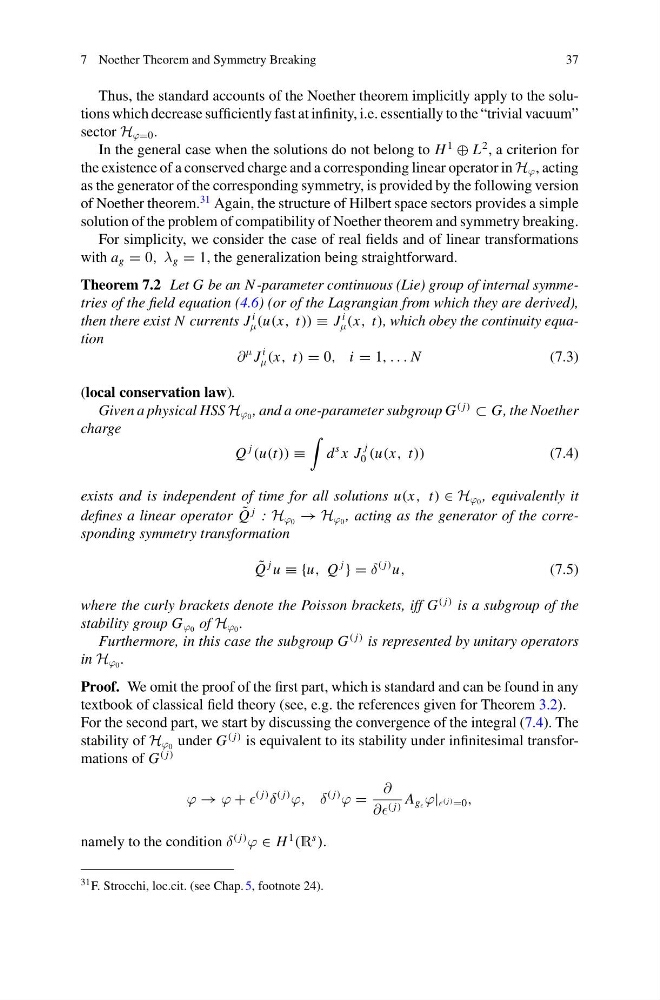
Theorem 7.2 Let G be an N -parameter continuous (Lie) group of internal symmetries of the field equation (4.6) (or of the Lagrangian from which they are derived),
then there exist N currents J
i
μ (u(x, t)) ≡ J
i
μ (x, t), which obey the continuity equation
∂
μ J
i
μ (x, t) = 0, i = 1, . . . N
(7.3)
(local conservation law).
Given a physical HSS H ϕ 0 , and a one-parameter subgroup G
( j)
⊂ G, the Noether
charge
Q
j
(u(t)) ≡
d
s x J
j
0 (u(x, t))
(7.4)
exists and is independent of time for all solutions u(x, t) ∈ H ϕ 0 , equivalently it
defines a linear operator ˜
Q
j : H ϕ 0 → H ϕ 0 , acting as the generator of the corresponding symmetry transformation
˜
Q
j u ≡ {u, Q
j
} = δ
( j) u,
(7.5)
where the curly brackets denote the Poisson brackets, iff G
( j) is a subgroup of the
stability group G ϕ 0 of H ϕ 0 .
Furthermore, in this case the subgroup G
( j) is represented by unitary operators
in H ϕ 0 .
Proof. We omit the proof of the first part, which is standard and can be found in any
textbook of classical field theory (see, e.g. the references given for Theorem 3.2).
For the second part, we start by discussing the convergence of the integral (7.4). The
stability of H ϕ 0 under G
( j) is equivalent to its stability under infinitesimal transformations of G
( j)
ϕ → ϕ +
( j)
δ
( j)
ϕ, δ
( j)
ϕ =
∂
∂∂ ( j) A g ϕ| ( j) =0 ,
namely to the condition δ
( j)
ϕ ∈ H
1
(R
s
).
31 F. Strocchi, loc.cit. (see Chap. 5, footnote 24).
37
Thus, the standard accounts of the Noether theorem implicitly apply to the solutions which decrease sufficiently fast at infinity, i.e. essentially to the “trivial vacuum”
sector H ϕ=0 .
In the general case when the solutions do not belong to H
1
⊕ L
2 , a criterion for
the existence of a conserved charge and a corresponding linear operator in H ϕ , acting
as the generator of the corresponding symmetry, is provided by the following version
of Noether theorem.
31 Again, the structure of Hilbert space sectors provides a simple
solution of the problem of compatibility of Noether theorem and symmetry breaking.
For simplicity, we consider the case of real fields and of linear transformations
with a g = 0, λ g = 1, the generalization being straightforward.
Theorem 7.2 Let G be an N -parameter continuous (Lie) group of internal symmetries of the field equation (4.6) (or of the Lagrangian from which they are derived),
then there exist N currents J
i
μ (u(x, t)) ≡ J
i
μ (x, t), which obey the continuity equation
∂
μ J
i
μ (x, t) = 0, i = 1, . . . N
(7.3)
(local conservation law).
Given a physical HSS H ϕ 0 , and a one-parameter subgroup G
( j)
⊂ G, the Noether
charge
Q
j
(u(t)) ≡
d
s x J
j
0 (u(x, t))
(7.4)
exists and is independent of time for all solutions u(x, t) ∈ H ϕ 0 , equivalently it
defines a linear operator ˜
Q
j : H ϕ 0 → H ϕ 0 , acting as the generator of the corresponding symmetry transformation
˜
Q
j u ≡ {u, Q
j
} = δ
( j) u,
(7.5)
where the curly brackets denote the Poisson brackets, iff G
( j) is a subgroup of the
stability group G ϕ 0 of H ϕ 0 .
Furthermore, in this case the subgroup G
( j) is represented by unitary operators
in H ϕ 0 .
Proof. We omit the proof of the first part, which is standard and can be found in any
textbook of classical field theory (see, e.g. the references given for Theorem 3.2).
For the second part, we start by discussing the convergence of the integral (7.4). The
stability of H ϕ 0 under G
( j) is equivalent to its stability under infinitesimal transformations of G
( j)
ϕ → ϕ +
( j)
δ
( j)
ϕ, δ
( j)
ϕ =
∂
∂∂ ( j) A g ϕ| ( j) =0 ,
namely to the condition δ
( j)
ϕ ∈ H
1
(R
s
).
31 F. Strocchi, loc.cit. (see Chap. 5, footnote 24).