

24
5 Stable Structures, Hilbert Sectors, Phases
For simplicity, we discuss the case in which the potential U (ϕ) belongs to the
following classes: it is an entire function in dimension s = 1 and it belongs to the
classes (4.10) and (4.11) in dimension s = 2, 3, respectively. For a more general
discussion see Ref. II.
19 Then we have
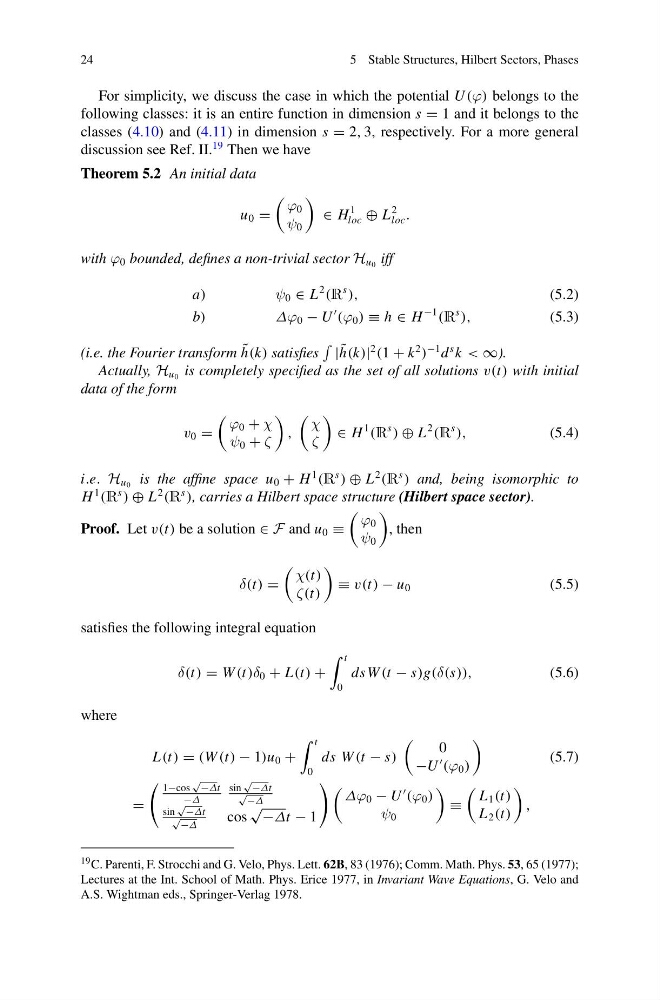
Theorem 5.2 An initial data
u 0 =
ϕ 0
ψ 0
∈ H
1
loc ⊕ L
2
loc .
with ϕ 0 bounded, defines a non-trivial sector H u 0 iff
a)
ψ 0 ∈ L
2
(R
s
),
(5.2)
b)
Δ ϕ 0 − U
(ϕ 0 ) ≡ h ∈ H
−1
(R
s
),
(5.3)
(i.e. the Fourier transform ˜
h(k) satisfies
| ˜
h(k)|
2
(1 + k
2
)
−1 d
s k < ∞).
Actually, H u 0 is completely specified as the set of all solutions v(t) with initial
data of the form
v 0 =
ϕ 0 + χ
ψ 0 + ζ
,
χ
ζ
∈ H
1
(R
s
) ⊕ L
2
(R
s
),
(5.4)
i.e. H u 0 is the affine space u 0 + H
1
(R
s
) ⊕ L
2
(R
s
) and, being isomorphic to
H
1
(R
s
) ⊕ L
2
(R
s
), carries a Hilbert space structure (Hilbert space sector).
Proof. Let v(t) be a solution ∈ F and u 0 ≡
ϕ 0
ψ 0
, then
δ(t) =
χ(t)
ζ(t)
≡ v(t) − u 0
(5.5)
satisfies the following integral equation
δ(t) = W (t)δ 0 + L(t) +
t
0
dsW (t − s)g(δ(s)),
(5.6)
where
L(t) = (W (t) − 1)u 0 +
t
0
ds W (t − s)
0
−U
(ϕ 0 )
(5.7)
=
1−cos
√ −Δt
−Δ
sin
√
−Δt
√ −Δ
sin
√
−Δt
√
−Δ
cos
√ −Δt − 1
Δϕ 0 − U
(ϕ 0 )
ψ 0
≡
L 1 (t)
L 2 (t)
,
19 C. Parenti, F. Strocchi and G. Velo, Phys. Lett. 62B, 83 (1976); Comm. Math. Phys. 53, 65 (1977);
Lectures at the Int. School of Math. Phys. Erice 1977, in Invariant Wave Equations, G. Velo and
A.S. Wightman eds., Springer-Verlag 1978.
5 Stable Structures, Hilbert Sectors, Phases
For simplicity, we discuss the case in which the potential U (ϕ) belongs to the
following classes: it is an entire function in dimension s = 1 and it belongs to the
classes (4.10) and (4.11) in dimension s = 2, 3, respectively. For a more general
discussion see Ref. II.
19 Then we have
Theorem 5.2 An initial data
u 0 =
ϕ 0
ψ 0
∈ H
1
loc ⊕ L
2
loc .
with ϕ 0 bounded, defines a non-trivial sector H u 0 iff
a)
ψ 0 ∈ L
2
(R
s
),
(5.2)
b)
Δ ϕ 0 − U
(ϕ 0 ) ≡ h ∈ H
−1
(R
s
),
(5.3)
(i.e. the Fourier transform ˜
h(k) satisfies
| ˜
h(k)|
2
(1 + k
2
)
−1 d
s k < ∞).
Actually, H u 0 is completely specified as the set of all solutions v(t) with initial
data of the form
v 0 =
ϕ 0 + χ
ψ 0 + ζ
,
χ
ζ
∈ H
1
(R
s
) ⊕ L
2
(R
s
),
(5.4)
i.e. H u 0 is the affine space u 0 + H
1
(R
s
) ⊕ L
2
(R
s
) and, being isomorphic to
H
1
(R
s
) ⊕ L
2
(R
s
), carries a Hilbert space structure (Hilbert space sector).
Proof. Let v(t) be a solution ∈ F and u 0 ≡
ϕ 0
ψ 0
, then
δ(t) =
χ(t)
ζ(t)
≡ v(t) − u 0
(5.5)
satisfies the following integral equation
δ(t) = W (t)δ 0 + L(t) +
t
0
dsW (t − s)g(δ(s)),
(5.6)
where
L(t) = (W (t) − 1)u 0 +
t
0
ds W (t − s)
0
−U
(ϕ 0 )
(5.7)
=
1−cos
√ −Δt
−Δ
sin
√
−Δt
√ −Δ
sin
√
−Δt
√
−Δ
cos
√ −Δt − 1
Δϕ 0 − U
(ϕ 0 )
ψ 0
≡
L 1 (t)
L 2 (t)
,
19 C. Parenti, F. Strocchi and G. Velo, Phys. Lett. 62B, 83 (1976); Comm. Math. Phys. 53, 65 (1977);
Lectures at the Int. School of Math. Phys. Erice 1977, in Invariant Wave Equations, G. Velo and
A.S. Wightman eds., Springer-Verlag 1978.