

260
Appendix E: Non-abelian Higgs Mechanism
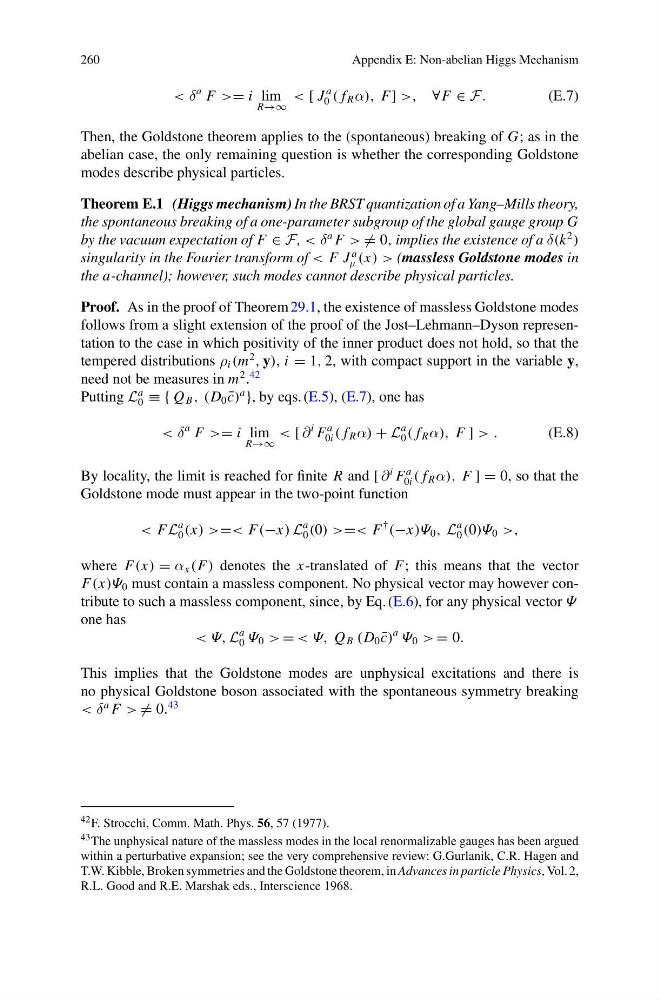
< δ
a F >= i lim
R→∞
< [ J
a
0 ( f R α), F] >, ∀F ∈ F.
(E.7)
Then, the Goldstone theorem applies to the (spontaneous) breaking of G; as in the
abelian case, the only remaining question is whether the corresponding Goldstone
modes describe physical particles.
Theorem E.1 (Higgs mechanism) In the BRST quantization of a Yang–Mills theory,
the spontaneous breaking of a one-parameter subgroup of the global gauge group G
by the vacuum expectation of F ∈ F, < δ
a F > = 0, implies the existence of a δ(k
2
)
singularity in the Fourier transform of < F J
a
μ (x) > (massless Goldstone modes in
the a-channel); however, such modes cannot describe physical particles.
Proof. As in the proof of Theorem 29.1, the existence of massless Goldstone modes
follows from a slight extension of the proof of the Jost–Lehmann–Dyson representation to the case in which positivity of the inner product does not hold, so that the
tempered distributions ρ i (m
2
, y), i = 1, 2, with compact support in the variable y,
need not be measures in m
2 .
42
Putting L
a
0 ≡ { Q B , (D 0 ¯
c)
a
}, by eqs. (E.5), (E.7), one has
< δ
a F >= i lim
R→∞
< [ ∂
i F
a
0i ( f R α) + L
a
0 ( f R α), F ] > .
(E.8)
By locality, the limit is reached for finite R and [ ∂
i F
a
0i ( f R α), F ] = 0, so that the
Goldstone mode must appear in the two-point function
< FL
a
0 (x) >=< F(−x) L
a
0 (0) >=< F
†
(−x)Ψ 0 , L
a
0 (0)Ψ 0 >,
where F(x) = α x (F) denotes the x-translated of F; this means that the vector
F(x)Ψ 0 must contain a massless component. No physical vector may however contribute to such a massless component, since, by Eq. (E.6), for any physical vector Ψ
one has
< Ψ, L
a
0 Ψ 0 > = < Ψ, Q B (D 0 ¯
c)
a
Ψ 0 > = 0.
This implies that the Goldstone modes are unphysical excitations and there is
no physical Goldstone boson associated with the spontaneous symmetry breaking
< δ
a F > = 0.
43
42 F. Strocchi, Comm. Math. Phys. 56, 57 (1977).
43 The unphysical nature of the massless modes in the local renormalizable gauges has been argued
within a perturbative expansion; see the very comprehensive review: G.Gurlanik, C.R. Hagen and
T.W. Kibble, Broken symmetries and the Goldstone theorem, in Advances in particle Physics, Vol. 2,
R.L. Good and R.E. Marshak eds., Interscience 1968.
Appendix E: Non-abelian Higgs Mechanism
< δ
a F >= i lim
R→∞
< [ J
a
0 ( f R α), F] >, ∀F ∈ F.
(E.7)
Then, the Goldstone theorem applies to the (spontaneous) breaking of G; as in the
abelian case, the only remaining question is whether the corresponding Goldstone
modes describe physical particles.
Theorem E.1 (Higgs mechanism) In the BRST quantization of a Yang–Mills theory,
the spontaneous breaking of a one-parameter subgroup of the global gauge group G
by the vacuum expectation of F ∈ F, < δ
a F > = 0, implies the existence of a δ(k
2
)
singularity in the Fourier transform of < F J
a
μ (x) > (massless Goldstone modes in
the a-channel); however, such modes cannot describe physical particles.
Proof. As in the proof of Theorem 29.1, the existence of massless Goldstone modes
follows from a slight extension of the proof of the Jost–Lehmann–Dyson representation to the case in which positivity of the inner product does not hold, so that the
tempered distributions ρ i (m
2
, y), i = 1, 2, with compact support in the variable y,
need not be measures in m
2 .
42
Putting L
a
0 ≡ { Q B , (D 0 ¯
c)
a
}, by eqs. (E.5), (E.7), one has
< δ
a F >= i lim
R→∞
< [ ∂
i F
a
0i ( f R α) + L
a
0 ( f R α), F ] > .
(E.8)
By locality, the limit is reached for finite R and [ ∂
i F
a
0i ( f R α), F ] = 0, so that the
Goldstone mode must appear in the two-point function
< FL
a
0 (x) >=< F(−x) L
a
0 (0) >=< F
†
(−x)Ψ 0 , L
a
0 (0)Ψ 0 >,
where F(x) = α x (F) denotes the x-translated of F; this means that the vector
F(x)Ψ 0 must contain a massless component. No physical vector may however contribute to such a massless component, since, by Eq. (E.6), for any physical vector Ψ
one has
< Ψ, L
a
0 Ψ 0 > = < Ψ, Q B (D 0 ¯
c)
a
Ψ 0 > = 0.
This implies that the Goldstone modes are unphysical excitations and there is
no physical Goldstone boson associated with the spontaneous symmetry breaking
< δ
a F > = 0.
43
42 F. Strocchi, Comm. Math. Phys. 56, 57 (1977).
43 The unphysical nature of the massless modes in the local renormalizable gauges has been argued
within a perturbative expansion; see the very comprehensive review: G.Gurlanik, C.R. Hagen and
T.W. Kibble, Broken symmetries and the Goldstone theorem, in Advances in particle Physics, Vol. 2,
R.L. Good and R.E. Marshak eds., Interscience 1968.