

Appendix E: Non-abelian Higgs Mechanism
259
δ
θ B
a
= 0, δ
θ c
a
= −
1
2 θ f
a
bc c
b c
c
, δ
θ
¯
c
a
= iθ B
a
,
(E.2)
with f
a
bc the real Lie-algebra structure constants ((T
a
) bc = −i f
a
bc ).
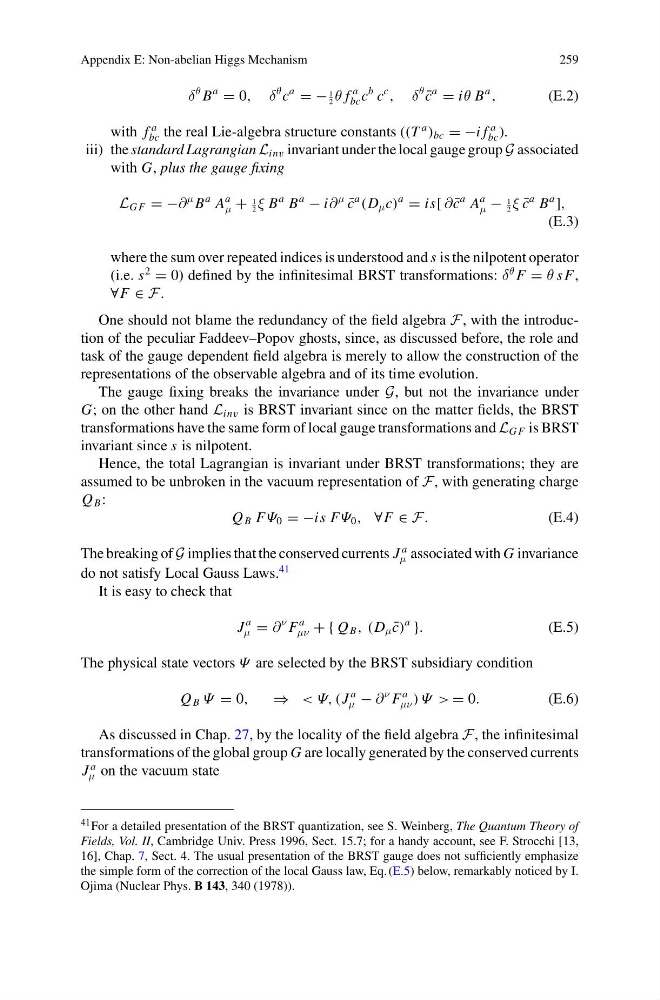
iii) the standard Lagrangian L inv invariant under the local gauge group G associated
with G, plus the gauge fixing
L G F = −∂
μ B
a A
a
μ +
1
2 ξ B
a B
a
− i∂
μ
¯
c
a
(D μ c)
a
= is[ ∂ ¯
c
a A
a
μ −
1
2 ξ ¯
c
a B
a
],
(E.3)
where the sum over repeated indices is understood and s is the nilpotent operator
(i.e. s
2
= 0) defined by the infinitesimal BRST transformations: δ
θ F = θ s F,
∀F ∈ F.
One should not blame the redundancy of the field algebra F, with the introduction of the peculiar Faddeev–Popov ghosts, since, as discussed before, the role and
task of the gauge dependent field algebra is merely to allow the construction of the
representations of the observable algebra and of its time evolution.
The gauge fixing breaks the invariance under G, but not the invariance under
G; on the other hand L inv is BRST invariant since on the matter fields, the BRST
transformations have the same form of local gauge transformations and L G F is BRST
invariant since s is nilpotent.
Hence, the total Lagrangian is invariant under BRST transformations; they are
assumed to be unbroken in the vacuum representation of F, with generating charge
Q B :
Q B FΨ 0 = −is FΨ 0 , ∀F ∈ F.
(E.4)
The breaking of G implies that the conserved currents J
a
μ associated with G invariance
do not satisfy Local Gauss Laws.
41
It is easy to check that
J
a
μ = ∂
ν F
a
μν + { Q B , (D μ ¯
c)
a
}.
(E.5)
The physical state vectors Ψ are selected by the BRST subsidiary condition
Q B Ψ = 0,
⇒ < Ψ, (J
a
μ − ∂
ν F
a
μν ) Ψ > = 0.
(E.6)
As discussed in Chap. 27, by the locality of the field algebra F, the infinitesimal
transformations of the global group G are locally generated by the conserved currents
J
a
μ on the vacuum state
41 For a detailed presentation of the BRST quantization, see S. Weinberg, The Quantum Theory of
Fields, Vol. II, Cambridge Univ. Press 1996, Sect. 15.7; for a handy account, see F. Strocchi [13,
16], Chap. 7, Sect. 4. The usual presentation of the BRST gauge does not sufficiently emphasize
the simple form of the correction of the local Gauss law, Eq. (E.5) below, remarkably noticed by I.
Ojima (Nuclear Phys. B 143, 340 (1978)).
259
δ
θ B
a
= 0, δ
θ c
a
= −
1
2 θ f
a
bc c
b c
c
, δ
θ
¯
c
a
= iθ B
a
,
(E.2)
with f
a
bc the real Lie-algebra structure constants ((T
a
) bc = −i f
a
bc ).
iii) the standard Lagrangian L inv invariant under the local gauge group G associated
with G, plus the gauge fixing
L G F = −∂
μ B
a A
a
μ +
1
2 ξ B
a B
a
− i∂
μ
¯
c
a
(D μ c)
a
= is[ ∂ ¯
c
a A
a
μ −
1
2 ξ ¯
c
a B
a
],
(E.3)
where the sum over repeated indices is understood and s is the nilpotent operator
(i.e. s
2
= 0) defined by the infinitesimal BRST transformations: δ
θ F = θ s F,
∀F ∈ F.
One should not blame the redundancy of the field algebra F, with the introduction of the peculiar Faddeev–Popov ghosts, since, as discussed before, the role and
task of the gauge dependent field algebra is merely to allow the construction of the
representations of the observable algebra and of its time evolution.
The gauge fixing breaks the invariance under G, but not the invariance under
G; on the other hand L inv is BRST invariant since on the matter fields, the BRST
transformations have the same form of local gauge transformations and L G F is BRST
invariant since s is nilpotent.
Hence, the total Lagrangian is invariant under BRST transformations; they are
assumed to be unbroken in the vacuum representation of F, with generating charge
Q B :
Q B FΨ 0 = −is FΨ 0 , ∀F ∈ F.
(E.4)
The breaking of G implies that the conserved currents J
a
μ associated with G invariance
do not satisfy Local Gauss Laws.
41
It is easy to check that
J
a
μ = ∂
ν F
a
μν + { Q B , (D μ ¯
c)
a
}.
(E.5)
The physical state vectors Ψ are selected by the BRST subsidiary condition
Q B Ψ = 0,
⇒ < Ψ, (J
a
μ − ∂
ν F
a
μν ) Ψ > = 0.
(E.6)
As discussed in Chap. 27, by the locality of the field algebra F, the infinitesimal
transformations of the global group G are locally generated by the conserved currents
J
a
μ on the vacuum state
41 For a detailed presentation of the BRST quantization, see S. Weinberg, The Quantum Theory of
Fields, Vol. II, Cambridge Univ. Press 1996, Sect. 15.7; for a handy account, see F. Strocchi [13,
16], Chap. 7, Sect. 4. The usual presentation of the BRST gauge does not sufficiently emphasize
the simple form of the correction of the local Gauss law, Eq. (E.5) below, remarkably noticed by I.
Ojima (Nuclear Phys. B 143, 340 (1978)).