

Appendix C
Anderson Model of Superconductivity
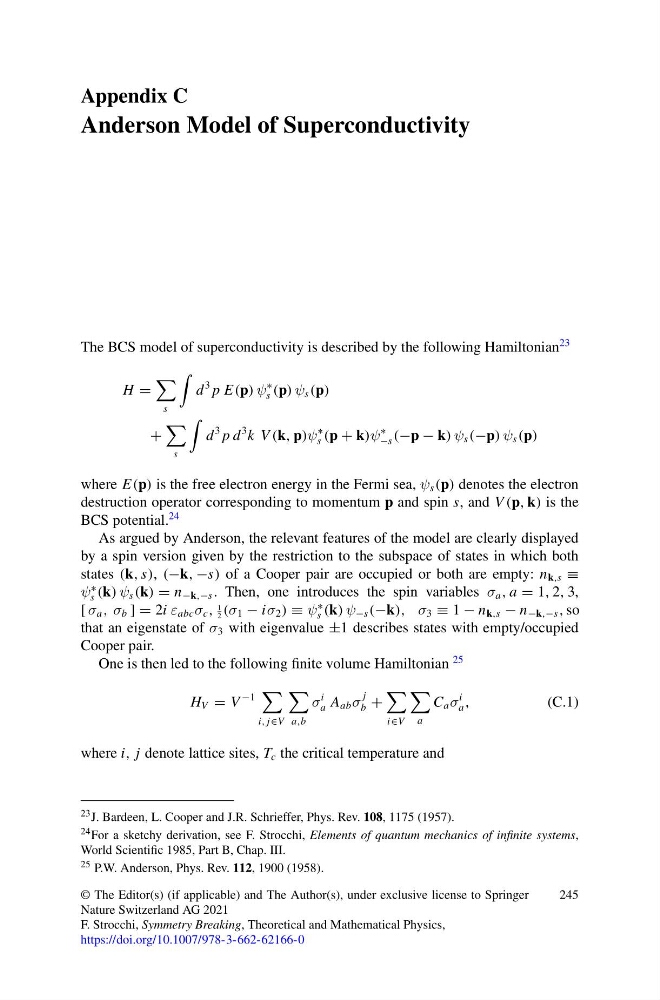
The BCS model of superconductivity is described by the following Hamiltonian
23
H =
s
d
3 p E(p) ψ
∗
s (p) ψ s (p)
+
s
d
3 p d
3 k V (k, p)ψ
∗
s (p + k)ψ
∗
−s (−p − k) ψ s (−p) ψ s (p)
where E(p) is the free electron energy in the Fermi sea, ψ s (p) denotes the electron
destruction operator corresponding to momentum p and spin s, and V (p, k) is the
BCS potential.
24
As argued by Anderson, the relevant features of the model are clearly displayed
by a spin version given by the restriction to the subspace of states in which both
states (k, s), (−k, −s) of a Cooper pair are occupied or both are empty: n k,s ≡
ψ
∗
s (k) ψ s (k) = n −k,−s . Then, one introduces the spin variables σ a , a = 1, 2, 3,
[ σ a , σ b ] = 2i ε abc σ c ,
1
2 (σ 1 − iσ 2 ) ≡ ψ
∗
s (k) ψ −s (−k), σ 3 ≡ 1 − n k,s − n −k,−s , so
that an eigenstate of σ 3 with eigenvalue ±1 describes states with empty/occupied
Cooper pair.
One is then led to the following finite volume Hamiltonian
25
H V = V
−1
i, j∈V
a,b
σ
i
a A ab σ
j
b +
i∈V
a
C a σ
i
a ,
(C.1)
where i, j denote lattice sites, T c the critical temperature and
23 J. Bardeen, L. Cooper and J.R. Schrieffer, Phys. Rev. 108, 1175 (1957).
24 For a sketchy derivation, see F. Strocchi, Elements of quantum mechanics of infinite systems,
World Scientific 1985, Part B, Chap. III.
25 P.W. Anderson, Phys. Rev. 112, 1900 (1958).
© The Editor(s) (if applicable) and The Author(s), under exclusive license to Springer
Nature Switzerland AG 2021
F. Strocchi, Symmetry Breaking, Theoretical and Mathematical Physics,
https://doi.org/10.1007/978-3-662-62166-0
245
Anderson Model of Superconductivity
The BCS model of superconductivity is described by the following Hamiltonian
23
H =
s
d
3 p E(p) ψ
∗
s (p) ψ s (p)
+
s
d
3 p d
3 k V (k, p)ψ
∗
s (p + k)ψ
∗
−s (−p − k) ψ s (−p) ψ s (p)
where E(p) is the free electron energy in the Fermi sea, ψ s (p) denotes the electron
destruction operator corresponding to momentum p and spin s, and V (p, k) is the
BCS potential.
24
As argued by Anderson, the relevant features of the model are clearly displayed
by a spin version given by the restriction to the subspace of states in which both
states (k, s), (−k, −s) of a Cooper pair are occupied or both are empty: n k,s ≡
ψ
∗
s (k) ψ s (k) = n −k,−s . Then, one introduces the spin variables σ a , a = 1, 2, 3,
[ σ a , σ b ] = 2i ε abc σ c ,
1
2 (σ 1 − iσ 2 ) ≡ ψ
∗
s (k) ψ −s (−k), σ 3 ≡ 1 − n k,s − n −k,−s , so
that an eigenstate of σ 3 with eigenvalue ±1 describes states with empty/occupied
Cooper pair.
One is then led to the following finite volume Hamiltonian
25
H V = V
−1
i, j∈V
a,b
σ
i
a A ab σ
j
b +
i∈V
a
C a σ
i
a ,
(C.1)
where i, j denote lattice sites, T c the critical temperature and
23 J. Bardeen, L. Cooper and J.R. Schrieffer, Phys. Rev. 108, 1175 (1957).
24 For a sketchy derivation, see F. Strocchi, Elements of quantum mechanics of infinite systems,
World Scientific 1985, Part B, Chap. III.
25 P.W. Anderson, Phys. Rev. 112, 1900 (1958).
© The Editor(s) (if applicable) and The Author(s), under exclusive license to Springer
Nature Switzerland AG 2021
F. Strocchi, Symmetry Breaking, Theoretical and Mathematical Physics,
https://doi.org/10.1007/978-3-662-62166-0
245