

12
3 Symmetries in Classical Field Theory
Quite generally, (3.1) occurs in the description of non-linear waves in many
branches of physics like non-linear optics, plasma physics, hydrodynamics, elementary particle physics etc.
3 The above equation (3.1) will be used to illustrate general
structures likely to be shared by a large class of non-linear hyperbolic equations.
The solution of the Cauchy problem for the (in general non-linear) equation (3.1),
with given initial data
ϕ(x, t = 0) = ϕ 0 (x), ∂ t ϕ(x, t = 0) = ψ 0 (x),
(3.3)
provides the corresponding classical field ϕ(x, t) described by (3.1).
In analogy with the previous discussion of the finite-dimensional systems, a
description of the system (3.1) consists in the identification of the class of initial
conditions, for which the time evolution is well defined. Deferring the mathematical
details, we will now denote by X the functional space within which the Cauchy
problem is well posed, i.e. such that for any initial data
u 0 =
ϕ 0
ψ 0
∈ X
(3.4)
there is a unique solution u(x, t) continuous in time (in the topology of X , see below)
and belonging to X for any t, briefly u(x, t) ∈ C
0
(X, R).
Thus, X can be regarded as describing the initial configurations of the system
(3.1) and it is stable under time evolution.
4
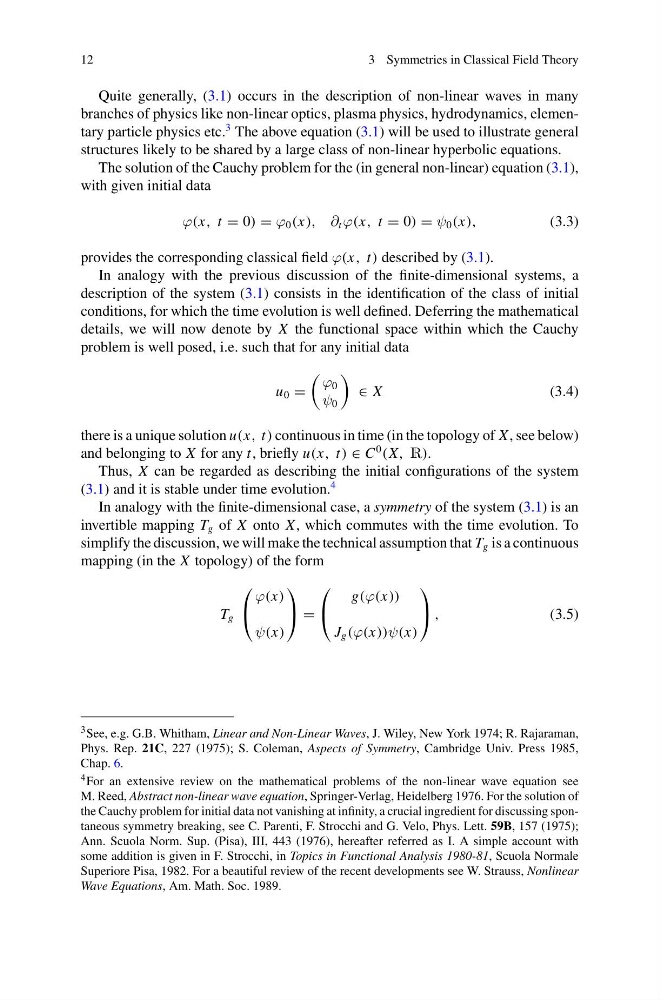
In analogy with the finite-dimensional case, a symmetry of the system (3.1) is an
invertible mapping T g of X onto X , which commutes with the time evolution. To
simplify the discussion, we will make the technical assumption that T g is a continuous
mapping (in the X topology) of the form
T g
⎛
⎝
ϕ(x)
ψ(x)
⎞
⎠ =
⎛
⎝
g(ϕ(x))
J g (ϕ(x))ψ(x)
⎞
⎠ ,
(3.5)
3 See, e.g. G.B. Whitham, Linear and Non-Linear Waves, J. Wiley, New York 1974; R. Rajaraman,
Phys. Rep. 21C, 227 (1975); S. Coleman, Aspects of Symmetry, Cambridge Univ. Press 1985,
Chap. 6.
4 For an extensive review on the mathematical problems of the non-linear wave equation see
M. Reed, Abstract non-linear wave equation, Springer-Verlag, Heidelberg 1976. For the solution of
the Cauchy problem for initial data not vanishing at infinity, a crucial ingredient for discussing spontaneous symmetry breaking, see C. Parenti, F. Strocchi and G. Velo, Phys. Lett. 59B, 157 (1975);
Ann. Scuola Norm. Sup. (Pisa), III, 443 (1976), hereafter referred as I. A simple account with
some addition is given in F. Strocchi, in Topics in Functional Analysis 1980-81, Scuola Normale
Superiore Pisa, 1982. For a beautiful review of the recent developments see W. Strauss, Nonlinear
Wave Equations, Am. Math. Soc. 1989.
3 Symmetries in Classical Field Theory
Quite generally, (3.1) occurs in the description of non-linear waves in many
branches of physics like non-linear optics, plasma physics, hydrodynamics, elementary particle physics etc.
3 The above equation (3.1) will be used to illustrate general
structures likely to be shared by a large class of non-linear hyperbolic equations.
The solution of the Cauchy problem for the (in general non-linear) equation (3.1),
with given initial data
ϕ(x, t = 0) = ϕ 0 (x), ∂ t ϕ(x, t = 0) = ψ 0 (x),
(3.3)
provides the corresponding classical field ϕ(x, t) described by (3.1).
In analogy with the previous discussion of the finite-dimensional systems, a
description of the system (3.1) consists in the identification of the class of initial
conditions, for which the time evolution is well defined. Deferring the mathematical
details, we will now denote by X the functional space within which the Cauchy
problem is well posed, i.e. such that for any initial data
u 0 =
ϕ 0
ψ 0
∈ X
(3.4)
there is a unique solution u(x, t) continuous in time (in the topology of X , see below)
and belonging to X for any t, briefly u(x, t) ∈ C
0
(X, R).
Thus, X can be regarded as describing the initial configurations of the system
(3.1) and it is stable under time evolution.
4
In analogy with the finite-dimensional case, a symmetry of the system (3.1) is an
invertible mapping T g of X onto X , which commutes with the time evolution. To
simplify the discussion, we will make the technical assumption that T g is a continuous
mapping (in the X topology) of the form
T g
⎛
⎝
ϕ(x)
ψ(x)
⎞
⎠ =
⎛
⎝
g(ϕ(x))
J g (ϕ(x))ψ(x)
⎞
⎠ ,
(3.5)
3 See, e.g. G.B. Whitham, Linear and Non-Linear Waves, J. Wiley, New York 1974; R. Rajaraman,
Phys. Rep. 21C, 227 (1975); S. Coleman, Aspects of Symmetry, Cambridge Univ. Press 1985,
Chap. 6.
4 For an extensive review on the mathematical problems of the non-linear wave equation see
M. Reed, Abstract non-linear wave equation, Springer-Verlag, Heidelberg 1976. For the solution of
the Cauchy problem for initial data not vanishing at infinity, a crucial ingredient for discussing spontaneous symmetry breaking, see C. Parenti, F. Strocchi and G. Velo, Phys. Lett. 59B, 157 (1975);
Ann. Scuola Norm. Sup. (Pisa), III, 443 (1976), hereafter referred as I. A simple account with
some addition is given in F. Strocchi, in Topics in Functional Analysis 1980-81, Scuola Normale
Superiore Pisa, 1982. For a beautiful review of the recent developments see W. Strauss, Nonlinear
Wave Equations, Am. Math. Soc. 1989.