

210
29 Symmetry Breaking in Gauge Theories
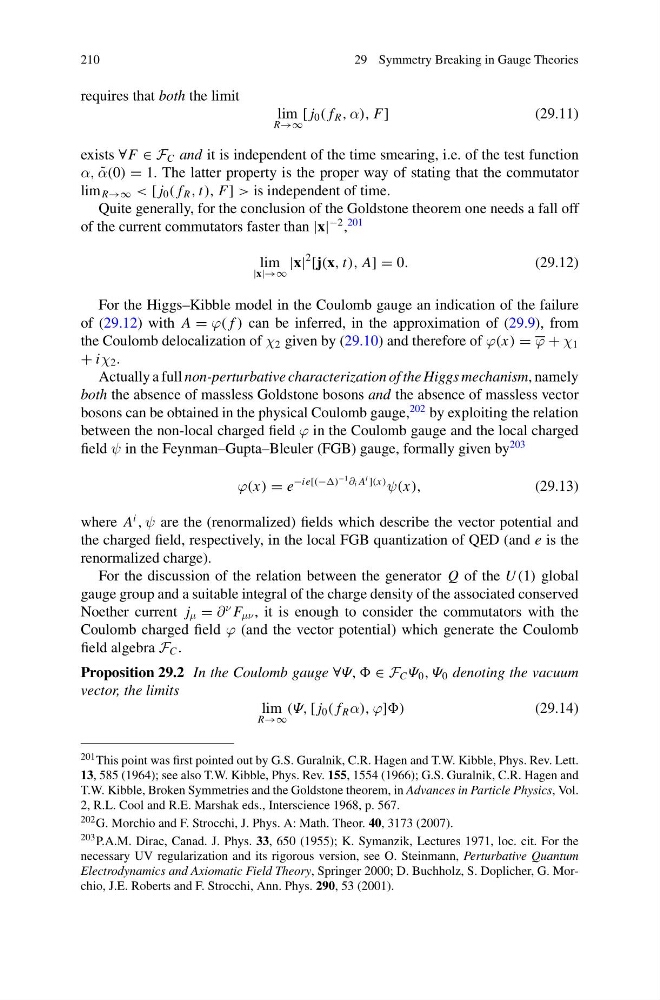
requires that both the limit
lim
R→∞
[ j 0 ( f R , α), F]
(29.11)
exists ∀F ∈ F C and it is independent of the time smearing, i.e. of the test function
α, ˜
α(0) = 1. The latter property is the proper way of stating that the commutator
lim R→∞ < [ j 0 ( f R , t), F] > is independent of time.
Quite generally, for the conclusion of the Goldstone theorem one needs a fall off
of the current commutators faster than |x|
−2 ,
201
lim
|x|→∞
|x|
2
[j(x, t), A] = 0.
(29.12)
For the Higgs–Kibble model in the Coulomb gauge an indication of the failure
of (29.12) with A = ϕ( f ) can be inferred, in the approximation of (29.9), from
the Coulomb delocalization of χ 2 given by (29.10) and therefore of ϕ(x) = ϕ + χ 1
+ iχ 2 .
Actually a full non-perturbative characterization of the Higgs mechanism, namely
both the absence of massless Goldstone bosons and the absence of massless vector
bosons can be obtained in the physical Coulomb gauge,
202 by exploiting the relation
between the non-local charged field ϕ in the Coulomb gauge and the local charged
field ψ in the Feynman–Gupta–Bleuler (FGB) gauge, formally given by
203
ϕ(x) = e
−ie[(−)
−1 ∂ i A
i ](x)
ψ(x),
(29.13)
where A
i
, ψ are the (renormalized) fields which describe the vector potential and
the charged field, respectively, in the local FGB quantization of QED (and e is the
renormalized charge).
For the discussion of the relation between the generator Q of the U (1) global
gauge group and a suitable integral of the charge density of the associated conserved
Noether current j μ = ∂
ν F μν , it is enough to consider the commutators with the
Coulomb charged field ϕ (and the vector potential) which generate the Coulomb
field algebra F C .
Proposition 29.2 In the Coulomb gauge ∀Ψ, , ∈ F C Ψ 0 , Ψ 0 denoting the vacuum
vector, the limits
lim
R→∞
(Ψ, [ j 0 ( f R α), ϕ])
(29.14)
201 This point was first pointed out by G.S. Guralnik, C.R. Hagen and T.W. Kibble, Phys. Rev. Lett.
13, 585 (1964); see also T.W. Kibble, Phys. Rev. 155, 1554 (1966); G.S. Guralnik, C.R. Hagen and
T.W. Kibble, Broken Symmetries and the Goldstone theorem, in Advances in Particle Physics, Vol.
2, R.L. Cool and R.E. Marshak eds., Interscience 1968, p. 567.
202 G. Morchio and F. Strocchi, J. Phys. A: Math. Theor. 40, 3173 (2007).
203 P.A.M. Dirac, Canad. J. Phys. 33, 650 (1955); K. Symanzik, Lectures 1971, loc. cit. For the
necessary UV regularization and its rigorous version, see O. Steinmann, Perturbative Quantum
Electrodynamics and Axiomatic Field Theory, Springer 2000; D. Buchholz, S. Doplicher, G. Morchio, J.E. Roberts and F. Strocchi, Ann. Phys. 290, 53 (2001).
29 Symmetry Breaking in Gauge Theories
requires that both the limit
lim
R→∞
[ j 0 ( f R , α), F]
(29.11)
exists ∀F ∈ F C and it is independent of the time smearing, i.e. of the test function
α, ˜
α(0) = 1. The latter property is the proper way of stating that the commutator
lim R→∞ < [ j 0 ( f R , t), F] > is independent of time.
Quite generally, for the conclusion of the Goldstone theorem one needs a fall off
of the current commutators faster than |x|
−2 ,
201
lim
|x|→∞
|x|
2
[j(x, t), A] = 0.
(29.12)
For the Higgs–Kibble model in the Coulomb gauge an indication of the failure
of (29.12) with A = ϕ( f ) can be inferred, in the approximation of (29.9), from
the Coulomb delocalization of χ 2 given by (29.10) and therefore of ϕ(x) = ϕ + χ 1
+ iχ 2 .
Actually a full non-perturbative characterization of the Higgs mechanism, namely
both the absence of massless Goldstone bosons and the absence of massless vector
bosons can be obtained in the physical Coulomb gauge,
202 by exploiting the relation
between the non-local charged field ϕ in the Coulomb gauge and the local charged
field ψ in the Feynman–Gupta–Bleuler (FGB) gauge, formally given by
203
ϕ(x) = e
−ie[(−)
−1 ∂ i A
i ](x)
ψ(x),
(29.13)
where A
i
, ψ are the (renormalized) fields which describe the vector potential and
the charged field, respectively, in the local FGB quantization of QED (and e is the
renormalized charge).
For the discussion of the relation between the generator Q of the U (1) global
gauge group and a suitable integral of the charge density of the associated conserved
Noether current j μ = ∂
ν F μν , it is enough to consider the commutators with the
Coulomb charged field ϕ (and the vector potential) which generate the Coulomb
field algebra F C .
Proposition 29.2 In the Coulomb gauge ∀Ψ, , ∈ F C Ψ 0 , Ψ 0 denoting the vacuum
vector, the limits
lim
R→∞
(Ψ, [ j 0 ( f R α), ϕ])
(29.14)
201 This point was first pointed out by G.S. Guralnik, C.R. Hagen and T.W. Kibble, Phys. Rev. Lett.
13, 585 (1964); see also T.W. Kibble, Phys. Rev. 155, 1554 (1966); G.S. Guralnik, C.R. Hagen and
T.W. Kibble, Broken Symmetries and the Goldstone theorem, in Advances in Particle Physics, Vol.
2, R.L. Cool and R.E. Marshak eds., Interscience 1968, p. 567.
202 G. Morchio and F. Strocchi, J. Phys. A: Math. Theor. 40, 3173 (2007).
203 P.A.M. Dirac, Canad. J. Phys. 33, 650 (1955); K. Symanzik, Lectures 1971, loc. cit. For the
necessary UV regularization and its rigorous version, see O. Steinmann, Perturbative Quantum
Electrodynamics and Axiomatic Field Theory, Springer 2000; D. Buchholz, S. Doplicher, G. Morchio, J.E. Roberts and F. Strocchi, Ann. Phys. 290, 53 (2001).