

29.3 Higgs Mechanism in the Coulomb Gauge
209
29.3 Higgs Mechanism in the Coulomb Gauge
The evasion of the Goldstone theorem in the case of breaking of the U (1) global
gauge symmetry can be understood on the basis of the discussion of Chap. 25, as a
consequence of the delocalization induced on the charged fields, and in particular on
the Higgs field order parameter, by the instantaneous Coulomb interaction term of
the Coulomb gauge Hamiltonian.
The Coulomb gauge can be obtained by adding the gauge fixing condition
∂ i A
i
(x) = 0,
(29.8)
equivalently by adding a Lagrangian multiplier L → L + ξ(∂ i A
i
) ≡ L C : the variation with respect to ξ gives (29.8). Proceeding as before, one gets the following
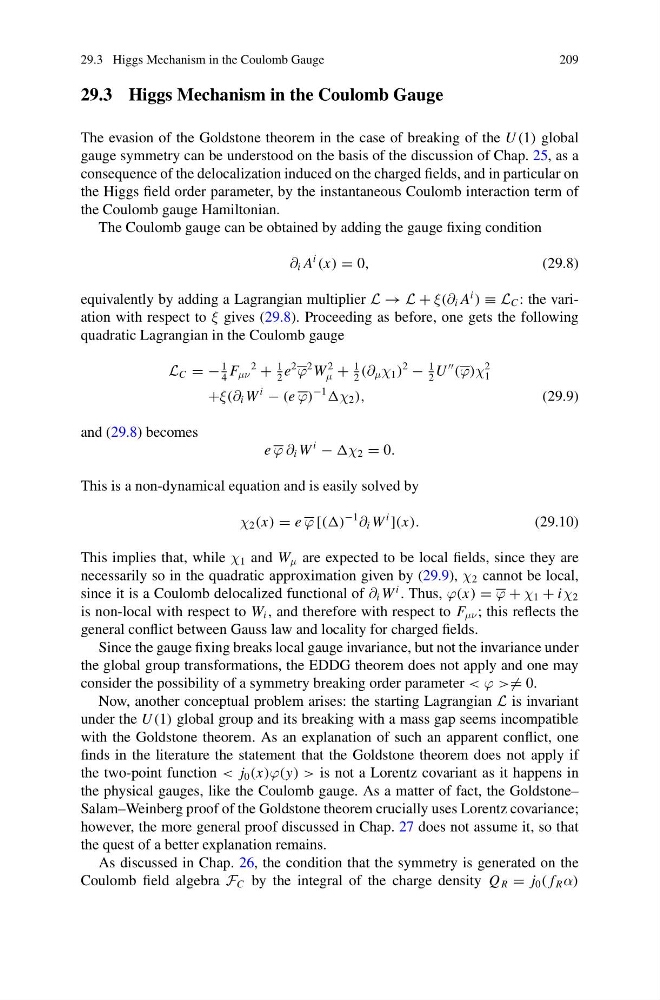
quadratic Lagrangian in the Coulomb gauge
L C = −
1
4
F μν
2
+
1
2
e
2
ϕ
2 W
2
μ +
1
2
(∂ μ χ 1 )
2
−
1
2
U
(ϕ)χ
2
1
+ξ(∂ i W
i
− (e ϕ)
−1
χ 2 ),
(29.9)
and (29.8) becomes
e ϕ ∂ i W
i
− χ 2 = 0.
This is a non-dynamical equation and is easily solved by
χ 2 (x) = e ϕ [(()
−1
∂ i W
i
](x).
(29.10)
This implies that, while χ 1 and W μ are expected to be local fields, since they are
necessarily so in the quadratic approximation given by (29.9), χ 2 cannot be local,
since it is a Coulomb delocalized functional of ∂ i W
i . Thus, ϕ(x) = ϕ + χ 1 + iχ 2
is non-local with respect to W i , and therefore with respect to F μν ; this reflects the
general conflict between Gauss law and locality for charged fields.
Since the gauge fixing breaks local gauge invariance, but not the invariance under
the global group transformations, the EDDG theorem does not apply and one may
consider the possibility of a symmetry breaking order parameter < ϕ > = 0.
Now, another conceptual problem arises: the starting Lagrangian L is invariant
under the U (1) global group and its breaking with a mass gap seems incompatible
with the Goldstone theorem. As an explanation of such an apparent conflict, one
finds in the literature the statement that the Goldstone theorem does not apply if
the two-point function < j 0 (x)ϕ(y) > is not a Lorentz covariant as it happens in
the physical gauges, like the Coulomb gauge. As a matter of fact, the Goldstone–
Salam–Weinberg proof of the Goldstone theorem crucially uses Lorentz covariance;
however, the more general proof discussed in Chap. 27 does not assume it, so that
the quest of a better explanation remains.
As discussed in Chap. 26, the condition that the symmetry is generated on the
Coulomb field algebra F C by the integral of the charge density Q R = j 0 ( f R α)
209
29.3 Higgs Mechanism in the Coulomb Gauge
The evasion of the Goldstone theorem in the case of breaking of the U (1) global
gauge symmetry can be understood on the basis of the discussion of Chap. 25, as a
consequence of the delocalization induced on the charged fields, and in particular on
the Higgs field order parameter, by the instantaneous Coulomb interaction term of
the Coulomb gauge Hamiltonian.
The Coulomb gauge can be obtained by adding the gauge fixing condition
∂ i A
i
(x) = 0,
(29.8)
equivalently by adding a Lagrangian multiplier L → L + ξ(∂ i A
i
) ≡ L C : the variation with respect to ξ gives (29.8). Proceeding as before, one gets the following
quadratic Lagrangian in the Coulomb gauge
L C = −
1
4
F μν
2
+
1
2
e
2
ϕ
2 W
2
μ +
1
2
(∂ μ χ 1 )
2
−
1
2
U
(ϕ)χ
2
1
+ξ(∂ i W
i
− (e ϕ)
−1
χ 2 ),
(29.9)
and (29.8) becomes
e ϕ ∂ i W
i
− χ 2 = 0.
This is a non-dynamical equation and is easily solved by
χ 2 (x) = e ϕ [(()
−1
∂ i W
i
](x).
(29.10)
This implies that, while χ 1 and W μ are expected to be local fields, since they are
necessarily so in the quadratic approximation given by (29.9), χ 2 cannot be local,
since it is a Coulomb delocalized functional of ∂ i W
i . Thus, ϕ(x) = ϕ + χ 1 + iχ 2
is non-local with respect to W i , and therefore with respect to F μν ; this reflects the
general conflict between Gauss law and locality for charged fields.
Since the gauge fixing breaks local gauge invariance, but not the invariance under
the global group transformations, the EDDG theorem does not apply and one may
consider the possibility of a symmetry breaking order parameter < ϕ > = 0.
Now, another conceptual problem arises: the starting Lagrangian L is invariant
under the U (1) global group and its breaking with a mass gap seems incompatible
with the Goldstone theorem. As an explanation of such an apparent conflict, one
finds in the literature the statement that the Goldstone theorem does not apply if
the two-point function < j 0 (x)ϕ(y) > is not a Lorentz covariant as it happens in
the physical gauges, like the Coulomb gauge. As a matter of fact, the Goldstone–
Salam–Weinberg proof of the Goldstone theorem crucially uses Lorentz covariance;
however, the more general proof discussed in Chap. 27 does not assume it, so that
the quest of a better explanation remains.
As discussed in Chap. 26, the condition that the symmetry is generated on the
Coulomb field algebra F C by the integral of the charge density Q R = j 0 ( f R α)