

28 An Extension of Goldstone Theorem to Non-symmetric Hamiltonians
201
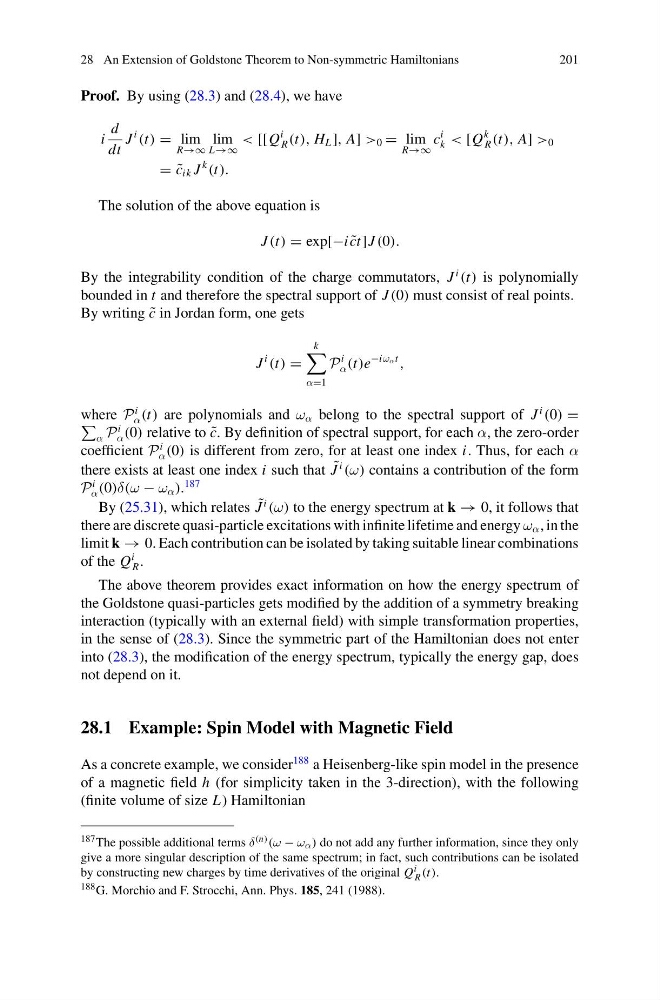
Proof. By using (28.3) and (28.4), we have
i
d
dt
J
i
(t) = lim
R→∞
lim
L→∞
< [[Q
i
R (t), H L ], A] > 0 = lim
R→∞
c
i
k < [Q
k
R (t), A] > 0
= ˜
c ik J
k
(t).
The solution of the above equation is
J (t) = exp[−i ˜
ct]J (0).
By the integrability condition of the charge commutators, J
i
(t) is polynomially
bounded in t and therefore the spectral support of J (0) must consist of real points.
By writing ˜
c in Jordan form, one gets
J
i
(t) =
k
α=1
P
i
α (t)e
−iω α t
,
where P
i
α (t) are polynomials and ω α belong to the spectral support of J
i
(0) =
α P
i
α (0) relative to ˜
c. By definition of spectral support, for each α, the zero-order
coefficient P
i
α (0) is different from zero, for at least one index i. Thus, for each α
there exists at least one index i such that ˜
J
i
(ω) contains a contribution of the form
P
i
α (0)δ(ω − ω α ).
187
By (25.31), which relates ˜
J
i
(ω) to the energy spectrum at k → 0, it follows that
there are discrete quasi-particle excitations with infinite lifetime and energy ω α , in the
limit k → 0. Each contribution can be isolated by taking suitable linear combinations
of the Q
i
R .
The above theorem provides exact information on how the energy spectrum of
the Goldstone quasi-particles gets modified by the addition of a symmetry breaking
interaction (typically with an external field) with simple transformation properties,
in the sense of (28.3). Since the symmetric part of the Hamiltonian does not enter
into (28.3), the modification of the energy spectrum, typically the energy gap, does
not depend on it.
28.1 Example: Spin Model with Magnetic Field
As a concrete example, we consider
188 a Heisenberg-like spin model in the presence
of a magnetic field h (for simplicity taken in the 3-direction), with the following
(finite volume of size L) Hamiltonian
187 The possible additional terms δ (n) (ω − ω α ) do not add any further information, since they only
give a more singular description of the same spectrum; in fact, such contributions can be isolated
by constructing new charges by time derivatives of the original Q i
R (t).
188 G. Morchio and F. Strocchi, Ann. Phys. 185, 241 (1988).
201
Proof. By using (28.3) and (28.4), we have
i
d
dt
J
i
(t) = lim
R→∞
lim
L→∞
< [[Q
i
R (t), H L ], A] > 0 = lim
R→∞
c
i
k < [Q
k
R (t), A] > 0
= ˜
c ik J
k
(t).
The solution of the above equation is
J (t) = exp[−i ˜
ct]J (0).
By the integrability condition of the charge commutators, J
i
(t) is polynomially
bounded in t and therefore the spectral support of J (0) must consist of real points.
By writing ˜
c in Jordan form, one gets
J
i
(t) =
k
α=1
P
i
α (t)e
−iω α t
,
where P
i
α (t) are polynomials and ω α belong to the spectral support of J
i
(0) =
α P
i
α (0) relative to ˜
c. By definition of spectral support, for each α, the zero-order
coefficient P
i
α (0) is different from zero, for at least one index i. Thus, for each α
there exists at least one index i such that ˜
J
i
(ω) contains a contribution of the form
P
i
α (0)δ(ω − ω α ).
187
By (25.31), which relates ˜
J
i
(ω) to the energy spectrum at k → 0, it follows that
there are discrete quasi-particle excitations with infinite lifetime and energy ω α , in the
limit k → 0. Each contribution can be isolated by taking suitable linear combinations
of the Q
i
R .
The above theorem provides exact information on how the energy spectrum of
the Goldstone quasi-particles gets modified by the addition of a symmetry breaking
interaction (typically with an external field) with simple transformation properties,
in the sense of (28.3). Since the symmetric part of the Hamiltonian does not enter
into (28.3), the modification of the energy spectrum, typically the energy gap, does
not depend on it.
28.1 Example: Spin Model with Magnetic Field
As a concrete example, we consider
188 a Heisenberg-like spin model in the presence
of a magnetic field h (for simplicity taken in the 3-direction), with the following
(finite volume of size L) Hamiltonian
187 The possible additional terms δ (n) (ω − ω α ) do not add any further information, since they only
give a more singular description of the same spectrum; in fact, such contributions can be isolated
by constructing new charges by time derivatives of the original Q i
R (t).
188 G. Morchio and F. Strocchi, Ann. Phys. 185, 241 (1988).