

200
28 An Extension of Goldstone Theorem to Non-symmetric Hamiltonians
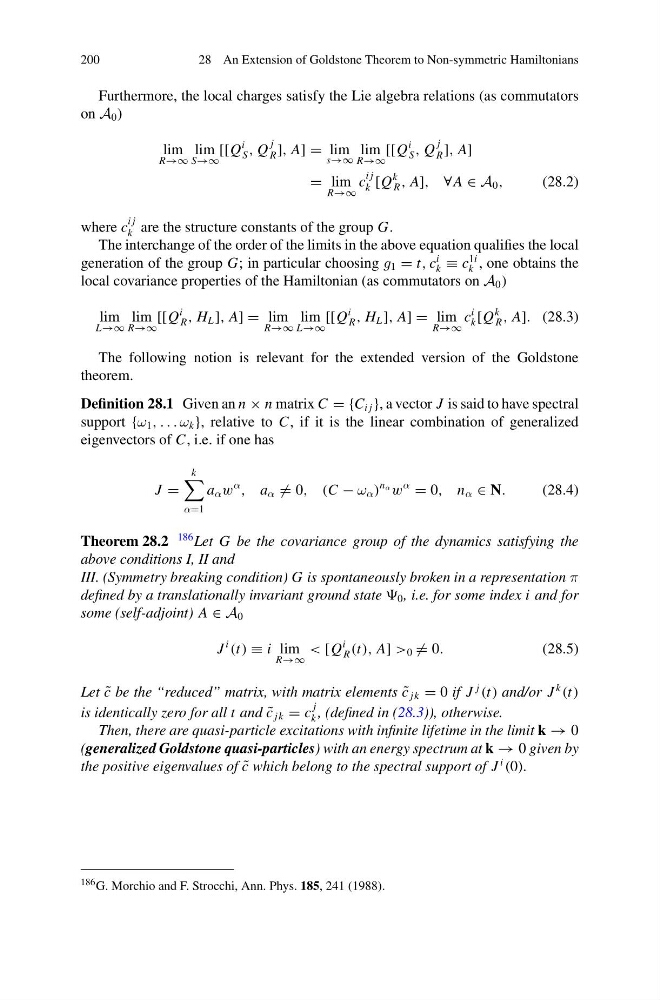
Furthermore, the local charges satisfy the Lie algebra relations (as commutators
on A 0 )
lim
R→∞
lim
S→∞
[[Q
i
S , Q
j
R ], A] = lim
s→∞
lim
R→∞
[[Q
i
S , Q
j
R ], A]
= lim
R→∞
c
i j
k [Q
k
R , A], ∀A ∈ A 0 ,
(28.2)
where c
i j
k are the structure constants of the group G.
The interchange of the order of the limits in the above equation qualifies the local
generation of the group G; in particular choosing g 1 = t, c
i
k ≡ c
1i
k , one obtains the
local covariance properties of the Hamiltonian (as commutators on A 0 )
lim
L→∞
lim
R→∞
[[Q
i
R , H L ], A] = lim
R→∞
lim
L→∞
[[Q
i
R , H L ], A] = lim
R→∞
c
i
k [Q
k
R , A]. (28.3)
The following notion is relevant for the extended version of the Goldstone
theorem.
Definition 28.1 Given an n × n matrix C = {C i j }, a vector J is said to have spectral
support {ω 1 , . . . ω k }, relative to C, if it is the linear combination of generalized
eigenvectors of C, i.e. if one has
J =
k
α=1
a α w
α
, a α = 0, (C − ω α )
n α w
α
= 0, n α ∈ N.
(28.4)
Theorem 28.2
186 Let G be the covariance group of the dynamics satisfying the
above conditions I, II and
III. (Symmetry breaking condition) G is spontaneously broken in a representation π
defined by a translationally invariant ground state 0 , i.e. for some index i and for
some (self-adjoint) A ∈ A 0
J
i
(t) ≡ i lim
R→∞
< [Q
i
R (t), A] > 0 = 0.
(28.5)
Let ˜
c be the “reduced” matrix, with matrix elements ˜
c jk = 0 if J
j
(t) and/or J
k
(t)
is identically zero for all t and ˜
c jk = c
j
k , (defined in (28.3)), otherwise.
Then, there are quasi-particle excitations with infinite lifetime in the limit k → 0
(generalized Goldstone quasi-particles) with an energy spectrum at k → 0 given by
the positive eigenvalues of ˜
c which belong to the spectral support of J
i
(0).
186 G. Morchio and F. Strocchi, Ann. Phys. 185, 241 (1988).
28 An Extension of Goldstone Theorem to Non-symmetric Hamiltonians
Furthermore, the local charges satisfy the Lie algebra relations (as commutators
on A 0 )
lim
R→∞
lim
S→∞
[[Q
i
S , Q
j
R ], A] = lim
s→∞
lim
R→∞
[[Q
i
S , Q
j
R ], A]
= lim
R→∞
c
i j
k [Q
k
R , A], ∀A ∈ A 0 ,
(28.2)
where c
i j
k are the structure constants of the group G.
The interchange of the order of the limits in the above equation qualifies the local
generation of the group G; in particular choosing g 1 = t, c
i
k ≡ c
1i
k , one obtains the
local covariance properties of the Hamiltonian (as commutators on A 0 )
lim
L→∞
lim
R→∞
[[Q
i
R , H L ], A] = lim
R→∞
lim
L→∞
[[Q
i
R , H L ], A] = lim
R→∞
c
i
k [Q
k
R , A]. (28.3)
The following notion is relevant for the extended version of the Goldstone
theorem.
Definition 28.1 Given an n × n matrix C = {C i j }, a vector J is said to have spectral
support {ω 1 , . . . ω k }, relative to C, if it is the linear combination of generalized
eigenvectors of C, i.e. if one has
J =
k
α=1
a α w
α
, a α = 0, (C − ω α )
n α w
α
= 0, n α ∈ N.
(28.4)
Theorem 28.2
186 Let G be the covariance group of the dynamics satisfying the
above conditions I, II and
III. (Symmetry breaking condition) G is spontaneously broken in a representation π
defined by a translationally invariant ground state 0 , i.e. for some index i and for
some (self-adjoint) A ∈ A 0
J
i
(t) ≡ i lim
R→∞
< [Q
i
R (t), A] > 0 = 0.
(28.5)
Let ˜
c be the “reduced” matrix, with matrix elements ˜
c jk = 0 if J
j
(t) and/or J
k
(t)
is identically zero for all t and ˜
c jk = c
j
k , (defined in (28.3)), otherwise.
Then, there are quasi-particle excitations with infinite lifetime in the limit k → 0
(generalized Goldstone quasi-particles) with an energy spectrum at k → 0 given by
the positive eigenvalues of ˜
c which belong to the spectral support of J
i
(0).
186 G. Morchio and F. Strocchi, Ann. Phys. 185, 241 (1988).