

27 The Goldstone Theorem for Relativistic Local Fields
197
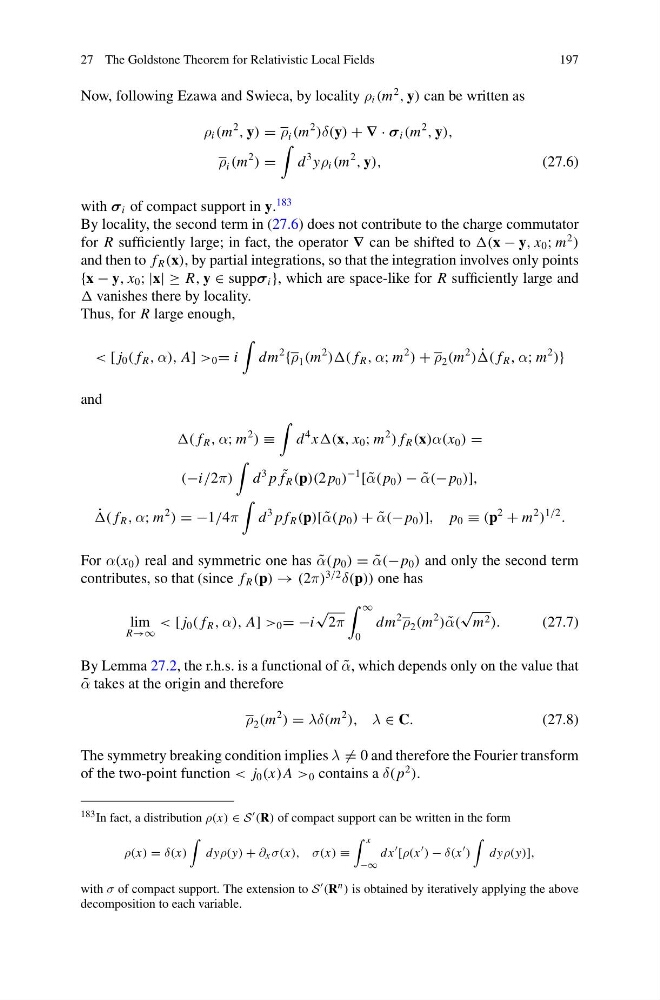
Now, following Ezawa and Swieca, by locality ρ i (m
2
, y) can be written as
ρ i (m
2
, y) = ρ i (m
2
)δ(y) + ∇ · σ i (m
2
, y),
ρ i (m
2
) =
d
3 yρ i (m
2
, y),
(27.6)
with σ i of compact support in y.
183
By locality, the second term in (27.6) does not contribute to the charge commutator
for R sufficiently large; in fact, the operator ∇ can be shifted to (x − y, x 0 ; m
2
)
and then to f R (x), by partial integrations, so that the integration involves only points
{x − y, x 0 ; |x| ≥ R, y ∈ suppσ i }, which are space-like for R sufficiently large and
vanishes there by locality.
Thus, for R large enough,
< [ j 0 ( f R , α), A] > 0 = i
dm
2
{ρ 1 (m
2
))( f R , α; m
2
) + ρ 2 (m
2
) ˙
( f R , α; m
2
)}
and
( f R , α; m
2
) ≡
d
4 x(x, x 0 ; m
2
) f R (x)α(x 0 ) =
(−i/2π)
d
3 p ˜
f R (p)(2 p 0 )
−1
[ ˜
α( p 0 ) − ˜
α(− p 0 )],
˙
( f R , α; m
2
) = −1/4π
d
3 p f R (p)[ ˜
α( p 0 ) + ˜
α(− p 0 )], p 0 ≡ (p
2
+ m
2
)
1/2
.
For α(x 0 ) real and symmetric one has ˜
α( p 0 ) = ˜
α(− p 0 ) and only the second term
contributes, so that (since f R (p) → (2π)
3/2
δ(p)) one has
lim
R→∞
< [ j 0 ( f R , α), A] > 0 = −i
√
2π
∞
0
dm
2
ρ 2 (m
2
) ˜
α(
√
m 2 ).
(27.7)
By Lemma 27.2, the r.h.s. is a functional of ˜
α, which depends only on the value that
˜
α takes at the origin and therefore
ρ 2 (m
2
) = λδ(m
2
), λ ∈ C.
(27.8)
The symmetry breaking condition implies λ = 0 and therefore the Fourier transform
of the two-point function < j 0 (x)A > 0 contains a δ( p
2
).
183 In fact, a distribution ρ(x) ∈ S (R) of compact support can be written in the form
ρ(x) = δ(x)
dyρ(y) + ∂ x σ(x), σ(x) ≡
x
−∞
dx
[ρ(x
) − δ(x
)
dyρ(y)],
with σ of compact support. The extension to S (R n ) is obtained by iteratively applying the above
decomposition to each variable.
197
Now, following Ezawa and Swieca, by locality ρ i (m
2
, y) can be written as
ρ i (m
2
, y) = ρ i (m
2
)δ(y) + ∇ · σ i (m
2
, y),
ρ i (m
2
) =
d
3 yρ i (m
2
, y),
(27.6)
with σ i of compact support in y.
183
By locality, the second term in (27.6) does not contribute to the charge commutator
for R sufficiently large; in fact, the operator ∇ can be shifted to (x − y, x 0 ; m
2
)
and then to f R (x), by partial integrations, so that the integration involves only points
{x − y, x 0 ; |x| ≥ R, y ∈ suppσ i }, which are space-like for R sufficiently large and
vanishes there by locality.
Thus, for R large enough,
< [ j 0 ( f R , α), A] > 0 = i
dm
2
{ρ 1 (m
2
))( f R , α; m
2
) + ρ 2 (m
2
) ˙
( f R , α; m
2
)}
and
( f R , α; m
2
) ≡
d
4 x(x, x 0 ; m
2
) f R (x)α(x 0 ) =
(−i/2π)
d
3 p ˜
f R (p)(2 p 0 )
−1
[ ˜
α( p 0 ) − ˜
α(− p 0 )],
˙
( f R , α; m
2
) = −1/4π
d
3 p f R (p)[ ˜
α( p 0 ) + ˜
α(− p 0 )], p 0 ≡ (p
2
+ m
2
)
1/2
.
For α(x 0 ) real and symmetric one has ˜
α( p 0 ) = ˜
α(− p 0 ) and only the second term
contributes, so that (since f R (p) → (2π)
3/2
δ(p)) one has
lim
R→∞
< [ j 0 ( f R , α), A] > 0 = −i
√
2π
∞
0
dm
2
ρ 2 (m
2
) ˜
α(
√
m 2 ).
(27.7)
By Lemma 27.2, the r.h.s. is a functional of ˜
α, which depends only on the value that
˜
α takes at the origin and therefore
ρ 2 (m
2
) = λδ(m
2
), λ ∈ C.
(27.8)
The symmetry breaking condition implies λ = 0 and therefore the Fourier transform
of the two-point function < j 0 (x)A > 0 contains a δ( p
2
).
183 In fact, a distribution ρ(x) ∈ S (R) of compact support can be written in the form
ρ(x) = δ(x)
dyρ(y) + ∂ x σ(x), σ(x) ≡
x
−∞
dx
[ρ(x
) − δ(x
)
dyρ(y)],
with σ of compact support. The extension to S (R n ) is obtained by iteratively applying the above
decomposition to each variable.