

18.1 Wigner Symmetries
123
one can select a strongly continuous set of representatives U (g) and in this case the
functions ω as well as ξ are continuous functions of the group elements.
106
Then, if g(λ), g(λ
) are two one-parameter groups in the neighbourhood of the
identity e, with g(λ) → e, g(λ
) → e, when λ, λ
→ 0, we can expand all terms of
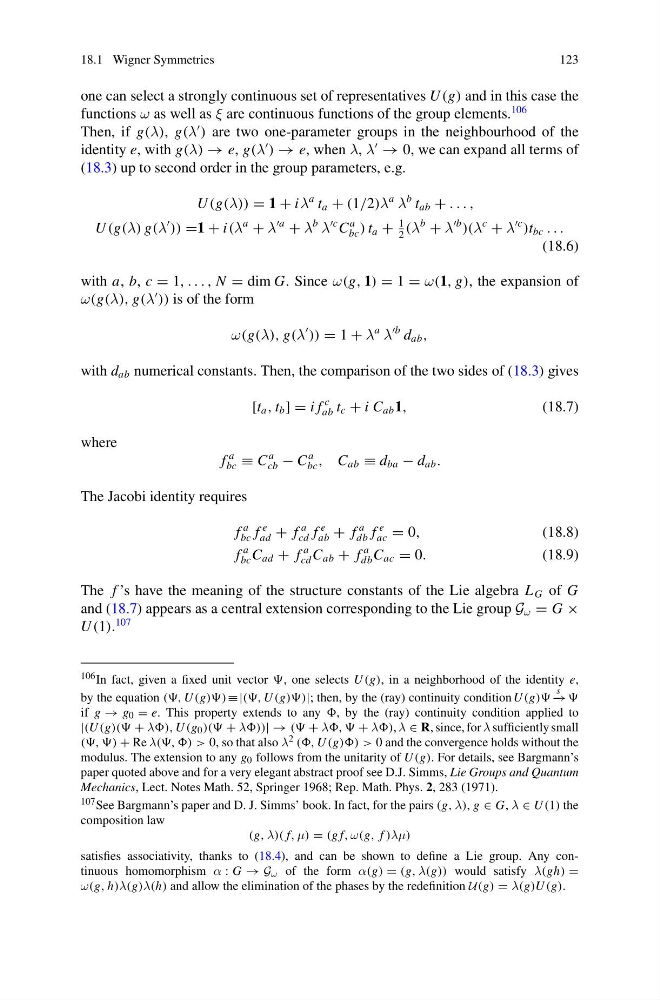
(18.3) up to second order in the group parameters, e.g.
U (g(λ)) = 1 + iλ
a t a + (1/2)λ
a
λ
b t ab + . . . ,
U (g(λ) g(λ
)) =1 + i(λ
a
+ λ
a
+ λ
b
λ
c C
a
bc ) t a +
1
2
(λ
b
+ λ
b
)(λ
c
+ λ
c
)t bc . . .
(18.6)
with a, b, c = 1, . . . , N = dim G. Since ω(g, 1) = 1 = ω(1, g), the expansion of
ω(g(λ), g(λ
)) is of the form
ω(g(λ), g(λ
)) = 1 + λ
a
λ
b d ab ,
with d ab numerical constants. Then, the comparison of the two sides of (18.3) gives
[t a , t b ] = i f
c
ab t c + i C ab 1,
(18.7)
where
f
a
bc ≡ C
a
cb − C
a
bc , C ab ≡ d ba − d ab .
The Jacobi identity requires
f
a
bc f
e
ad + f
a
cd f
e
ab + f
a
db f
e
ac = 0,
(18.8)
f
a
bc C ad + f
a
cd C ab + f
a
db C ac = 0.
(18.9)
The f ’s have the meaning of the structure constants of the Lie algebra L G of G
and (18.7) appears as a central extension corresponding to the Lie group G ω = G ×
U (1).
107
106 In fact, given a fixed unit vector , one selects U (g), in a neighborhood of the identity e,
by the equation ((, U (g))) ≡|((, U (g)))|; then, by the (ray) continuity condition U (g))
s
− →
if g → g 0 = e. This property extends to any , by the (ray) continuity condition applied to
|(U (g)(( + λ), U (g 0 )(( + λ))| → (( + λ , + λ), λ ∈ R, since, for λ sufficiently small
((, ,) + Re λ((, ,) > 0, so that also λ 2 ((, U (g))) > 0 and the convergence holds without the
modulus. The extension to any g 0 follows from the unitarity of U (g). For details, see Bargmann’s
paper quoted above and for a very elegant abstract proof see D.J. Simms, Lie Groups and Quantum
Mechanics, Lect. Notes Math. 52, Springer 1968; Rep. Math. Phys. 2, 283 (1971).
107 See Bargmann’s paper and D. J. Simms’ book. In fact, for the pairs (g, λ), g ∈ G, λ ∈ U (1) the
composition law
(g, λ)( f, μ) = (g f, ω(g, f )λμ)
satisfies associativity, thanks to (18.4), and can be shown to define a Lie group. Any continuous homomorphism α : G → G ω of the form α(g) = (g, λ(g)) would satisfy λ(gh) =
ω(g, h)λ(g)λ(h) and allow the elimination of the phases by the redefinition U (g) = λ(g)U (g).
123
one can select a strongly continuous set of representatives U (g) and in this case the
functions ω as well as ξ are continuous functions of the group elements.
106
Then, if g(λ), g(λ
) are two one-parameter groups in the neighbourhood of the
identity e, with g(λ) → e, g(λ
) → e, when λ, λ
→ 0, we can expand all terms of
(18.3) up to second order in the group parameters, e.g.
U (g(λ)) = 1 + iλ
a t a + (1/2)λ
a
λ
b t ab + . . . ,
U (g(λ) g(λ
)) =1 + i(λ
a
+ λ
a
+ λ
b
λ
c C
a
bc ) t a +
1
2
(λ
b
+ λ
b
)(λ
c
+ λ
c
)t bc . . .
(18.6)
with a, b, c = 1, . . . , N = dim G. Since ω(g, 1) = 1 = ω(1, g), the expansion of
ω(g(λ), g(λ
)) is of the form
ω(g(λ), g(λ
)) = 1 + λ
a
λ
b d ab ,
with d ab numerical constants. Then, the comparison of the two sides of (18.3) gives
[t a , t b ] = i f
c
ab t c + i C ab 1,
(18.7)
where
f
a
bc ≡ C
a
cb − C
a
bc , C ab ≡ d ba − d ab .
The Jacobi identity requires
f
a
bc f
e
ad + f
a
cd f
e
ab + f
a
db f
e
ac = 0,
(18.8)
f
a
bc C ad + f
a
cd C ab + f
a
db C ac = 0.
(18.9)
The f ’s have the meaning of the structure constants of the Lie algebra L G of G
and (18.7) appears as a central extension corresponding to the Lie group G ω = G ×
U (1).
107
106 In fact, given a fixed unit vector , one selects U (g), in a neighborhood of the identity e,
by the equation ((, U (g))) ≡|((, U (g)))|; then, by the (ray) continuity condition U (g))
s
− →
if g → g 0 = e. This property extends to any , by the (ray) continuity condition applied to
|(U (g)(( + λ), U (g 0 )(( + λ))| → (( + λ , + λ), λ ∈ R, since, for λ sufficiently small
((, ,) + Re λ((, ,) > 0, so that also λ 2 ((, U (g))) > 0 and the convergence holds without the
modulus. The extension to any g 0 follows from the unitarity of U (g). For details, see Bargmann’s
paper quoted above and for a very elegant abstract proof see D.J. Simms, Lie Groups and Quantum
Mechanics, Lect. Notes Math. 52, Springer 1968; Rep. Math. Phys. 2, 283 (1971).
107 See Bargmann’s paper and D. J. Simms’ book. In fact, for the pairs (g, λ), g ∈ G, λ ∈ U (1) the
composition law
(g, λ)( f, μ) = (g f, ω(g, f )λμ)
satisfies associativity, thanks to (18.4), and can be shown to define a Lie group. Any continuous homomorphism α : G → G ω of the form α(g) = (g, λ(g)) would satisfy λ(gh) =
ω(g, h)λ(g)λ(h) and allow the elimination of the phases by the redefinition U (g) = λ(g)U (g).