

122
18 Symmetry Breaking in Quantum Systems
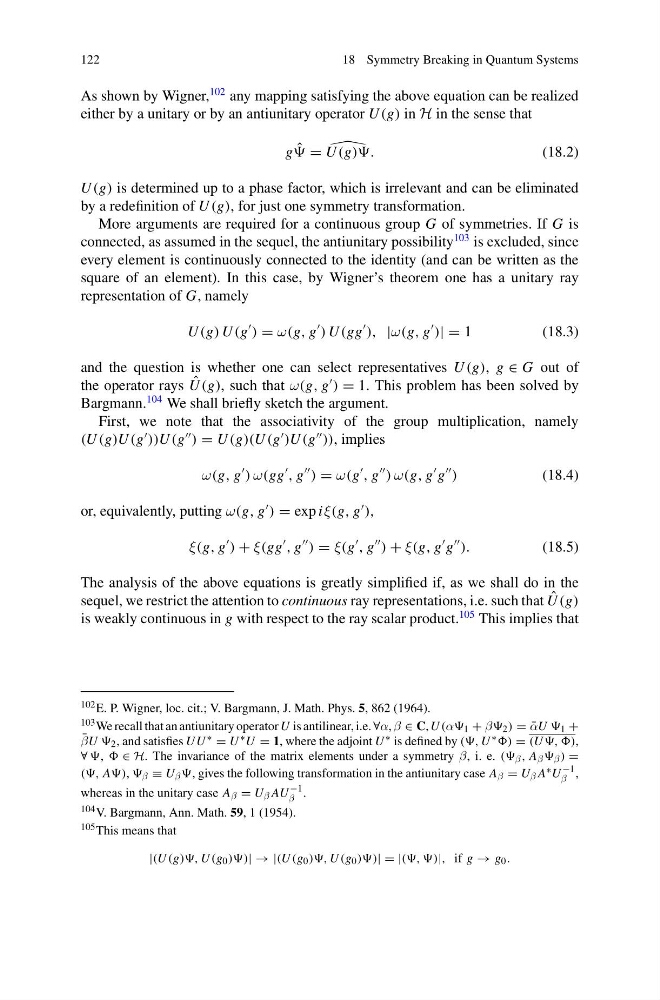
As shown by Wigner,
102 any mapping satisfying the above equation can be realized
either by a unitary or by an antiunitary operator U (g) in H in the sense that
g ˆ
=
U (g)).
(18.2)
U (g) is determined up to a phase factor, which is irrelevant and can be eliminated
by a redefinition of U (g), for just one symmetry transformation.
More arguments are required for a continuous group G of symmetries. If G is
connected, as assumed in the sequel, the antiunitary possibility
103 is excluded, since
every element is continuously connected to the identity (and can be written as the
square of an element). In this case, by Wigner’s theorem one has a unitary ray
representation of G, namely
U (g) U (g
) = ω(g, g
) U (gg
), |ω(g, g
)| = 1
(18.3)
and the question is whether one can select representatives U (g), g ∈ G out of
the operator rays ˆ
U (g), such that ω(g, g
) = 1. This problem has been solved by
Bargmann.
104 We shall briefly sketch the argument.
First, we note that the associativity of the group multiplication, namely
(U (g)U (g
))U (g
) = U (g)(U (g
)U (g
)), implies
ω(g, g
) ω(gg
, g
) = ω(g
, g
) ω(g, g
g
)
(18.4)
or, equivalently, putting ω(g, g
) = exp iξ(g, g
),
ξ(g, g
) + ξ(gg
, g
) = ξ(g
, g
) + ξ(g, g
g
).
(18.5)
The analysis of the above equations is greatly simplified if, as we shall do in the
sequel, we restrict the attention to continuous ray representations, i.e. such that ˆ
U (g)
is weakly continuous in g with respect to the ray scalar product.
105 This implies that
102 E. P. Wigner, loc. cit.; V. Bargmann, J. Math. Phys. 5, 862 (1964).
103 We recall that an antiunitary operator U is antilinear, i.e. ∀α, β ∈ C, U (α 1 + β 2 ) = ¯
αU 1 +
¯
βU 2 , and satisfies UU ∗ = U ∗ U = 1, where the adjoint U ∗ is defined by ((, U ∗ ) = (U , ,),
∀ , ∈ H. The invariance of the matrix elements under a symmetry β, i. e. (( β , A β β ) =
((, A), β ≡ U β , gives the following transformation in the antiunitary case A β = U β A ∗ U
−1
β ,
whereas in the unitary case A β = U β AU
−1
β .
104 V. Bargmann, Ann. Math. 59, 1 (1954).
105 This means that
|(U (g)), U (g 0 )))| → |(U (g 0 )), U (g 0 )))| = |((, ,)|, if g → g 0 .
18 Symmetry Breaking in Quantum Systems
As shown by Wigner,
102 any mapping satisfying the above equation can be realized
either by a unitary or by an antiunitary operator U (g) in H in the sense that
g ˆ
=
U (g)).
(18.2)
U (g) is determined up to a phase factor, which is irrelevant and can be eliminated
by a redefinition of U (g), for just one symmetry transformation.
More arguments are required for a continuous group G of symmetries. If G is
connected, as assumed in the sequel, the antiunitary possibility
103 is excluded, since
every element is continuously connected to the identity (and can be written as the
square of an element). In this case, by Wigner’s theorem one has a unitary ray
representation of G, namely
U (g) U (g
) = ω(g, g
) U (gg
), |ω(g, g
)| = 1
(18.3)
and the question is whether one can select representatives U (g), g ∈ G out of
the operator rays ˆ
U (g), such that ω(g, g
) = 1. This problem has been solved by
Bargmann.
104 We shall briefly sketch the argument.
First, we note that the associativity of the group multiplication, namely
(U (g)U (g
))U (g
) = U (g)(U (g
)U (g
)), implies
ω(g, g
) ω(gg
, g
) = ω(g
, g
) ω(g, g
g
)
(18.4)
or, equivalently, putting ω(g, g
) = exp iξ(g, g
),
ξ(g, g
) + ξ(gg
, g
) = ξ(g
, g
) + ξ(g, g
g
).
(18.5)
The analysis of the above equations is greatly simplified if, as we shall do in the
sequel, we restrict the attention to continuous ray representations, i.e. such that ˆ
U (g)
is weakly continuous in g with respect to the ray scalar product.
105 This implies that
102 E. P. Wigner, loc. cit.; V. Bargmann, J. Math. Phys. 5, 862 (1964).
103 We recall that an antiunitary operator U is antilinear, i.e. ∀α, β ∈ C, U (α 1 + β 2 ) = ¯
αU 1 +
¯
βU 2 , and satisfies UU ∗ = U ∗ U = 1, where the adjoint U ∗ is defined by ((, U ∗ ) = (U , ,),
∀ , ∈ H. The invariance of the matrix elements under a symmetry β, i. e. (( β , A β β ) =
((, A), β ≡ U β , gives the following transformation in the antiunitary case A β = U β A ∗ U
−1
β ,
whereas in the unitary case A β = U β AU
−1
β .
104 V. Bargmann, Ann. Math. 59, 1 (1954).
105 This means that
|(U (g)), U (g 0 )))| → |(U (g 0 )), U (g 0 )))| = |((, ,)|, if g → g 0 .