

4.1 Disjoining Pressure
89
dG =
μ
0
+ (dY (h)/dh)v m
dn =
μ
0
− Π v m
dn
(4.1.8)
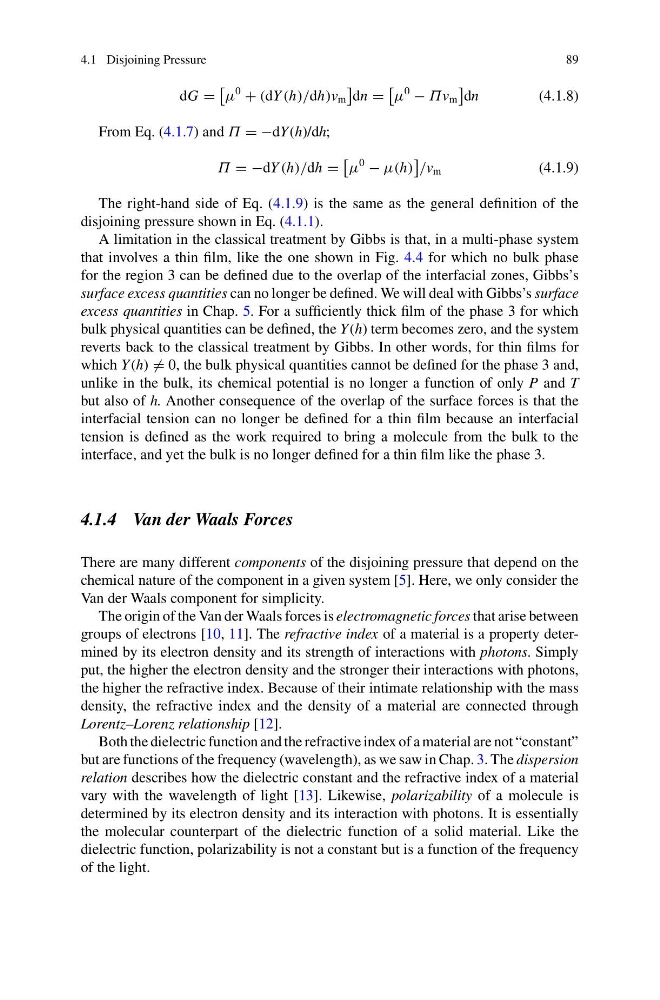
From Eq. (4.1.7) and Π = −dY (h)/dh;
Π = −dY (h)/dh =
μ
0
− μ(h)
/v m
(4.1.9)
The right-hand side of Eq. (4.1.9) is the same as the general definition of the
disjoining pressure shown in Eq. (4.1.1).
A limitation in the classical treatment by Gibbs is that, in a multi-phase system
that involves a thin film, like the one shown in Fig. 4.4 for which no bulk phase
for the region 3 can be defined due to the overlap of the interfacial zones, Gibbs’s
surface excess quantities can no longer be defined. We will deal with Gibbs’s surface
excess quantities in Chap. 5. For a sufficiently thick film of the phase 3 for which
bulk physical quantities can be defined, the Y (h) term becomes zero, and the system
reverts back to the classical treatment by Gibbs. In other words, for thin films for
which Y (h) = 0, the bulk physical quantities cannot be defined for the phase 3 and,
unlike in the bulk, its chemical potential is no longer a function of only P and T
but also of h. Another consequence of the overlap of the surface forces is that the
interfacial tension can no longer be defined for a thin film because an interfacial
tension is defined as the work required to bring a molecule from the bulk to the
interface, and yet the bulk is no longer defined for a thin film like the phase 3.
4.1.4 Van der Waals Forces
There are many different components of the disjoining pressure that depend on the
chemical nature of the component in a given system [5]. Here, we only consider the
Van der Waals component for simplicity.
The origin of the Van der Waals forces is electromagnetic forces that arise between
groups of electrons [10, 11]. The refractive index of a material is a property determined by its electron density and its strength of interactions with photons. Simply
put, the higher the electron density and the stronger their interactions with photons,
the higher the refractive index. Because of their intimate relationship with the mass
density, the refractive index and the density of a material are connected through
Lorentz–Lorenz relationship [12].
Both the dielectric function and the refractive index of a material are not “constant”
but are functions of the frequency (wavelength), as we saw in Chap. 3. The dispersion
relation describes how the dielectric constant and the refractive index of a material
vary with the wavelength of light [13]. Likewise, polarizability of a molecule is
determined by its electron density and its interaction with photons. It is essentially
the molecular counterpart of the dielectric function of a solid material. Like the
dielectric function, polarizability is not a constant but is a function of the frequency
of the light.
89
dG =
μ
0
+ (dY (h)/dh)v m
dn =
μ
0
− Π v m
dn
(4.1.8)
From Eq. (4.1.7) and Π = −dY (h)/dh;
Π = −dY (h)/dh =
μ
0
− μ(h)
/v m
(4.1.9)
The right-hand side of Eq. (4.1.9) is the same as the general definition of the
disjoining pressure shown in Eq. (4.1.1).
A limitation in the classical treatment by Gibbs is that, in a multi-phase system
that involves a thin film, like the one shown in Fig. 4.4 for which no bulk phase
for the region 3 can be defined due to the overlap of the interfacial zones, Gibbs’s
surface excess quantities can no longer be defined. We will deal with Gibbs’s surface
excess quantities in Chap. 5. For a sufficiently thick film of the phase 3 for which
bulk physical quantities can be defined, the Y (h) term becomes zero, and the system
reverts back to the classical treatment by Gibbs. In other words, for thin films for
which Y (h) = 0, the bulk physical quantities cannot be defined for the phase 3 and,
unlike in the bulk, its chemical potential is no longer a function of only P and T
but also of h. Another consequence of the overlap of the surface forces is that the
interfacial tension can no longer be defined for a thin film because an interfacial
tension is defined as the work required to bring a molecule from the bulk to the
interface, and yet the bulk is no longer defined for a thin film like the phase 3.
4.1.4 Van der Waals Forces
There are many different components of the disjoining pressure that depend on the
chemical nature of the component in a given system [5]. Here, we only consider the
Van der Waals component for simplicity.
The origin of the Van der Waals forces is electromagnetic forces that arise between
groups of electrons [10, 11]. The refractive index of a material is a property determined by its electron density and its strength of interactions with photons. Simply
put, the higher the electron density and the stronger their interactions with photons,
the higher the refractive index. Because of their intimate relationship with the mass
density, the refractive index and the density of a material are connected through
Lorentz–Lorenz relationship [12].
Both the dielectric function and the refractive index of a material are not “constant”
but are functions of the frequency (wavelength), as we saw in Chap. 3. The dispersion
relation describes how the dielectric constant and the refractive index of a material
vary with the wavelength of light [13]. Likewise, polarizability of a molecule is
determined by its electron density and its interaction with photons. It is essentially
the molecular counterpart of the dielectric function of a solid material. Like the
dielectric function, polarizability is not a constant but is a function of the frequency
of the light.