

88
4 Interfacial Gaseous States
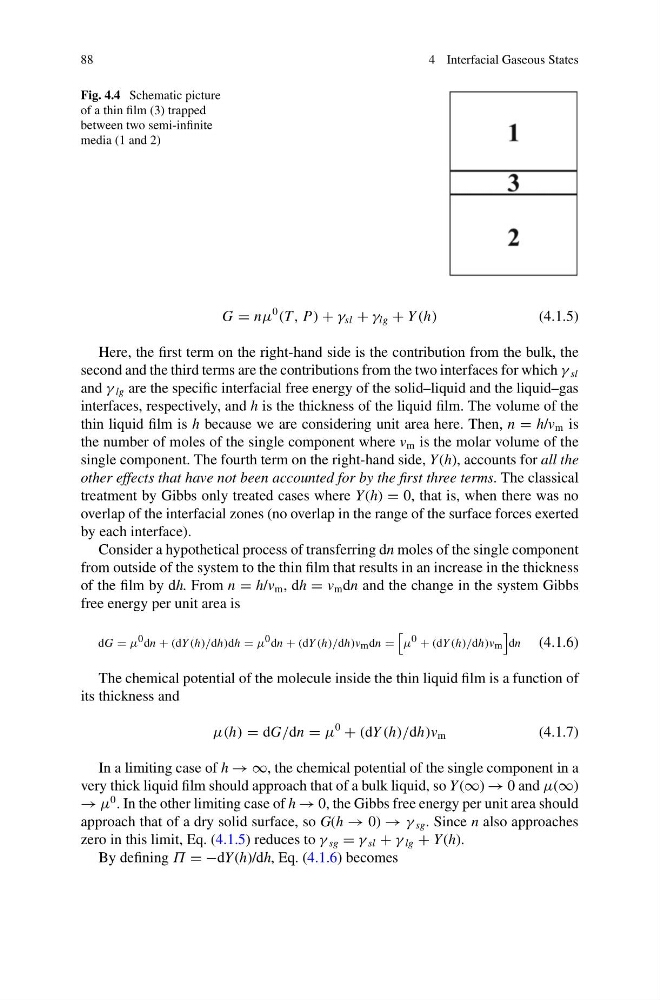
Fig. 4.4 Schematic picture
of a thin film (3) trapped
between two semi-infinite
media (1 and 2)
G = nμ
0
(T, P) + γ sl + γ lg + Y (h)
(4.1.5)
Here, the first term on the right-hand side is the contribution from the bulk, the
second and the third terms are the contributions from the two interfaces for which γ sl
and γ lg are the specific interfacial free energy of the solid–liquid and the liquid–gas
interfaces, respectively, and h is the thickness of the liquid film. The volume of the
thin liquid film is h because we are considering unit area here. Then, n = h/v m is
the number of moles of the single component where v m is the molar volume of the
single component. The fourth term on the right-hand side, Y (h), accounts for all the
other effects that have not been accounted for by the first three terms. The classical
treatment by Gibbs only treated cases where Y (h) = 0, that is, when there was no
overlap of the interfacial zones (no overlap in the range of the surface forces exerted
by each interface).
Consider a hypothetical process of transferring dn moles of the single component
from outside of the system to the thin film that results in an increase in the thickness
of the film by dh. From n = h/v m , dh = v m dn and the change in the system Gibbs
free energy per unit area is
dG = μ 0 dn + (dY (h)/dh)dh = μ 0 dn + (dY (h)/dh)v m dn =
μ 0 + (dY (h)/dh)v m
dn
(4.1.6)
The chemical potential of the molecule inside the thin liquid film is a function of
its thickness and
μ(h) = dG/dn = μ
0
+ (dY (h)/dh)v m
(4.1.7)
In a limiting case of h → ∞, the chemical potential of the single component in a
very thick liquid film should approach that of a bulk liquid, so Y (∞) → 0 and μ(∞)
→ μ
0 . In the other limiting case of h → 0, the Gibbs free energy per unit area should
approach that of a dry solid surface, so G(h → 0) → γ sg . Since n also approaches
zero in this limit, Eq. (4.1.5) reduces to γ sg = γ sl + γ lg + Y (h).
By defining Π = −dY (h)/dh, Eq. (4.1.6) becomes
4 Interfacial Gaseous States
Fig. 4.4 Schematic picture
of a thin film (3) trapped
between two semi-infinite
media (1 and 2)
G = nμ
0
(T, P) + γ sl + γ lg + Y (h)
(4.1.5)
Here, the first term on the right-hand side is the contribution from the bulk, the
second and the third terms are the contributions from the two interfaces for which γ sl
and γ lg are the specific interfacial free energy of the solid–liquid and the liquid–gas
interfaces, respectively, and h is the thickness of the liquid film. The volume of the
thin liquid film is h because we are considering unit area here. Then, n = h/v m is
the number of moles of the single component where v m is the molar volume of the
single component. The fourth term on the right-hand side, Y (h), accounts for all the
other effects that have not been accounted for by the first three terms. The classical
treatment by Gibbs only treated cases where Y (h) = 0, that is, when there was no
overlap of the interfacial zones (no overlap in the range of the surface forces exerted
by each interface).
Consider a hypothetical process of transferring dn moles of the single component
from outside of the system to the thin film that results in an increase in the thickness
of the film by dh. From n = h/v m , dh = v m dn and the change in the system Gibbs
free energy per unit area is
dG = μ 0 dn + (dY (h)/dh)dh = μ 0 dn + (dY (h)/dh)v m dn =
μ 0 + (dY (h)/dh)v m
dn
(4.1.6)
The chemical potential of the molecule inside the thin liquid film is a function of
its thickness and
μ(h) = dG/dn = μ
0
+ (dY (h)/dh)v m
(4.1.7)
In a limiting case of h → ∞, the chemical potential of the single component in a
very thick liquid film should approach that of a bulk liquid, so Y (∞) → 0 and μ(∞)
→ μ
0 . In the other limiting case of h → 0, the Gibbs free energy per unit area should
approach that of a dry solid surface, so G(h → 0) → γ sg . Since n also approaches
zero in this limit, Eq. (4.1.5) reduces to γ sg = γ sl + γ lg + Y (h).
By defining Π = −dY (h)/dh, Eq. (4.1.6) becomes