

2.3 Tea Time Break: The Fourier Transform and the Laplace Transform
55
we conceive an analogue of Eq. (2.3.3)? In Eq. (2.3.4), we took the inner product of
an arbitrary vector |a> with all the base vectors in our three-dimensional space to
find out what each coefficient of |a> in Eq. (2.3.3) is. Then, we may take the inner
products of another arbitrary vector |b> in the trigonometric space with all the base
vectors of the trigonometric space to find out each trigonometric component of |b>.
For example, let us define the arbitrary vector |b> as
|b >≡ 3| sin(2x) > −1| sin(3x) > +2| sin(4x) >
(2.3.6)
Then,
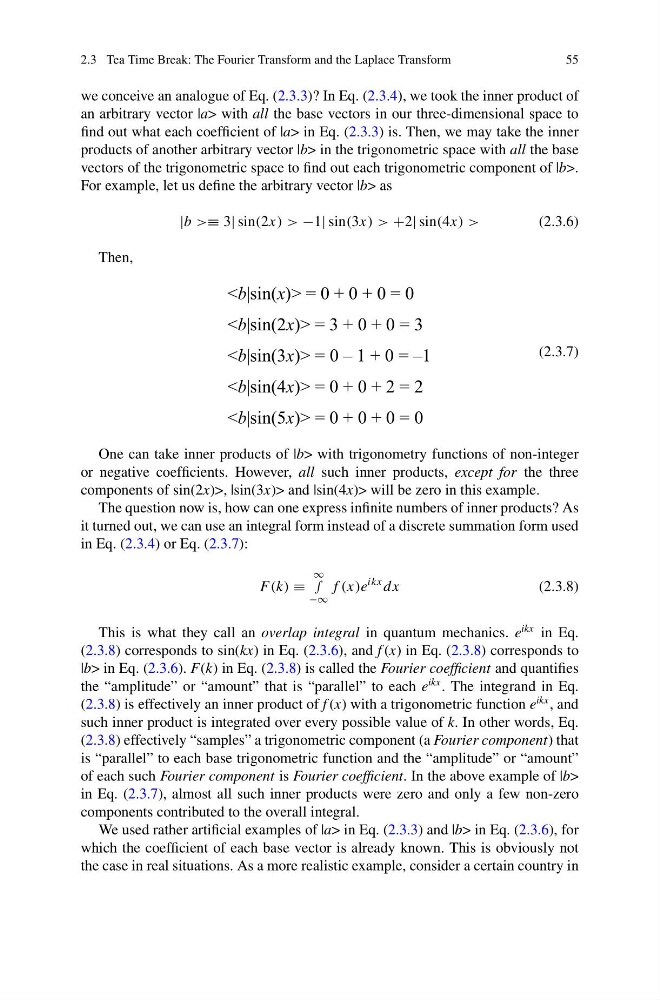
= 0 – 1 + 0 = –1
)> = 3 + 0 + 0 = 3
)> = 0 + 0 + 2 = 2
)> = 0 + 0 + 0 = 0
(2.3.7)
One can take inner products of |b> with trigonometry functions of non-integer
or negative coefficients. However, all such inner products, except for the three
components of sin(2x)>, |sin(3x)> and |sin(4x)> will be zero in this example.
The question now is, how can one express infinite numbers of inner products? As
it turned out, we can use an integral form instead of a discrete summation form used
in Eq. (2.3.4) or Eq. (2.3.7):
F(k) ≡
∞
∫
−∞
f (x)e
ikx dx
(2.3.8)
This is what they call an overlap integral in quantum mechanics. e
ikx in Eq.
(2.3.8) corresponds to sin(kx) in Eq. (2.3.6), and f (x) in Eq. (2.3.8) corresponds to
|b> in Eq. (2.3.6). F(k) in Eq. (2.3.8) is called the Fourier coefficient and quantifies
the “amplitude” or “amount” that is “parallel” to each e
ikx . The integrand in Eq.
(2.3.8) is effectively an inner product of f (x) with a trigonometric function e
ikx , and
such inner product is integrated over every possible value of k. In other words, Eq.
(2.3.8) effectively “samples” a trigonometric component (a Fourier component) that
is “parallel” to each base trigonometric function and the “amplitude” or “amount”
of each such Fourier component is Fourier coefficient. In the above example of |b>
in Eq. (2.3.7), almost all such inner products were zero and only a few non-zero
components contributed to the overall integral.
We used rather artificial examples of |a> in Eq. (2.3.3) and |b> in Eq. (2.3.6), for
which the coefficient of each base vector is already known. This is obviously not
the case in real situations. As a more realistic example, consider a certain country in
55
we conceive an analogue of Eq. (2.3.3)? In Eq. (2.3.4), we took the inner product of
an arbitrary vector |a> with all the base vectors in our three-dimensional space to
find out what each coefficient of |a> in Eq. (2.3.3) is. Then, we may take the inner
products of another arbitrary vector |b> in the trigonometric space with all the base
vectors of the trigonometric space to find out each trigonometric component of |b>.
For example, let us define the arbitrary vector |b> as
|b >≡ 3| sin(2x) > −1| sin(3x) > +2| sin(4x) >
(2.3.6)
Then,
)> = 3 + 0 + 0 = 3
)> = 0 + 0 + 2 = 2
)> = 0 + 0 + 0 = 0
(2.3.7)
One can take inner products of |b> with trigonometry functions of non-integer
or negative coefficients. However, all such inner products, except for the three
components of sin(2x)>, |sin(3x)> and |sin(4x)> will be zero in this example.
The question now is, how can one express infinite numbers of inner products? As
it turned out, we can use an integral form instead of a discrete summation form used
in Eq. (2.3.4) or Eq. (2.3.7):
F(k) ≡
∞
∫
−∞
f (x)e
ikx dx
(2.3.8)
This is what they call an overlap integral in quantum mechanics. e
ikx in Eq.
(2.3.8) corresponds to sin(kx) in Eq. (2.3.6), and f (x) in Eq. (2.3.8) corresponds to
|b> in Eq. (2.3.6). F(k) in Eq. (2.3.8) is called the Fourier coefficient and quantifies
the “amplitude” or “amount” that is “parallel” to each e
ikx . The integrand in Eq.
(2.3.8) is effectively an inner product of f (x) with a trigonometric function e
ikx , and
such inner product is integrated over every possible value of k. In other words, Eq.
(2.3.8) effectively “samples” a trigonometric component (a Fourier component) that
is “parallel” to each base trigonometric function and the “amplitude” or “amount”
of each such Fourier component is Fourier coefficient. In the above example of |b>
in Eq. (2.3.7), almost all such inner products were zero and only a few non-zero
components contributed to the overall integral.
We used rather artificial examples of |a> in Eq. (2.3.3) and |b> in Eq. (2.3.6), for
which the coefficient of each base vector is already known. This is obviously not
the case in real situations. As a more realistic example, consider a certain country in