

50
2 Experimental Methods for Determination of Nucleation Rates
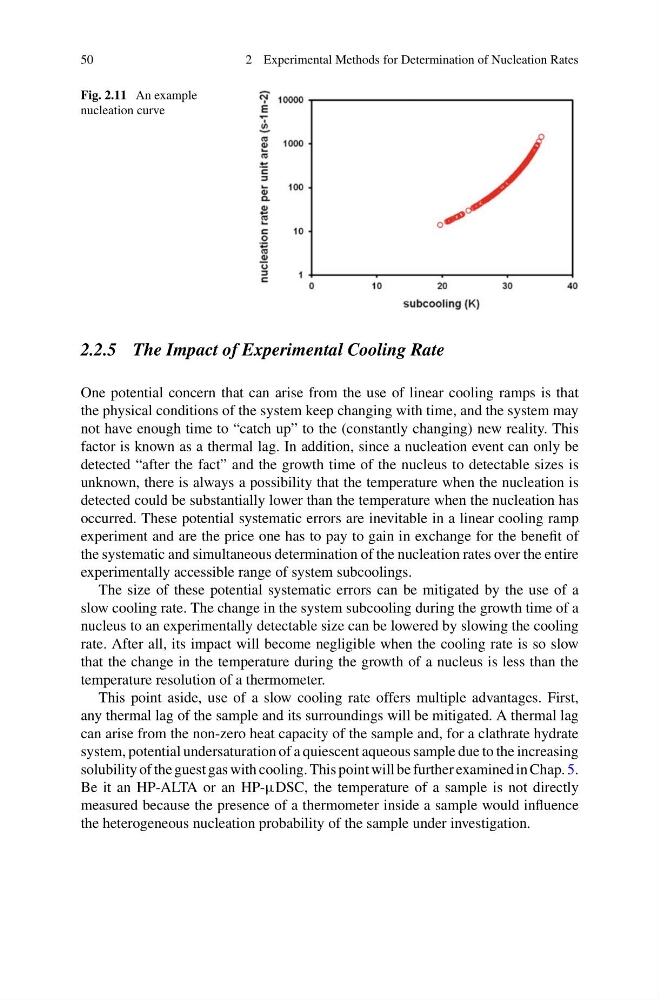
Fig. 2.11 An example
nucleation curve
2.2.5 The Impact of Experimental Cooling Rate
One potential concern that can arise from the use of linear cooling ramps is that
the physical conditions of the system keep changing with time, and the system may
not have enough time to “catch up” to the (constantly changing) new reality. This
factor is known as a thermal lag. In addition, since a nucleation event can only be
detected “after the fact” and the growth time of the nucleus to detectable sizes is
unknown, there is always a possibility that the temperature when the nucleation is
detected could be substantially lower than the temperature when the nucleation has
occurred. These potential systematic errors are inevitable in a linear cooling ramp
experiment and are the price one has to pay to gain in exchange for the benefit of
the systematic and simultaneous determination of the nucleation rates over the entire
experimentally accessible range of system subcoolings.
The size of these potential systematic errors can be mitigated by the use of a
slow cooling rate. The change in the system subcooling during the growth time of a
nucleus to an experimentally detectable size can be lowered by slowing the cooling
rate. After all, its impact will become negligible when the cooling rate is so slow
that the change in the temperature during the growth of a nucleus is less than the
temperature resolution of a thermometer.
This point aside, use of a slow cooling rate offers multiple advantages. First,
any thermal lag of the sample and its surroundings will be mitigated. A thermal lag
can arise from the non-zero heat capacity of the sample and, for a clathrate hydrate
system, potential undersaturation of a quiescent aqueous sample due to the increasing
solubility of the guest gas with cooling. This point will be further examined in Chap. 5.
Be it an HP-ALTA or an HP-μDSC, the temperature of a sample is not directly
measured because the presence of a thermometer inside a sample would influence
the heterogeneous nucleation probability of the sample under investigation.
2 Experimental Methods for Determination of Nucleation Rates
Fig. 2.11 An example
nucleation curve
2.2.5 The Impact of Experimental Cooling Rate
One potential concern that can arise from the use of linear cooling ramps is that
the physical conditions of the system keep changing with time, and the system may
not have enough time to “catch up” to the (constantly changing) new reality. This
factor is known as a thermal lag. In addition, since a nucleation event can only be
detected “after the fact” and the growth time of the nucleus to detectable sizes is
unknown, there is always a possibility that the temperature when the nucleation is
detected could be substantially lower than the temperature when the nucleation has
occurred. These potential systematic errors are inevitable in a linear cooling ramp
experiment and are the price one has to pay to gain in exchange for the benefit of
the systematic and simultaneous determination of the nucleation rates over the entire
experimentally accessible range of system subcoolings.
The size of these potential systematic errors can be mitigated by the use of a
slow cooling rate. The change in the system subcooling during the growth time of a
nucleus to an experimentally detectable size can be lowered by slowing the cooling
rate. After all, its impact will become negligible when the cooling rate is so slow
that the change in the temperature during the growth of a nucleus is less than the
temperature resolution of a thermometer.
This point aside, use of a slow cooling rate offers multiple advantages. First,
any thermal lag of the sample and its surroundings will be mitigated. A thermal lag
can arise from the non-zero heat capacity of the sample and, for a clathrate hydrate
system, potential undersaturation of a quiescent aqueous sample due to the increasing
solubility of the guest gas with cooling. This point will be further examined in Chap. 5.
Be it an HP-ALTA or an HP-μDSC, the temperature of a sample is not directly
measured because the presence of a thermometer inside a sample would influence
the heterogeneous nucleation probability of the sample under investigation.