

26
1 Nucleation Theory
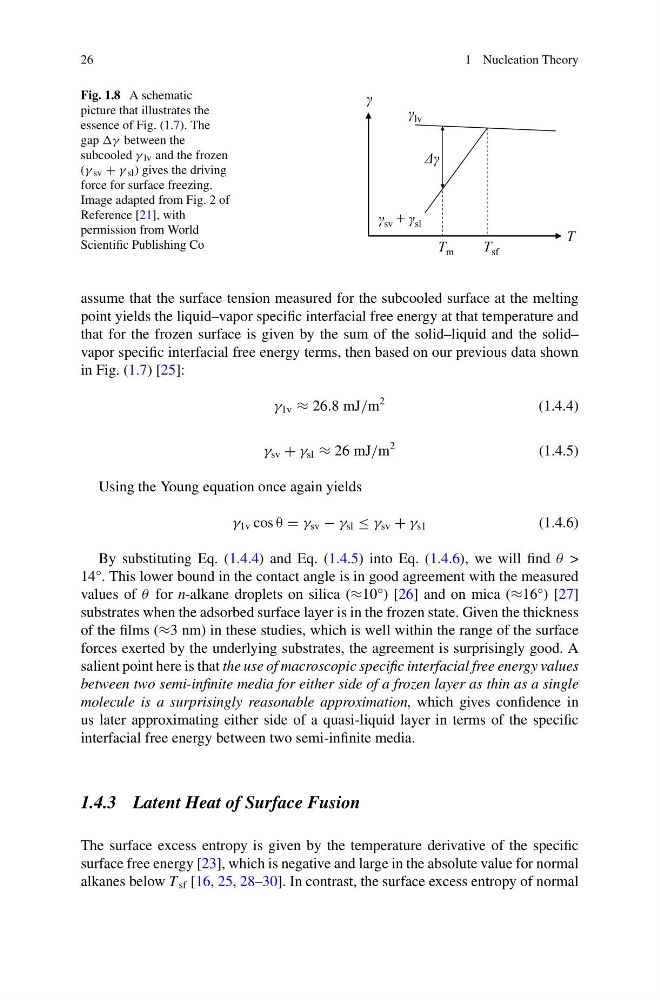
Fig. 1.8 A schematic
picture that illustrates the
essence of Fig. (1.7). The
gap between the
subcooled γ lv and the frozen
(γ sv + γ sl ) gives the driving
force for surface freezing.
Image adapted from Fig. 2 of
Reference [21], with
permission from World
Scientific Publishing Co
T sf
T
T m
γ lv
Δγ
γ sv + γ sl
γ
assume that the surface tension measured for the subcooled surface at the melting
point yields the liquid–vapor specific interfacial free energy at that temperature and
that for the frozen surface is given by the sum of the solid–liquid and the solid–
vapor specific interfacial free energy terms, then based on our previous data shown
in Fig. (1.7) [25]:
γ 1v ≈ 26.8 mJ/m
2
(1.4.4)
γ sv + γ sl ≈ 26 mJ/m
2
(1.4.5)
Using the Young equation once again yields
γ 1v cos θ = γ sv − γ sl ≤ γ sv + γ s1
(1.4.6)
By substituting Eq. (1.4.4) and Eq. (1.4.5) into Eq. (1.4.6), we will find θ >
14°. This lower bound in the contact angle is in good agreement with the measured
values of θ for n-alkane droplets on silica (≈10°) [26] and on mica (≈16°) [27]
substrates when the adsorbed surface layer is in the frozen state. Given the thickness
of the films (≈3 nm) in these studies, which is well within the range of the surface
forces exerted by the underlying substrates, the agreement is surprisingly good. A
salient point here is that the use of macroscopic specific interfacial free energy values
between two semi-infinite media for either side of a frozen layer as thin as a single
molecule is a surprisingly reasonable approximation, which gives confidence in
us later approximating either side of a quasi-liquid layer in terms of the specific
interfacial free energy between two semi-infinite media.
1.4.3 Latent Heat of Surface Fusion
The surface excess entropy is given by the temperature derivative of the specific
surface free energy [23], which is negative and large in the absolute value for normal
alkanes below T sf [16, 25, 28–30]. In contrast, the surface excess entropy of normal
1 Nucleation Theory
Fig. 1.8 A schematic
picture that illustrates the
essence of Fig. (1.7). The
gap between the
subcooled γ lv and the frozen
(γ sv + γ sl ) gives the driving
force for surface freezing.
Image adapted from Fig. 2 of
Reference [21], with
permission from World
Scientific Publishing Co
T sf
T
T m
γ lv
Δγ
γ sv + γ sl
γ
assume that the surface tension measured for the subcooled surface at the melting
point yields the liquid–vapor specific interfacial free energy at that temperature and
that for the frozen surface is given by the sum of the solid–liquid and the solid–
vapor specific interfacial free energy terms, then based on our previous data shown
in Fig. (1.7) [25]:
γ 1v ≈ 26.8 mJ/m
2
(1.4.4)
γ sv + γ sl ≈ 26 mJ/m
2
(1.4.5)
Using the Young equation once again yields
γ 1v cos θ = γ sv − γ sl ≤ γ sv + γ s1
(1.4.6)
By substituting Eq. (1.4.4) and Eq. (1.4.5) into Eq. (1.4.6), we will find θ >
14°. This lower bound in the contact angle is in good agreement with the measured
values of θ for n-alkane droplets on silica (≈10°) [26] and on mica (≈16°) [27]
substrates when the adsorbed surface layer is in the frozen state. Given the thickness
of the films (≈3 nm) in these studies, which is well within the range of the surface
forces exerted by the underlying substrates, the agreement is surprisingly good. A
salient point here is that the use of macroscopic specific interfacial free energy values
between two semi-infinite media for either side of a frozen layer as thin as a single
molecule is a surprisingly reasonable approximation, which gives confidence in
us later approximating either side of a quasi-liquid layer in terms of the specific
interfacial free energy between two semi-infinite media.
1.4.3 Latent Heat of Surface Fusion
The surface excess entropy is given by the temperature derivative of the specific
surface free energy [23], which is negative and large in the absolute value for normal
alkanes below T sf [16, 25, 28–30]. In contrast, the surface excess entropy of normal