

1.4 Nucleation of Two-Dimensional Solid Layers
25
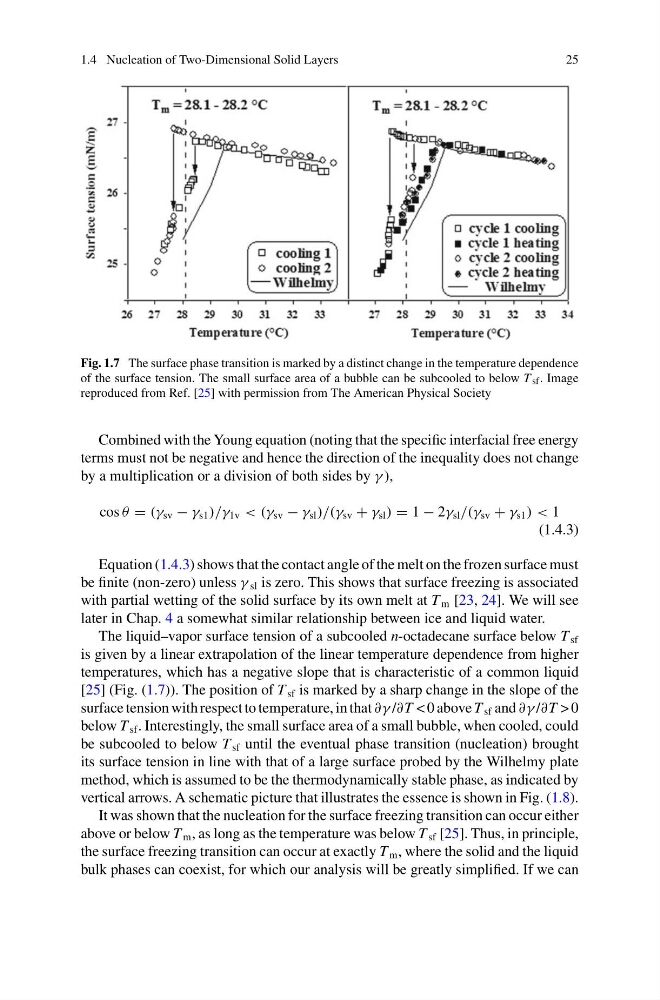
Fig. 1.7 The surface phase transition is marked by a distinct change in the temperature dependence
of the surface tension. The small surface area of a bubble can be subcooled to below T sf . Image
reproduced from Ref. [25] with permission from The American Physical Society
Combined with the Young equation (noting that the specific interfacial free energy
terms must not be negative and hence the direction of the inequality does not change
by a multiplication or a division of both sides by γ ),
cos θ = (γ sv − γ s1 )/γ 1v < (γ sv − γ sl )/(γ sv + γ sl ) = 1 − 2γ sl /(γ sv + γ s1 ) < 1
(1.4.3)
Equation (1.4.3) shows that the contact angle of the melt on the frozen surface must
be finite (non-zero) unless γ sl is zero. This shows that surface freezing is associated
with partial wetting of the solid surface by its own melt at T m [23, 24]. We will see
later in Chap. 4 a somewhat similar relationship between ice and liquid water.
The liquid–vapor surface tension of a subcooled n-octadecane surface below T sf
is given by a linear extrapolation of the linear temperature dependence from higher
temperatures, which has a negative slope that is characteristic of a common liquid
[25] (Fig. (1.7)). The position of T sf is marked by a sharp change in the slope of the
surface tension with respect to temperature, in that ∂γ /∂T < 0 above T sf and ∂γ /∂T > 0
below T sf . Interestingly, the small surface area of a small bubble, when cooled, could
be subcooled to below T sf until the eventual phase transition (nucleation) brought
its surface tension in line with that of a large surface probed by the Wilhelmy plate
method, which is assumed to be the thermodynamically stable phase, as indicated by
vertical arrows. A schematic picture that illustrates the essence is shown in Fig. (1.8).
It was shown that the nucleation for the surface freezing transition can occur either
above or below T m , as long as the temperature was below T sf [25]. Thus, in principle,
the surface freezing transition can occur at exactly T m , where the solid and the liquid
bulk phases can coexist, for which our analysis will be greatly simplified. If we can
25
Fig. 1.7 The surface phase transition is marked by a distinct change in the temperature dependence
of the surface tension. The small surface area of a bubble can be subcooled to below T sf . Image
reproduced from Ref. [25] with permission from The American Physical Society
Combined with the Young equation (noting that the specific interfacial free energy
terms must not be negative and hence the direction of the inequality does not change
by a multiplication or a division of both sides by γ ),
cos θ = (γ sv − γ s1 )/γ 1v < (γ sv − γ sl )/(γ sv + γ sl ) = 1 − 2γ sl /(γ sv + γ s1 ) < 1
(1.4.3)
Equation (1.4.3) shows that the contact angle of the melt on the frozen surface must
be finite (non-zero) unless γ sl is zero. This shows that surface freezing is associated
with partial wetting of the solid surface by its own melt at T m [23, 24]. We will see
later in Chap. 4 a somewhat similar relationship between ice and liquid water.
The liquid–vapor surface tension of a subcooled n-octadecane surface below T sf
is given by a linear extrapolation of the linear temperature dependence from higher
temperatures, which has a negative slope that is characteristic of a common liquid
[25] (Fig. (1.7)). The position of T sf is marked by a sharp change in the slope of the
surface tension with respect to temperature, in that ∂γ /∂T < 0 above T sf and ∂γ /∂T > 0
below T sf . Interestingly, the small surface area of a small bubble, when cooled, could
be subcooled to below T sf until the eventual phase transition (nucleation) brought
its surface tension in line with that of a large surface probed by the Wilhelmy plate
method, which is assumed to be the thermodynamically stable phase, as indicated by
vertical arrows. A schematic picture that illustrates the essence is shown in Fig. (1.8).
It was shown that the nucleation for the surface freezing transition can occur either
above or below T m , as long as the temperature was below T sf [25]. Thus, in principle,
the surface freezing transition can occur at exactly T m , where the solid and the liquid
bulk phases can coexist, for which our analysis will be greatly simplified. If we can