

20
1 Nucleation Theory
The maximum nucleation work will be realized when n
∗
heterogeneous =
(3μ/2aγ )
−3 , which is larger than n
∗
heterogeneous . The corresponding maximum
nucleation work, W homogeneous (n
∗
heterogeneous ), is
W homogeneous
n
∗
homogeneous
=
4 a
3
γ
3
/27
1//μ
2
(1.2.41)
From Eq. (1.2.39) and Eq. (1.2.41),
W heterogeneous
n
∗
heterogeneous
/W homogeneous
n
∗
heterogeneous
=
(1.2.42)
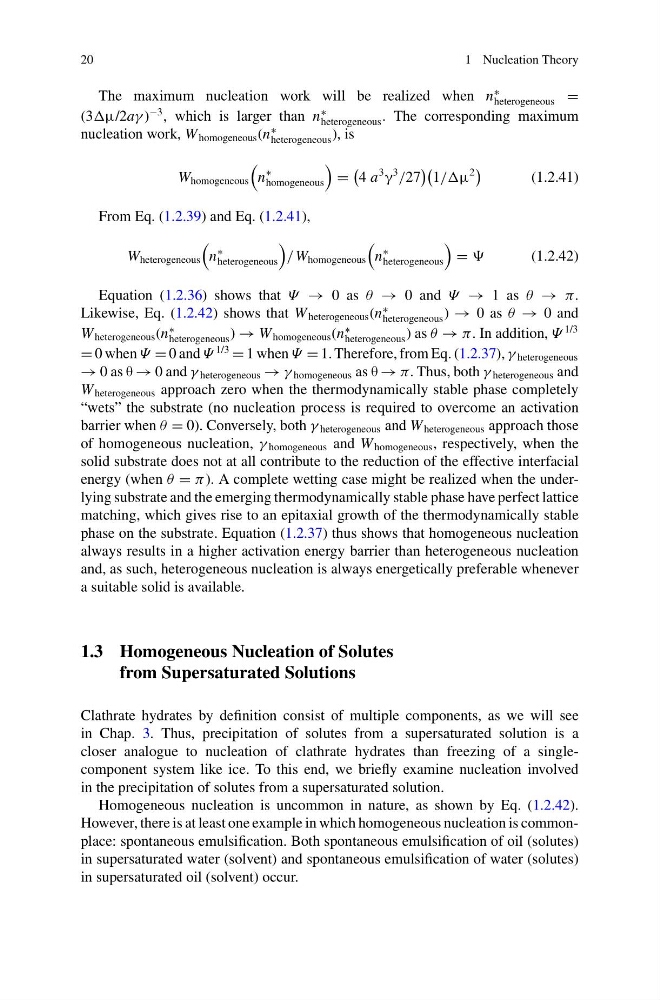
Equation (1.2.36) shows that Ψ → 0 as θ → 0 and Ψ → 1 as θ → π.
Likewise, Eq. (1.2.42) shows that W heterogeneous (n
∗
heterogeneous ) → 0 as θ → 0 and
W heterogeneous (n
∗
heterogeneous ) → W homogeneous (n
∗
heterogeneous ) as θ → π. In addition, Ψ
1/3
= 0 when Ψ = 0 and Ψ
1/3
= 1 when Ψ = 1. Therefore, from Eq. (1.2.37), γ heterogeneous
→ 0 as θ → 0 and γ heterogeneous → γ homogeneous as θ → π. Thus, both γ heterogeneous and
W heterogeneous approach zero when the thermodynamically stable phase completely
“wets” the substrate (no nucleation process is required to overcome an activation
barrier when θ = 0). Conversely, both γ heterogeneous and W heterogeneous approach those
of homogeneous nucleation, γ homogeneous and W homogeneous , respectively, when the
solid substrate does not at all contribute to the reduction of the effective interfacial
energy (when θ = π ). A complete wetting case might be realized when the underlying substrate and the emerging thermodynamically stable phase have perfect lattice
matching, which gives rise to an epitaxial growth of the thermodynamically stable
phase on the substrate. Equation (1.2.37) thus shows that homogeneous nucleation
always results in a higher activation energy barrier than heterogeneous nucleation
and, as such, heterogeneous nucleation is always energetically preferable whenever
a suitable solid is available.
1.3 Homogeneous Nucleation of Solutes
from Supersaturated Solutions
Clathrate hydrates by definition consist of multiple components, as we will see
in Chap. 3. Thus, precipitation of solutes from a supersaturated solution is a
closer analogue to nucleation of clathrate hydrates than freezing of a singlecomponent system like ice. To this end, we briefly examine nucleation involved
in the precipitation of solutes from a supersaturated solution.
Homogeneous nucleation is uncommon in nature, as shown by Eq. (1.2.42).
However, there is at least one example in which homogeneous nucleation is commonplace: spontaneous emulsification. Both spontaneous emulsification of oil (solutes)
in supersaturated water (solvent) and spontaneous emulsification of water (solutes)
in supersaturated oil (solvent) occur.
1 Nucleation Theory
The maximum nucleation work will be realized when n
∗
heterogeneous =
(3μ/2aγ )
−3 , which is larger than n
∗
heterogeneous . The corresponding maximum
nucleation work, W homogeneous (n
∗
heterogeneous ), is
W homogeneous
n
∗
homogeneous
=
4 a
3
γ
3
/27
1//μ
2
(1.2.41)
From Eq. (1.2.39) and Eq. (1.2.41),
W heterogeneous
n
∗
heterogeneous
/W homogeneous
n
∗
heterogeneous
=
(1.2.42)
Equation (1.2.36) shows that Ψ → 0 as θ → 0 and Ψ → 1 as θ → π.
Likewise, Eq. (1.2.42) shows that W heterogeneous (n
∗
heterogeneous ) → 0 as θ → 0 and
W heterogeneous (n
∗
heterogeneous ) → W homogeneous (n
∗
heterogeneous ) as θ → π. In addition, Ψ
1/3
= 0 when Ψ = 0 and Ψ
1/3
= 1 when Ψ = 1. Therefore, from Eq. (1.2.37), γ heterogeneous
→ 0 as θ → 0 and γ heterogeneous → γ homogeneous as θ → π. Thus, both γ heterogeneous and
W heterogeneous approach zero when the thermodynamically stable phase completely
“wets” the substrate (no nucleation process is required to overcome an activation
barrier when θ = 0). Conversely, both γ heterogeneous and W heterogeneous approach those
of homogeneous nucleation, γ homogeneous and W homogeneous , respectively, when the
solid substrate does not at all contribute to the reduction of the effective interfacial
energy (when θ = π ). A complete wetting case might be realized when the underlying substrate and the emerging thermodynamically stable phase have perfect lattice
matching, which gives rise to an epitaxial growth of the thermodynamically stable
phase on the substrate. Equation (1.2.37) thus shows that homogeneous nucleation
always results in a higher activation energy barrier than heterogeneous nucleation
and, as such, heterogeneous nucleation is always energetically preferable whenever
a suitable solid is available.
1.3 Homogeneous Nucleation of Solutes
from Supersaturated Solutions
Clathrate hydrates by definition consist of multiple components, as we will see
in Chap. 3. Thus, precipitation of solutes from a supersaturated solution is a
closer analogue to nucleation of clathrate hydrates than freezing of a singlecomponent system like ice. To this end, we briefly examine nucleation involved
in the precipitation of solutes from a supersaturated solution.
Homogeneous nucleation is uncommon in nature, as shown by Eq. (1.2.42).
However, there is at least one example in which homogeneous nucleation is commonplace: spontaneous emulsification. Both spontaneous emulsification of oil (solutes)
in supersaturated water (solvent) and spontaneous emulsification of water (solutes)
in supersaturated oil (solvent) occur.