

1.2 Classical Nucleation Theory
19
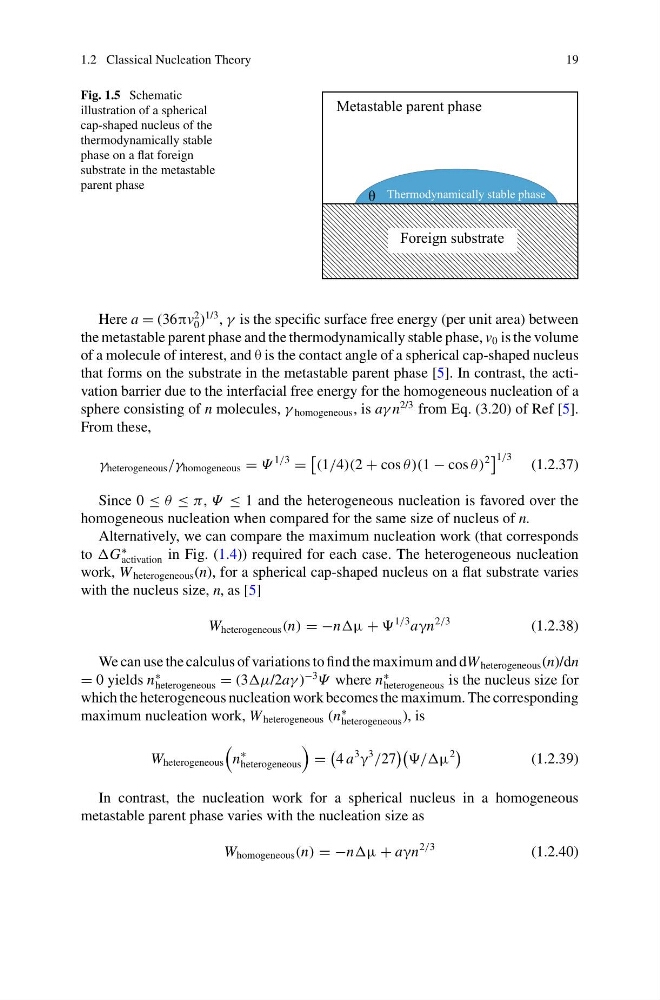
Fig. 1.5 Schematic
illustration of a spherical
cap-shaped nucleus of the
thermodynamically stable
phase on a flat foreign
substrate in the metastable
parent phase
Foreign substrate
Metastable parent phase
Thermodynamically stable phase
θ
Here a = (36πv
2
0 )
1/3 , γ is the specific surface free energy (per unit area) between
the metastable parent phase and the thermodynamically stable phase, v 0 is the volume
of a molecule of interest, and θ is the contact angle of a spherical cap-shaped nucleus
that forms on the substrate in the metastable parent phase [5]. In contrast, the activation barrier due to the interfacial free energy for the homogeneous nucleation of a
sphere consisting of n molecules, γ homogeneous , is aγ n
2/3 from Eq. (3.20) of Ref [5].
From these,
γ heterogeneous /γ homogeneous = Ψ
1/3
=
(1/4)(2 + cos θ)(1 − cos θ)
2
1/3 (1.2.37)
Since 0 ≤ θ ≤ π, Ψ ≤ 1 and the heterogeneous nucleation is favored over the
homogeneous nucleation when compared for the same size of nucleus of n.
Alternatively, we can compare the maximum nucleation work (that corresponds
to
∗
activation in Fig. (1.4)) required for each case. The heterogeneous nucleation
work, W heterogeneous (n), for a spherical cap-shaped nucleus on a flat substrate varies
with the nucleus size, n, as [5]
W heterogeneous (n) = −n +
1/3 aγn
2/3
(1.2.38)
We can use the calculus of variations to find the maximum and dW heterogeneous (n)/dn
= 0 yields n
∗
heterogeneous = (3μ/2aγ )
−3
Ψ where n
∗
heterogeneous is the nucleus size for
which the heterogeneous nucleation work becomes the maximum. The corresponding
maximum nucleation work, W heterogeneous (n
∗
heterogeneous ), is
W heterogeneous
n
∗
heterogeneous
=
4 a
3
γ
3
/27
//μ
2
(1.2.39)
In contrast, the nucleation work for a spherical nucleus in a homogeneous
metastable parent phase varies with the nucleation size as
W homogeneous (n) = −n + aγn
2/3
(1.2.40)
19
Fig. 1.5 Schematic
illustration of a spherical
cap-shaped nucleus of the
thermodynamically stable
phase on a flat foreign
substrate in the metastable
parent phase
Foreign substrate
Metastable parent phase
Thermodynamically stable phase
θ
Here a = (36πv
2
0 )
1/3 , γ is the specific surface free energy (per unit area) between
the metastable parent phase and the thermodynamically stable phase, v 0 is the volume
of a molecule of interest, and θ is the contact angle of a spherical cap-shaped nucleus
that forms on the substrate in the metastable parent phase [5]. In contrast, the activation barrier due to the interfacial free energy for the homogeneous nucleation of a
sphere consisting of n molecules, γ homogeneous , is aγ n
2/3 from Eq. (3.20) of Ref [5].
From these,
γ heterogeneous /γ homogeneous = Ψ
1/3
=
(1/4)(2 + cos θ)(1 − cos θ)
2
1/3 (1.2.37)
Since 0 ≤ θ ≤ π, Ψ ≤ 1 and the heterogeneous nucleation is favored over the
homogeneous nucleation when compared for the same size of nucleus of n.
Alternatively, we can compare the maximum nucleation work (that corresponds
to
∗
activation in Fig. (1.4)) required for each case. The heterogeneous nucleation
work, W heterogeneous (n), for a spherical cap-shaped nucleus on a flat substrate varies
with the nucleus size, n, as [5]
W heterogeneous (n) = −n +
1/3 aγn
2/3
(1.2.38)
We can use the calculus of variations to find the maximum and dW heterogeneous (n)/dn
= 0 yields n
∗
heterogeneous = (3μ/2aγ )
−3
Ψ where n
∗
heterogeneous is the nucleus size for
which the heterogeneous nucleation work becomes the maximum. The corresponding
maximum nucleation work, W heterogeneous (n
∗
heterogeneous ), is
W heterogeneous
n
∗
heterogeneous
=
4 a
3
γ
3
/27
//μ
2
(1.2.39)
In contrast, the nucleation work for a spherical nucleus in a homogeneous
metastable parent phase varies with the nucleation size as
W homogeneous (n) = −n + aγn
2/3
(1.2.40)