

138
5 Nucleation of Gas Hydrates
solvable. To tackle the large numbers of ions in a salt solution and the enormously
complex interplay among them, a number of simplifications and approximations have
been introduced.
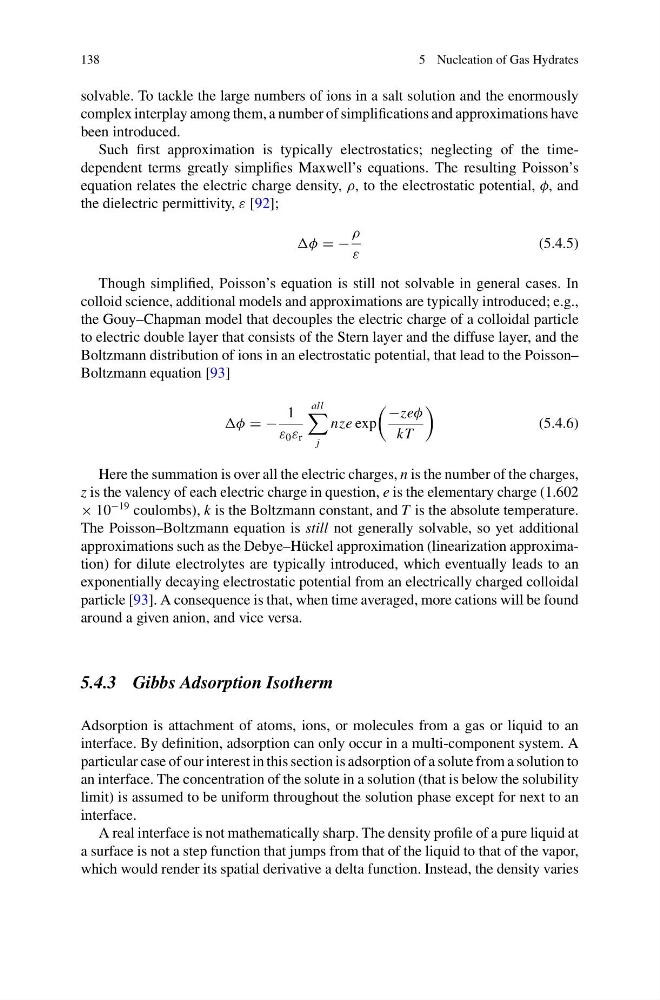
Such first approximation is typically electrostatics; neglecting of the timedependent terms greatly simplifies Maxwell’s equations. The resulting Poisson’s
equation relates the electric charge density, ρ, to the electrostatic potential, φ, and
the dielectric permittivity, ε [92];
φ = −
ρ
ε
(5.4.5)
Though simplified, Poisson’s equation is still not solvable in general cases. In
colloid science, additional models and approximations are typically introduced; e.g.,
the Gouy–Chapman model that decouples the electric charge of a colloidal particle
to electric double layer that consists of the Stern layer and the diffuse layer, and the
Boltzmann distribution of ions in an electrostatic potential, that lead to the Poisson–
Boltzmann equation [93]
φ = −
1
ε 0 ε r
all
j
nze exp
−zeφ
kT
(5.4.6)
Here the summation is over all the electric charges, n is the number of the charges,
z is the valency of each electric charge in question, e is the elementary charge (1.602
× 10
−19 coulombs), k is the Boltzmann constant, and T is the absolute temperature.
The Poisson–Boltzmann equation is still not generally solvable, so yet additional
approximations such as the Debye–Hückel approximation (linearization approximation) for dilute electrolytes are typically introduced, which eventually leads to an
exponentially decaying electrostatic potential from an electrically charged colloidal
particle [93]. A consequence is that, when time averaged, more cations will be found
around a given anion, and vice versa.
5.4.3 Gibbs Adsorption Isotherm
Adsorption is attachment of atoms, ions, or molecules from a gas or liquid to an
interface. By definition, adsorption can only occur in a multi-component system. A
particular case of our interest in this section is adsorption of a solute from a solution to
an interface. The concentration of the solute in a solution (that is below the solubility
limit) is assumed to be uniform throughout the solution phase except for next to an
interface.
A real interface is not mathematically sharp. The density profile of a pure liquid at
a surface is not a step function that jumps from that of the liquid to that of the vapor,
which would render its spatial derivative a delta function. Instead, the density varies
5 Nucleation of Gas Hydrates
solvable. To tackle the large numbers of ions in a salt solution and the enormously
complex interplay among them, a number of simplifications and approximations have
been introduced.
Such first approximation is typically electrostatics; neglecting of the timedependent terms greatly simplifies Maxwell’s equations. The resulting Poisson’s
equation relates the electric charge density, ρ, to the electrostatic potential, φ, and
the dielectric permittivity, ε [92];
φ = −
ρ
ε
(5.4.5)
Though simplified, Poisson’s equation is still not solvable in general cases. In
colloid science, additional models and approximations are typically introduced; e.g.,
the Gouy–Chapman model that decouples the electric charge of a colloidal particle
to electric double layer that consists of the Stern layer and the diffuse layer, and the
Boltzmann distribution of ions in an electrostatic potential, that lead to the Poisson–
Boltzmann equation [93]
φ = −
1
ε 0 ε r
all
j
nze exp
−zeφ
kT
(5.4.6)
Here the summation is over all the electric charges, n is the number of the charges,
z is the valency of each electric charge in question, e is the elementary charge (1.602
× 10
−19 coulombs), k is the Boltzmann constant, and T is the absolute temperature.
The Poisson–Boltzmann equation is still not generally solvable, so yet additional
approximations such as the Debye–Hückel approximation (linearization approximation) for dilute electrolytes are typically introduced, which eventually leads to an
exponentially decaying electrostatic potential from an electrically charged colloidal
particle [93]. A consequence is that, when time averaged, more cations will be found
around a given anion, and vice versa.
5.4.3 Gibbs Adsorption Isotherm
Adsorption is attachment of atoms, ions, or molecules from a gas or liquid to an
interface. By definition, adsorption can only occur in a multi-component system. A
particular case of our interest in this section is adsorption of a solute from a solution to
an interface. The concentration of the solute in a solution (that is below the solubility
limit) is assumed to be uniform throughout the solution phase except for next to an
interface.
A real interface is not mathematically sharp. The density profile of a pure liquid at
a surface is not a step function that jumps from that of the liquid to that of the vapor,
which would render its spatial derivative a delta function. Instead, the density varies