

5.4 Effects of Electrolytes
137
mixing is proportional to the number of ions and independent of the identity of ion
species [91]. However, salts are not preferred as THIs due to the corrosive effects on
pipes and production facilities.
As a research field, nucleation of clathrate hydrates in electrolyte solutions is in its
infancy and very little is understood about the impacts of electrolytes on the kinetics
of clathrate hydrate formation. Nucleation of clathrate hydrates in the absence of
ions is already complex and the complexities are compounded by another enormously
complex issue of the impact of ions on hydrogen bonding and on the structure of liquid
water. Since very little is understood about the effects of electrolytes on nucleation
of clathrate hydrates beyond the ubiquitous thermodynamic inhibition, we here only
briefly summarize various issues that are relevant in future research effort on the
subject.
5.4.2 Locations of Ions in a Salt Solution
Global electro-neutrality means that equal numbers of opposite electric charges must
exist in a given closed system. How these electric charges are spatially distributed
in a given system is a complex problem. Each electric charge generates an electric
field around it and at the same time feels the forces by the electric fields generated
by other electric charges. The electromagnetic fields generated by electric charges
are governed by Maxwell’s equations and the motions of the electric charges due
to the electromagnetic fields are governed by Newton’s equations of motion [92].
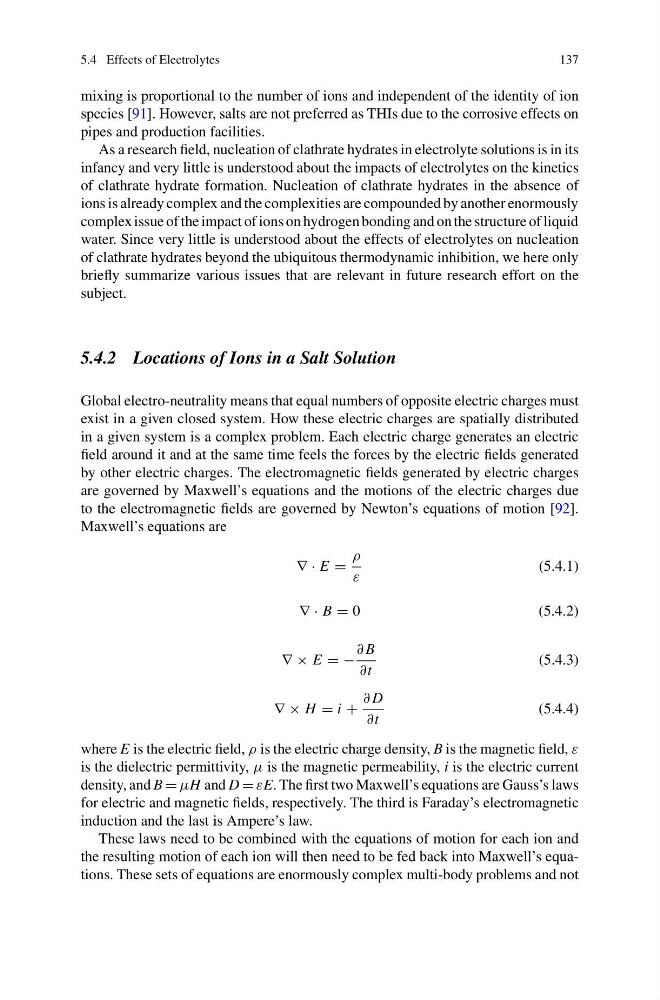
Maxwell’s equations are
∇ · E =
ρ
ε
(5.4.1)
∇ · B = 0
(5.4.2)
∇ × E = −
∂ B
∂t
(5.4.3)
∇ × H = i +
∂ D
∂t
(5.4.4)
where E is the electric field, ρ is the electric charge density, B is the magnetic field, ε
is the dielectric permittivity, μ is the magnetic permeability, i is the electric current
density, and B = μH and D = εE. The first two Maxwell’s equations are Gauss’s laws
for electric and magnetic fields, respectively. The third is Faraday’s electromagnetic
induction and the last is Ampere’s law.
These laws need to be combined with the equations of motion for each ion and
the resulting motion of each ion will then need to be fed back into Maxwell’s equations. These sets of equations are enormously complex multi-body problems and not
137
mixing is proportional to the number of ions and independent of the identity of ion
species [91]. However, salts are not preferred as THIs due to the corrosive effects on
pipes and production facilities.
As a research field, nucleation of clathrate hydrates in electrolyte solutions is in its
infancy and very little is understood about the impacts of electrolytes on the kinetics
of clathrate hydrate formation. Nucleation of clathrate hydrates in the absence of
ions is already complex and the complexities are compounded by another enormously
complex issue of the impact of ions on hydrogen bonding and on the structure of liquid
water. Since very little is understood about the effects of electrolytes on nucleation
of clathrate hydrates beyond the ubiquitous thermodynamic inhibition, we here only
briefly summarize various issues that are relevant in future research effort on the
subject.
5.4.2 Locations of Ions in a Salt Solution
Global electro-neutrality means that equal numbers of opposite electric charges must
exist in a given closed system. How these electric charges are spatially distributed
in a given system is a complex problem. Each electric charge generates an electric
field around it and at the same time feels the forces by the electric fields generated
by other electric charges. The electromagnetic fields generated by electric charges
are governed by Maxwell’s equations and the motions of the electric charges due
to the electromagnetic fields are governed by Newton’s equations of motion [92].
Maxwell’s equations are
∇ · E =
ρ
ε
(5.4.1)
∇ · B = 0
(5.4.2)
∇ × E = −
∂ B
∂t
(5.4.3)
∇ × H = i +
∂ D
∂t
(5.4.4)
where E is the electric field, ρ is the electric charge density, B is the magnetic field, ε
is the dielectric permittivity, μ is the magnetic permeability, i is the electric current
density, and B = μH and D = εE. The first two Maxwell’s equations are Gauss’s laws
for electric and magnetic fields, respectively. The third is Faraday’s electromagnetic
induction and the last is Ampere’s law.
These laws need to be combined with the equations of motion for each ion and
the resulting motion of each ion will then need to be fed back into Maxwell’s equations. These sets of equations are enormously complex multi-body problems and not