

5.2 Nucleation Rate of Gas Hydrates
125
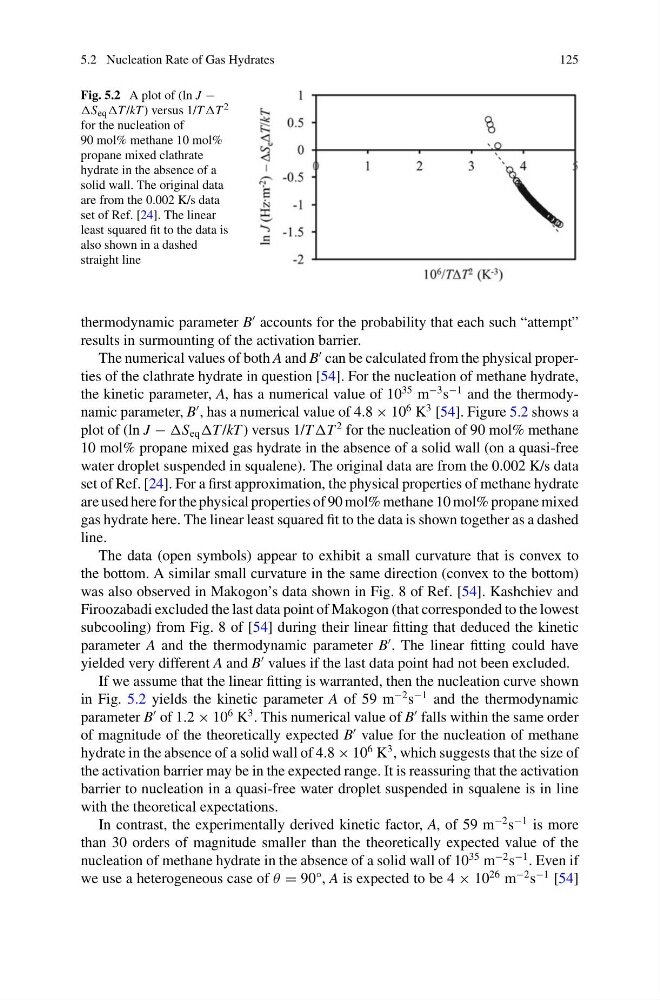
Fig. 5.2 A plot of (ln J −
S eq T /kT ) versus 1/T T 2
for the nucleation of
90 mol% methane 10 mol%
propane mixed clathrate
hydrate in the absence of a
solid wall. The original data
are from the 0.002 K/s data
set of Ref. [24]. The linear
least squared fit to the data is
also shown in a dashed
straight line
thermodynamic parameter B
accounts for the probability that each such “attempt”
results in surmounting of the activation barrier.
The numerical values of both A and B
can be calculated from the physical properties of the clathrate hydrate in question [54]. For the nucleation of methane hydrate,
the kinetic parameter, A, has a numerical value of 10
35 m
−3 s
−1 and the thermodynamic parameter, B
, has a numerical value of 4.8 × 10
6 K
3 [54]. Figure 5.2 shows a
plot of (ln J − S eq T /kT ) versus 1/T T
2 for the nucleation of 90 mol% methane
10 mol% propane mixed gas hydrate in the absence of a solid wall (on a quasi-free
water droplet suspended in squalene). The original data are from the 0.002 K/s data
set of Ref. [24]. For a first approximation, the physical properties of methane hydrate
are used here for the physical properties of 90 mol% methane 10 mol% propane mixed
gas hydrate here. The linear least squared fit to the data is shown together as a dashed
line.
The data (open symbols) appear to exhibit a small curvature that is convex to
the bottom. A similar small curvature in the same direction (convex to the bottom)
was also observed in Makogon’s data shown in Fig. 8 of Ref. [54]. Kashchiev and
Firoozabadi excluded the last data point of Makogon (that corresponded to the lowest
subcooling) from Fig. 8 of [54] during their linear fitting that deduced the kinetic
parameter A and the thermodynamic parameter B
. The linear fitting could have
yielded very different A and B
values if the last data point had not been excluded.
If we assume that the linear fitting is warranted, then the nucleation curve shown
in Fig. 5.2 yields the kinetic parameter A of 59 m
−2 s
−1 and the thermodynamic
parameter B
of 1.2 × 10
6 K
3 . This numerical value of B
falls within the same order
of magnitude of the theoretically expected B
value for the nucleation of methane
hydrate in the absence of a solid wall of 4.8 × 10
6 K
3 , which suggests that the size of
the activation barrier may be in the expected range. It is reassuring that the activation
barrier to nucleation in a quasi-free water droplet suspended in squalene is in line
with the theoretical expectations.
In contrast, the experimentally derived kinetic factor, A, of 59 m
−2 s
−1 is more
than 30 orders of magnitude smaller than the theoretically expected value of the
nucleation of methane hydrate in the absence of a solid wall of 10
35 m
−2 s
−1 . Even if
we use a heterogeneous case of θ = 90°, A is expected to be 4 × 10
26 m
−2 s
−1 [54]
125
Fig. 5.2 A plot of (ln J −
S eq T /kT ) versus 1/T T 2
for the nucleation of
90 mol% methane 10 mol%
propane mixed clathrate
hydrate in the absence of a
solid wall. The original data
are from the 0.002 K/s data
set of Ref. [24]. The linear
least squared fit to the data is
also shown in a dashed
straight line
thermodynamic parameter B
accounts for the probability that each such “attempt”
results in surmounting of the activation barrier.
The numerical values of both A and B
can be calculated from the physical properties of the clathrate hydrate in question [54]. For the nucleation of methane hydrate,
the kinetic parameter, A, has a numerical value of 10
35 m
−3 s
−1 and the thermodynamic parameter, B
, has a numerical value of 4.8 × 10
6 K
3 [54]. Figure 5.2 shows a
plot of (ln J − S eq T /kT ) versus 1/T T
2 for the nucleation of 90 mol% methane
10 mol% propane mixed gas hydrate in the absence of a solid wall (on a quasi-free
water droplet suspended in squalene). The original data are from the 0.002 K/s data
set of Ref. [24]. For a first approximation, the physical properties of methane hydrate
are used here for the physical properties of 90 mol% methane 10 mol% propane mixed
gas hydrate here. The linear least squared fit to the data is shown together as a dashed
line.
The data (open symbols) appear to exhibit a small curvature that is convex to
the bottom. A similar small curvature in the same direction (convex to the bottom)
was also observed in Makogon’s data shown in Fig. 8 of Ref. [54]. Kashchiev and
Firoozabadi excluded the last data point of Makogon (that corresponded to the lowest
subcooling) from Fig. 8 of [54] during their linear fitting that deduced the kinetic
parameter A and the thermodynamic parameter B
. The linear fitting could have
yielded very different A and B
values if the last data point had not been excluded.
If we assume that the linear fitting is warranted, then the nucleation curve shown
in Fig. 5.2 yields the kinetic parameter A of 59 m
−2 s
−1 and the thermodynamic
parameter B
of 1.2 × 10
6 K
3 . This numerical value of B
falls within the same order
of magnitude of the theoretically expected B
value for the nucleation of methane
hydrate in the absence of a solid wall of 4.8 × 10
6 K
3 , which suggests that the size of
the activation barrier may be in the expected range. It is reassuring that the activation
barrier to nucleation in a quasi-free water droplet suspended in squalene is in line
with the theoretical expectations.
In contrast, the experimentally derived kinetic factor, A, of 59 m
−2 s
−1 is more
than 30 orders of magnitude smaller than the theoretically expected value of the
nucleation of methane hydrate in the absence of a solid wall of 10
35 m
−2 s
−1 . Even if
we use a heterogeneous case of θ = 90°, A is expected to be 4 × 10
26 m
−2 s
−1 [54]