

124
5 Nucleation of Gas Hydrates
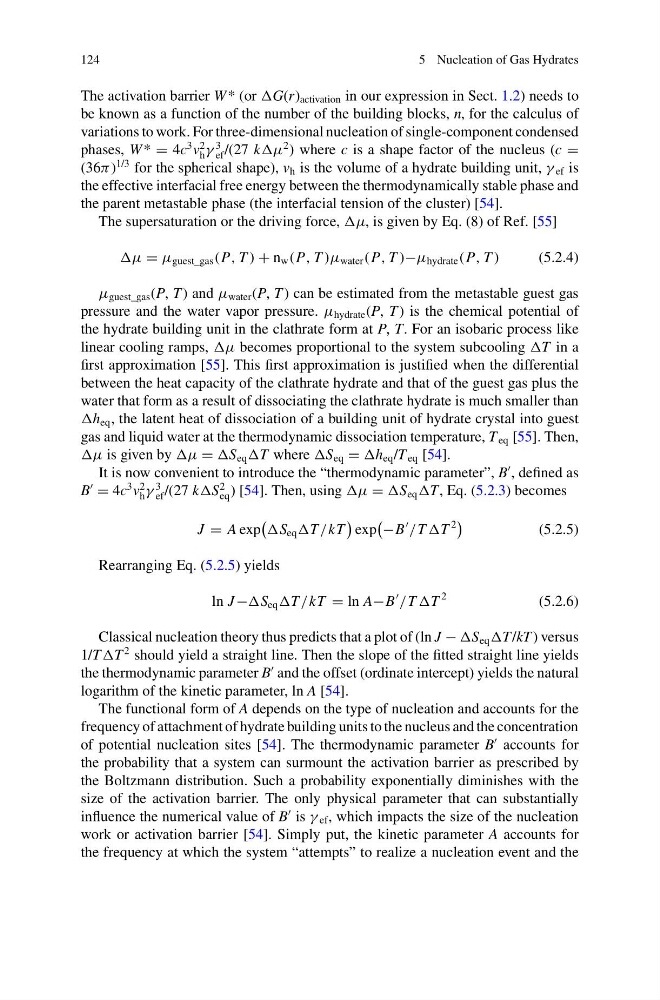
The activation barrier W * (or G(r) activation in our expression in Sect. 1.2) needs to
be known as a function of the number of the building blocks, n, for the calculus of
variations to work. For three-dimensional nucleation of single-component condensed
phases, W * = 4c
3 v
2
h γ
3
ef /(27 kμ
2 ) where c is a shape factor of the nucleus (c =
(36π )
1/3 for the spherical shape), v h is the volume of a hydrate building unit, γ ef is
the effective interfacial free energy between the thermodynamically stable phase and
the parent metastable phase (the interfacial tension of the cluster) [54].
The supersaturation or the driving force, μ, is given by Eq. (8) of Ref. [55]
μ = μ guest_gas (P, T ) + n w (P, T )μ water (P, T )−μ hydrate (P, T )
(5.2.4)
μ guest_gas (P, T ) and μ water (P, T ) can be estimated from the metastable guest gas
pressure and the water vapor pressure. μ hydrate (P, T ) is the chemical potential of
the hydrate building unit in the clathrate form at P, T. For an isobaric process like
linear cooling ramps, μ becomes proportional to the system subcooling T in a
first approximation [55]. This first approximation is justified when the differential
between the heat capacity of the clathrate hydrate and that of the guest gas plus the
water that form as a result of dissociating the clathrate hydrate is much smaller than
h eq , the latent heat of dissociation of a building unit of hydrate crystal into guest
gas and liquid water at the thermodynamic dissociation temperature, T eq [55]. Then,
μ is given by μ = S eq T where S eq = h eq /T eq [54].
It is now convenient to introduce the “thermodynamic parameter”, B
, defined as
B
= 4c
3 v
2
h γ
3
ef /(27 kS
2
eq ) [54]. Then, using μ = S eq T, Eq. (5.2.3) becomes
J = A exp
S eq T /kT
exp
−B
/T T
2
(5.2.5)
Rearranging Eq. (5.2.5) yields
ln J −S eq T /kT = ln A−B
/T T
2
(5.2.6)
Classical nucleation theory thus predicts that a plot of (ln J − S eq T /kT ) versus
1/T T
2 should yield a straight line. Then the slope of the fitted straight line yields
the thermodynamic parameter B
and the offset (ordinate intercept) yields the natural
logarithm of the kinetic parameter, ln A [54].
The functional form of A depends on the type of nucleation and accounts for the
frequency of attachment of hydrate building units to the nucleus and the concentration
of potential nucleation sites [54]. The thermodynamic parameter B
accounts for
the probability that a system can surmount the activation barrier as prescribed by
the Boltzmann distribution. Such a probability exponentially diminishes with the
size of the activation barrier. The only physical parameter that can substantially
influence the numerical value of B
is γ ef , which impacts the size of the nucleation
work or activation barrier [54]. Simply put, the kinetic parameter A accounts for
the frequency at which the system “attempts” to realize a nucleation event and the
5 Nucleation of Gas Hydrates
The activation barrier W * (or G(r) activation in our expression in Sect. 1.2) needs to
be known as a function of the number of the building blocks, n, for the calculus of
variations to work. For three-dimensional nucleation of single-component condensed
phases, W * = 4c
3 v
2
h γ
3
ef /(27 kμ
2 ) where c is a shape factor of the nucleus (c =
(36π )
1/3 for the spherical shape), v h is the volume of a hydrate building unit, γ ef is
the effective interfacial free energy between the thermodynamically stable phase and
the parent metastable phase (the interfacial tension of the cluster) [54].
The supersaturation or the driving force, μ, is given by Eq. (8) of Ref. [55]
μ = μ guest_gas (P, T ) + n w (P, T )μ water (P, T )−μ hydrate (P, T )
(5.2.4)
μ guest_gas (P, T ) and μ water (P, T ) can be estimated from the metastable guest gas
pressure and the water vapor pressure. μ hydrate (P, T ) is the chemical potential of
the hydrate building unit in the clathrate form at P, T. For an isobaric process like
linear cooling ramps, μ becomes proportional to the system subcooling T in a
first approximation [55]. This first approximation is justified when the differential
between the heat capacity of the clathrate hydrate and that of the guest gas plus the
water that form as a result of dissociating the clathrate hydrate is much smaller than
h eq , the latent heat of dissociation of a building unit of hydrate crystal into guest
gas and liquid water at the thermodynamic dissociation temperature, T eq [55]. Then,
μ is given by μ = S eq T where S eq = h eq /T eq [54].
It is now convenient to introduce the “thermodynamic parameter”, B
, defined as
B
= 4c
3 v
2
h γ
3
ef /(27 kS
2
eq ) [54]. Then, using μ = S eq T, Eq. (5.2.3) becomes
J = A exp
S eq T /kT
exp
−B
/T T
2
(5.2.5)
Rearranging Eq. (5.2.5) yields
ln J −S eq T /kT = ln A−B
/T T
2
(5.2.6)
Classical nucleation theory thus predicts that a plot of (ln J − S eq T /kT ) versus
1/T T
2 should yield a straight line. Then the slope of the fitted straight line yields
the thermodynamic parameter B
and the offset (ordinate intercept) yields the natural
logarithm of the kinetic parameter, ln A [54].
The functional form of A depends on the type of nucleation and accounts for the
frequency of attachment of hydrate building units to the nucleus and the concentration
of potential nucleation sites [54]. The thermodynamic parameter B
accounts for
the probability that a system can surmount the activation barrier as prescribed by
the Boltzmann distribution. Such a probability exponentially diminishes with the
size of the activation barrier. The only physical parameter that can substantially
influence the numerical value of B
is γ ef , which impacts the size of the nucleation
work or activation barrier [54]. Simply put, the kinetic parameter A accounts for
the frequency at which the system “attempts” to realize a nucleation event and the