

118
5 Nucleation of Gas Hydrates
wall immersed in liquid water), as detailed in Sect. 5.1 [1]. Similar features also
likely apply to clathrate hydrates.
The traditional wisdom has been that a suitable measure of the system size for
homogeneous nucleation is the system volume because the number of potential nucleation sites is expected to be proportional to the system volume. Likewise, it has been
considered that a suitable measure of the system size for heterogeneous nucleation is
the area of a surface or an interface that is responsible for the heterogeneous nucleation [18]. The activation barriers of these two cases are then related through the
effective interfacial free energy between the thermodynamically stable phase and the
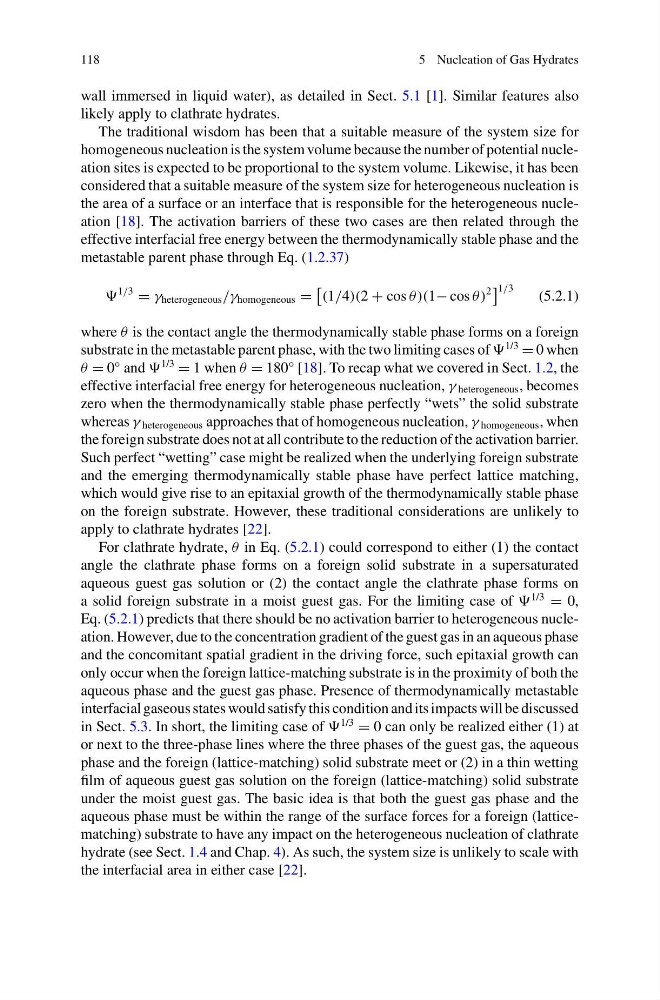
metastable parent phase through Eq. (1.2.37)
1/3
= γ heterogeneous /γ homogeneous =
(1/4)(2 + cos θ )(1− cos θ )
2
1/3
(5.2.1)
where θ is the contact angle the thermodynamically stable phase forms on a foreign
substrate in the metastable parent phase, with the two limiting cases of
1/3
= 0 when
θ = 0° and
1/3
= 1 when θ = 180° [18]. To recap what we covered in Sect. 1.2, the
effective interfacial free energy for heterogeneous nucleation, γ heterogeneous , becomes
zero when the thermodynamically stable phase perfectly “wets” the solid substrate
whereas γ heterogeneous approaches that of homogeneous nucleation, γ homogeneous , when
the foreign substrate does not at all contribute to the reduction of the activation barrier.
Such perfect “wetting” case might be realized when the underlying foreign substrate
and the emerging thermodynamically stable phase have perfect lattice matching,
which would give rise to an epitaxial growth of the thermodynamically stable phase
on the foreign substrate. However, these traditional considerations are unlikely to
apply to clathrate hydrates [22].
For clathrate hydrate, θ in Eq. (5.2.1) could correspond to either (1) the contact
angle the clathrate phase forms on a foreign solid substrate in a supersaturated
aqueous guest gas solution or (2) the contact angle the clathrate phase forms on
a solid foreign substrate in a moist guest gas. For the limiting case of
1/3
= 0,
Eq. (5.2.1) predicts that there should be no activation barrier to heterogeneous nucleation. However, due to the concentration gradient of the guest gas in an aqueous phase
and the concomitant spatial gradient in the driving force, such epitaxial growth can
only occur when the foreign lattice-matching substrate is in the proximity of both the
aqueous phase and the guest gas phase. Presence of thermodynamically metastable
interfacial gaseous states would satisfy this condition and its impacts will be discussed
in Sect. 5.3. In short, the limiting case of
1/3
= 0 can only be realized either (1) at
or next to the three-phase lines where the three phases of the guest gas, the aqueous
phase and the foreign (lattice-matching) solid substrate meet or (2) in a thin wetting
film of aqueous guest gas solution on the foreign (lattice-matching) solid substrate
under the moist guest gas. The basic idea is that both the guest gas phase and the
aqueous phase must be within the range of the surface forces for a foreign (latticematching) substrate to have any impact on the heterogeneous nucleation of clathrate
hydrate (see Sect. 1.4 and Chap. 4). As such, the system size is unlikely to scale with
the interfacial area in either case [22].
5 Nucleation of Gas Hydrates
wall immersed in liquid water), as detailed in Sect. 5.1 [1]. Similar features also
likely apply to clathrate hydrates.
The traditional wisdom has been that a suitable measure of the system size for
homogeneous nucleation is the system volume because the number of potential nucleation sites is expected to be proportional to the system volume. Likewise, it has been
considered that a suitable measure of the system size for heterogeneous nucleation is
the area of a surface or an interface that is responsible for the heterogeneous nucleation [18]. The activation barriers of these two cases are then related through the
effective interfacial free energy between the thermodynamically stable phase and the
metastable parent phase through Eq. (1.2.37)
1/3
= γ heterogeneous /γ homogeneous =
(1/4)(2 + cos θ )(1− cos θ )
2
1/3
(5.2.1)
where θ is the contact angle the thermodynamically stable phase forms on a foreign
substrate in the metastable parent phase, with the two limiting cases of
1/3
= 0 when
θ = 0° and
1/3
= 1 when θ = 180° [18]. To recap what we covered in Sect. 1.2, the
effective interfacial free energy for heterogeneous nucleation, γ heterogeneous , becomes
zero when the thermodynamically stable phase perfectly “wets” the solid substrate
whereas γ heterogeneous approaches that of homogeneous nucleation, γ homogeneous , when
the foreign substrate does not at all contribute to the reduction of the activation barrier.
Such perfect “wetting” case might be realized when the underlying foreign substrate
and the emerging thermodynamically stable phase have perfect lattice matching,
which would give rise to an epitaxial growth of the thermodynamically stable phase
on the foreign substrate. However, these traditional considerations are unlikely to
apply to clathrate hydrates [22].
For clathrate hydrate, θ in Eq. (5.2.1) could correspond to either (1) the contact
angle the clathrate phase forms on a foreign solid substrate in a supersaturated
aqueous guest gas solution or (2) the contact angle the clathrate phase forms on
a solid foreign substrate in a moist guest gas. For the limiting case of
1/3
= 0,
Eq. (5.2.1) predicts that there should be no activation barrier to heterogeneous nucleation. However, due to the concentration gradient of the guest gas in an aqueous phase
and the concomitant spatial gradient in the driving force, such epitaxial growth can
only occur when the foreign lattice-matching substrate is in the proximity of both the
aqueous phase and the guest gas phase. Presence of thermodynamically metastable
interfacial gaseous states would satisfy this condition and its impacts will be discussed
in Sect. 5.3. In short, the limiting case of
1/3
= 0 can only be realized either (1) at
or next to the three-phase lines where the three phases of the guest gas, the aqueous
phase and the foreign (lattice-matching) solid substrate meet or (2) in a thin wetting
film of aqueous guest gas solution on the foreign (lattice-matching) solid substrate
under the moist guest gas. The basic idea is that both the guest gas phase and the
aqueous phase must be within the range of the surface forces for a foreign (latticematching) substrate to have any impact on the heterogeneous nucleation of clathrate
hydrate (see Sect. 1.4 and Chap. 4). As such, the system size is unlikely to scale with
the interfacial area in either case [22].