

2
1 Nucleation Theory
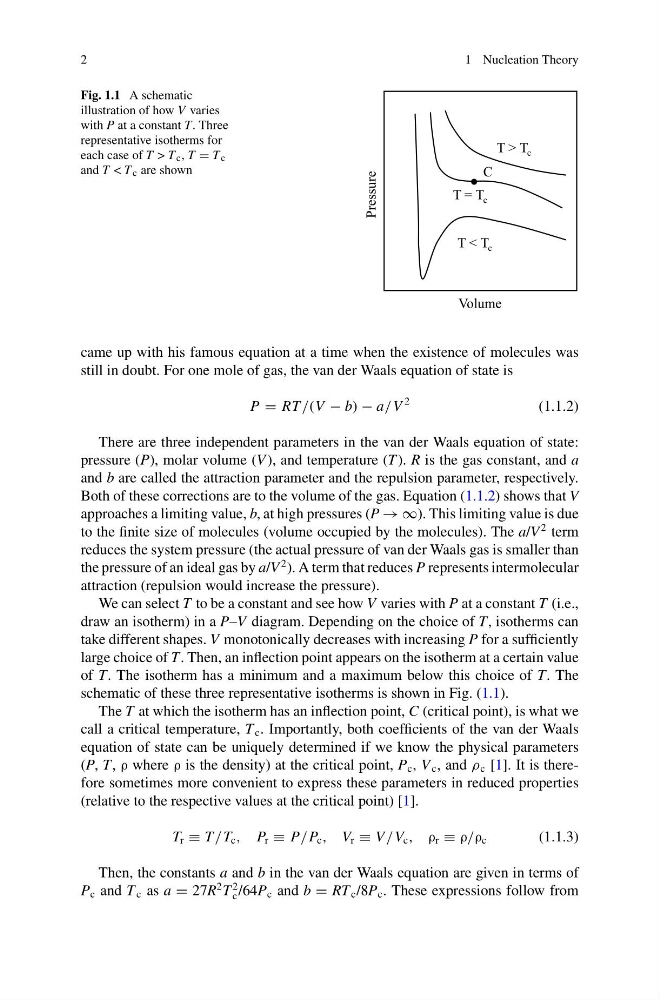
Fig. 1.1 A schematic
illustration of how V varies
with P at a constant T. Three
representative isotherms for
each case of T > T c , T = T c
and T < T c are shown
T = T c
Pressure
T > T c
T < T c
Volume
C
came up with his famous equation at a time when the existence of molecules was
still in doubt. For one mole of gas, the van der Waals equation of state is
P = RT /(V − b) − a/V
2
(1.1.2)
There are three independent parameters in the van der Waals equation of state:
pressure (P), molar volume (V ), and temperature (T ). R is the gas constant, and a
and b are called the attraction parameter and the repulsion parameter, respectively.
Both of these corrections are to the volume of the gas. Equation (1.1.2) shows that V
approaches a limiting value, b, at high pressures (P → ∞). This limiting value is due
to the finite size of molecules (volume occupied by the molecules). The a/V
2 term
reduces the system pressure (the actual pressure of van der Waals gas is smaller than
the pressure of an ideal gas by a/V
2 ). A term that reduces P represents intermolecular
attraction (repulsion would increase the pressure).
We can select T to be a constant and see how V varies with P at a constant T (i.e.,
draw an isotherm) in a P–V diagram. Depending on the choice of T, isotherms can
take different shapes. V monotonically decreases with increasing P for a sufficiently
large choice of T. Then, an inflection point appears on the isotherm at a certain value
of T. The isotherm has a minimum and a maximum below this choice of T. The
schematic of these three representative isotherms is shown in Fig. (1.1).
The T at which the isotherm has an inflection point, C (critical point), is what we
call a critical temperature, T c . Importantly, both coefficients of the van der Waals
equation of state can be uniquely determined if we know the physical parameters
(P, T, ρ where ρ is the density) at the critical point, P c , V c , and ρ c [1]. It is therefore sometimes more convenient to express these parameters in reduced properties
(relative to the respective values at the critical point) [1].
T r ≡ T /T c , P r ≡ P/P c , V r ≡ V /V c , ρ r ≡ ρ/ρ c
(1.1.3)
Then, the constants a and b in the van der Waals equation are given in terms of
P c and T c as a = 27R
2 T
2
c /64P c and b = RT c /8P c . These expressions follow from
1 Nucleation Theory
Fig. 1.1 A schematic
illustration of how V varies
with P at a constant T. Three
representative isotherms for
each case of T > T c , T = T c
and T < T c are shown
T = T c
Pressure
T > T c
T < T c
Volume
C
came up with his famous equation at a time when the existence of molecules was
still in doubt. For one mole of gas, the van der Waals equation of state is
P = RT /(V − b) − a/V
2
(1.1.2)
There are three independent parameters in the van der Waals equation of state:
pressure (P), molar volume (V ), and temperature (T ). R is the gas constant, and a
and b are called the attraction parameter and the repulsion parameter, respectively.
Both of these corrections are to the volume of the gas. Equation (1.1.2) shows that V
approaches a limiting value, b, at high pressures (P → ∞). This limiting value is due
to the finite size of molecules (volume occupied by the molecules). The a/V
2 term
reduces the system pressure (the actual pressure of van der Waals gas is smaller than
the pressure of an ideal gas by a/V
2 ). A term that reduces P represents intermolecular
attraction (repulsion would increase the pressure).
We can select T to be a constant and see how V varies with P at a constant T (i.e.,
draw an isotherm) in a P–V diagram. Depending on the choice of T, isotherms can
take different shapes. V monotonically decreases with increasing P for a sufficiently
large choice of T. Then, an inflection point appears on the isotherm at a certain value
of T. The isotherm has a minimum and a maximum below this choice of T. The
schematic of these three representative isotherms is shown in Fig. (1.1).
The T at which the isotherm has an inflection point, C (critical point), is what we
call a critical temperature, T c . Importantly, both coefficients of the van der Waals
equation of state can be uniquely determined if we know the physical parameters
(P, T, ρ where ρ is the density) at the critical point, P c , V c , and ρ c [1]. It is therefore sometimes more convenient to express these parameters in reduced properties
(relative to the respective values at the critical point) [1].
T r ≡ T /T c , P r ≡ P/P c , V r ≡ V /V c , ρ r ≡ ρ/ρ c
(1.1.3)
Then, the constants a and b in the van der Waals equation are given in terms of
P c and T c as a = 27R
2 T
2
c /64P c and b = RT c /8P c . These expressions follow from