

106
4 Interfacial Gaseous States
Up until now, we relied on the approximation that the specific interfacial free
energy of either side of a thin film may be adequately approximated by the specific
interfacial free energy of two corresponding semi-infinite media. This approximation
corresponds to neglecting the disjoining pressure of the thin film. However, there may
be another factor that can come into play that may act in the opposite direction, which
is the effect of surface forces on quasi-liquid layers that have not been considered in
the literature. The relevant physical property here is the disjoining pressure, Π (h),
we introduced in Sect. 4.1. Using Eq. (4.1.1), G(h) per unit area in Eq. (4.3.2)
becomes
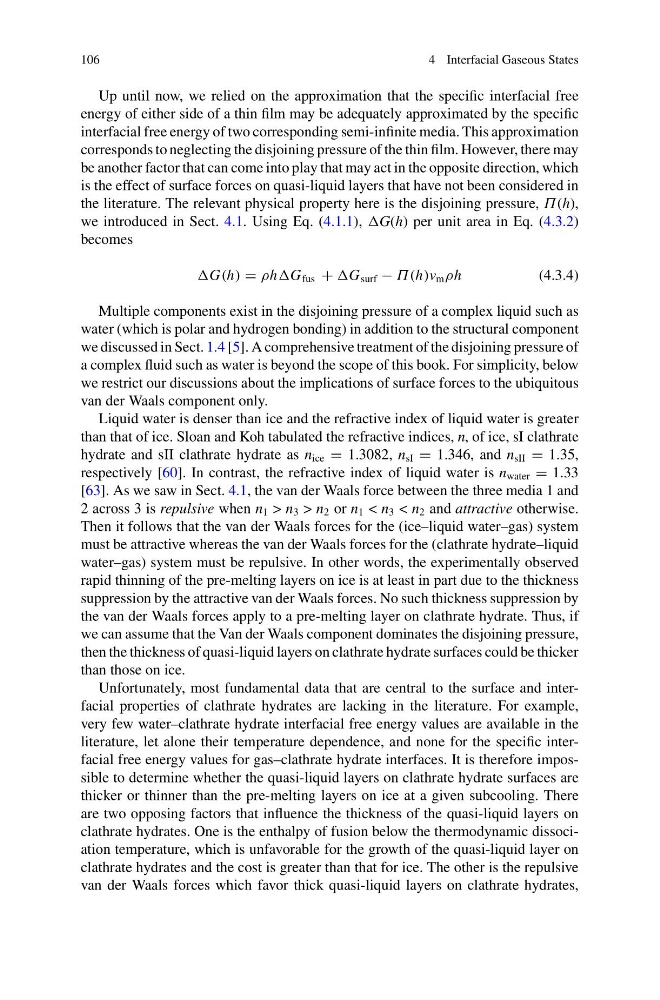
G(h) = ρhG fus + G surf − Π(h)v m ρh
(4.3.4)
Multiple components exist in the disjoining pressure of a complex liquid such as
water (which is polar and hydrogen bonding) in addition to the structural component
we discussed in Sect. 1.4 [5]. A comprehensive treatment of the disjoining pressure of
a complex fluid such as water is beyond the scope of this book. For simplicity, below
we restrict our discussions about the implications of surface forces to the ubiquitous
van der Waals component only.
Liquid water is denser than ice and the refractive index of liquid water is greater
than that of ice. Sloan and Koh tabulated the refractive indices, n, of ice, sI clathrate
hydrate and sII clathrate hydrate as n ice = 1.3082, n sI = 1.346, and n sII = 1.35,
respectively [60]. In contrast, the refractive index of liquid water is n water = 1.33
[63]. As we saw in Sect. 4.1, the van der Waals force between the three media 1 and
2 across 3 is repulsive when n 1 > n 3 > n 2 or n 1 < n 3 < n 2 and attractive otherwise.
Then it follows that the van der Waals forces for the (ice–liquid water–gas) system
must be attractive whereas the van der Waals forces for the (clathrate hydrate–liquid
water–gas) system must be repulsive. In other words, the experimentally observed
rapid thinning of the pre-melting layers on ice is at least in part due to the thickness
suppression by the attractive van der Waals forces. No such thickness suppression by
the van der Waals forces apply to a pre-melting layer on clathrate hydrate. Thus, if
we can assume that the Van der Waals component dominates the disjoining pressure,
then the thickness of quasi-liquid layers on clathrate hydrate surfaces could be thicker
than those on ice.
Unfortunately, most fundamental data that are central to the surface and interfacial properties of clathrate hydrates are lacking in the literature. For example,
very few water–clathrate hydrate interfacial free energy values are available in the
literature, let alone their temperature dependence, and none for the specific interfacial free energy values for gas–clathrate hydrate interfaces. It is therefore impossible to determine whether the quasi-liquid layers on clathrate hydrate surfaces are
thicker or thinner than the pre-melting layers on ice at a given subcooling. There
are two opposing factors that influence the thickness of the quasi-liquid layers on
clathrate hydrates. One is the enthalpy of fusion below the thermodynamic dissociation temperature, which is unfavorable for the growth of the quasi-liquid layer on
clathrate hydrates and the cost is greater than that for ice. The other is the repulsive
van der Waals forces which favor thick quasi-liquid layers on clathrate hydrates,
4 Interfacial Gaseous States
Up until now, we relied on the approximation that the specific interfacial free
energy of either side of a thin film may be adequately approximated by the specific
interfacial free energy of two corresponding semi-infinite media. This approximation
corresponds to neglecting the disjoining pressure of the thin film. However, there may
be another factor that can come into play that may act in the opposite direction, which
is the effect of surface forces on quasi-liquid layers that have not been considered in
the literature. The relevant physical property here is the disjoining pressure, Π (h),
we introduced in Sect. 4.1. Using Eq. (4.1.1), G(h) per unit area in Eq. (4.3.2)
becomes
G(h) = ρhG fus + G surf − Π(h)v m ρh
(4.3.4)
Multiple components exist in the disjoining pressure of a complex liquid such as
water (which is polar and hydrogen bonding) in addition to the structural component
we discussed in Sect. 1.4 [5]. A comprehensive treatment of the disjoining pressure of
a complex fluid such as water is beyond the scope of this book. For simplicity, below
we restrict our discussions about the implications of surface forces to the ubiquitous
van der Waals component only.
Liquid water is denser than ice and the refractive index of liquid water is greater
than that of ice. Sloan and Koh tabulated the refractive indices, n, of ice, sI clathrate
hydrate and sII clathrate hydrate as n ice = 1.3082, n sI = 1.346, and n sII = 1.35,
respectively [60]. In contrast, the refractive index of liquid water is n water = 1.33
[63]. As we saw in Sect. 4.1, the van der Waals force between the three media 1 and
2 across 3 is repulsive when n 1 > n 3 > n 2 or n 1 < n 3 < n 2 and attractive otherwise.
Then it follows that the van der Waals forces for the (ice–liquid water–gas) system
must be attractive whereas the van der Waals forces for the (clathrate hydrate–liquid
water–gas) system must be repulsive. In other words, the experimentally observed
rapid thinning of the pre-melting layers on ice is at least in part due to the thickness
suppression by the attractive van der Waals forces. No such thickness suppression by
the van der Waals forces apply to a pre-melting layer on clathrate hydrate. Thus, if
we can assume that the Van der Waals component dominates the disjoining pressure,
then the thickness of quasi-liquid layers on clathrate hydrate surfaces could be thicker
than those on ice.
Unfortunately, most fundamental data that are central to the surface and interfacial properties of clathrate hydrates are lacking in the literature. For example,
very few water–clathrate hydrate interfacial free energy values are available in the
literature, let alone their temperature dependence, and none for the specific interfacial free energy values for gas–clathrate hydrate interfaces. It is therefore impossible to determine whether the quasi-liquid layers on clathrate hydrate surfaces are
thicker or thinner than the pre-melting layers on ice at a given subcooling. There
are two opposing factors that influence the thickness of the quasi-liquid layers on
clathrate hydrates. One is the enthalpy of fusion below the thermodynamic dissociation temperature, which is unfavorable for the growth of the quasi-liquid layer on
clathrate hydrates and the cost is greater than that for ice. The other is the repulsive
van der Waals forces which favor thick quasi-liquid layers on clathrate hydrates,