

4.3 Is the Surface of Gas Hydrates Dry?
105
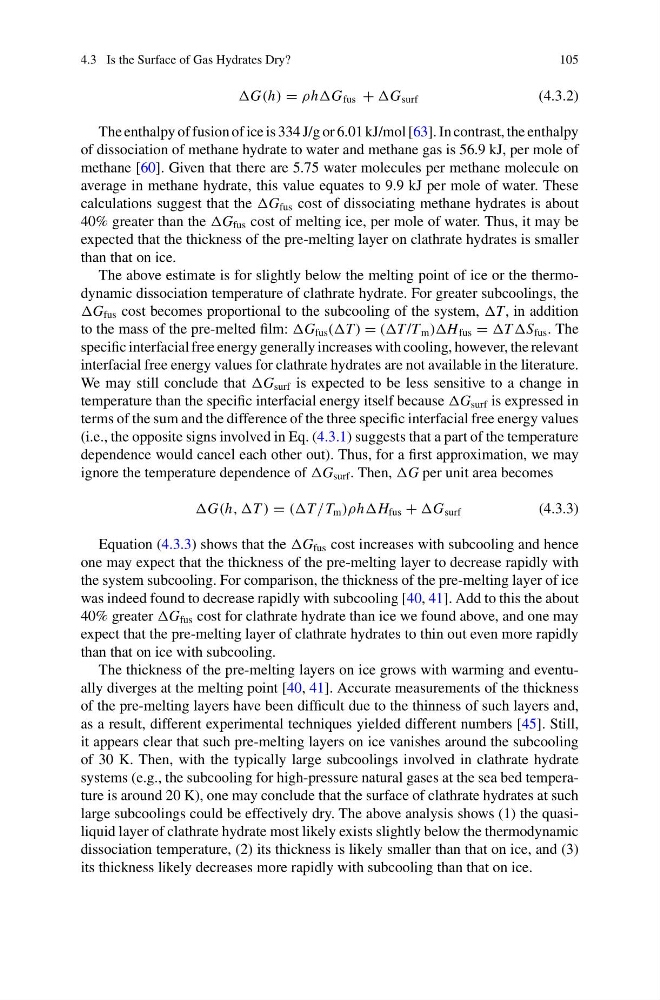
G(h) = ρhG fus + G surf
(4.3.2)
The enthalpy of fusion of ice is 334 J/g or 6.01 kJ/mol [63]. In contrast, the enthalpy
of dissociation of methane hydrate to water and methane gas is 56.9 kJ, per mole of
methane [60]. Given that there are 5.75 water molecules per methane molecule on
average in methane hydrate, this value equates to 9.9 kJ per mole of water. These
calculations suggest that the G fus cost of dissociating methane hydrates is about
40% greater than the G fus cost of melting ice, per mole of water. Thus, it may be
expected that the thickness of the pre-melting layer on clathrate hydrates is smaller
than that on ice.
The above estimate is for slightly below the melting point of ice or the thermodynamic dissociation temperature of clathrate hydrate. For greater subcoolings, the
G fus cost becomes proportional to the subcooling of the system, T, in addition
to the mass of the pre-melted film: G fus (T ) = (T /T m )H fus = T S fus . The
specific interfacial free energy generally increases with cooling, however, the relevant
interfacial free energy values for clathrate hydrates are not available in the literature.
We may still conclude that G surf is expected to be less sensitive to a change in
temperature than the specific interfacial energy itself because G surf is expressed in
terms of the sum and the difference of the three specific interfacial free energy values
(i.e., the opposite signs involved in Eq. (4.3.1) suggests that a part of the temperature
dependence would cancel each other out). Thus, for a first approximation, we may
ignore the temperature dependence of G surf . Then, G per unit area becomes
G(h, ,T ) = (T /T m )ρhH fus + G surf
(4.3.3)
Equation (4.3.3) shows that the G fus cost increases with subcooling and hence
one may expect that the thickness of the pre-melting layer to decrease rapidly with
the system subcooling. For comparison, the thickness of the pre-melting layer of ice
was indeed found to decrease rapidly with subcooling [40, 41]. Add to this the about
40% greater G fus cost for clathrate hydrate than ice we found above, and one may
expect that the pre-melting layer of clathrate hydrates to thin out even more rapidly
than that on ice with subcooling.
The thickness of the pre-melting layers on ice grows with warming and eventually diverges at the melting point [40, 41]. Accurate measurements of the thickness
of the pre-melting layers have been difficult due to the thinness of such layers and,
as a result, different experimental techniques yielded different numbers [45]. Still,
it appears clear that such pre-melting layers on ice vanishes around the subcooling
of 30 K. Then, with the typically large subcoolings involved in clathrate hydrate
systems (e.g., the subcooling for high-pressure natural gases at the sea bed temperature is around 20 K), one may conclude that the surface of clathrate hydrates at such
large subcoolings could be effectively dry. The above analysis shows (1) the quasiliquid layer of clathrate hydrate most likely exists slightly below the thermodynamic
dissociation temperature, (2) its thickness is likely smaller than that on ice, and (3)
its thickness likely decreases more rapidly with subcooling than that on ice.
105
G(h) = ρhG fus + G surf
(4.3.2)
The enthalpy of fusion of ice is 334 J/g or 6.01 kJ/mol [63]. In contrast, the enthalpy
of dissociation of methane hydrate to water and methane gas is 56.9 kJ, per mole of
methane [60]. Given that there are 5.75 water molecules per methane molecule on
average in methane hydrate, this value equates to 9.9 kJ per mole of water. These
calculations suggest that the G fus cost of dissociating methane hydrates is about
40% greater than the G fus cost of melting ice, per mole of water. Thus, it may be
expected that the thickness of the pre-melting layer on clathrate hydrates is smaller
than that on ice.
The above estimate is for slightly below the melting point of ice or the thermodynamic dissociation temperature of clathrate hydrate. For greater subcoolings, the
G fus cost becomes proportional to the subcooling of the system, T, in addition
to the mass of the pre-melted film: G fus (T ) = (T /T m )H fus = T S fus . The
specific interfacial free energy generally increases with cooling, however, the relevant
interfacial free energy values for clathrate hydrates are not available in the literature.
We may still conclude that G surf is expected to be less sensitive to a change in
temperature than the specific interfacial energy itself because G surf is expressed in
terms of the sum and the difference of the three specific interfacial free energy values
(i.e., the opposite signs involved in Eq. (4.3.1) suggests that a part of the temperature
dependence would cancel each other out). Thus, for a first approximation, we may
ignore the temperature dependence of G surf . Then, G per unit area becomes
G(h, ,T ) = (T /T m )ρhH fus + G surf
(4.3.3)
Equation (4.3.3) shows that the G fus cost increases with subcooling and hence
one may expect that the thickness of the pre-melting layer to decrease rapidly with
the system subcooling. For comparison, the thickness of the pre-melting layer of ice
was indeed found to decrease rapidly with subcooling [40, 41]. Add to this the about
40% greater G fus cost for clathrate hydrate than ice we found above, and one may
expect that the pre-melting layer of clathrate hydrates to thin out even more rapidly
than that on ice with subcooling.
The thickness of the pre-melting layers on ice grows with warming and eventually diverges at the melting point [40, 41]. Accurate measurements of the thickness
of the pre-melting layers have been difficult due to the thinness of such layers and,
as a result, different experimental techniques yielded different numbers [45]. Still,
it appears clear that such pre-melting layers on ice vanishes around the subcooling
of 30 K. Then, with the typically large subcoolings involved in clathrate hydrate
systems (e.g., the subcooling for high-pressure natural gases at the sea bed temperature is around 20 K), one may conclude that the surface of clathrate hydrates at such
large subcoolings could be effectively dry. The above analysis shows (1) the quasiliquid layer of clathrate hydrate most likely exists slightly below the thermodynamic
dissociation temperature, (2) its thickness is likely smaller than that on ice, and (3)
its thickness likely decreases more rapidly with subcooling than that on ice.