

2 Fundamentals of Friction Stir Welding, Its Application, and Advancements
47
around the threaded pin profile. The workpiece material within the rotational zone
causes the bulk of the vertical movement. Continuous vorticity developed due to the
forward and backward material movement along the threads of the tool. Material
entering this zone thus follows an incomplete helical path. The vorticity because
of the continuous rotational and the translational of the tool pin forms a helical
path [25, 26]. The material movement is influenced by the tool shoulder instead of
pin threads at the upper surface of the joint [27]. The contact between the material
moving in this upper zone and the lower thread cause difference in the degree of
material movement. This gradient is a dominating factor in weld formation [28].
In a threaded pin, the plasticized material rotates around the thread of the pin and
continues to move in a downward direction towards the bottom of the weld region.
The vertical downward motion results in a pile-up of the material per unit time
leading to an increase in transfer velocity. This results in more material transfer near
the bottom portion making material particles to attain a sufficient transfer height
towards the TMAZ. The plastically deformed material touching the pin undergoes
continuous pressure due to the extrusion process [24]. The material displacement
acts perpendicular to the thread surface of the pin. The above material flow patterns
ultimately end up in a bond formation [27].
2.2.2 Microstructural Zones in FSW
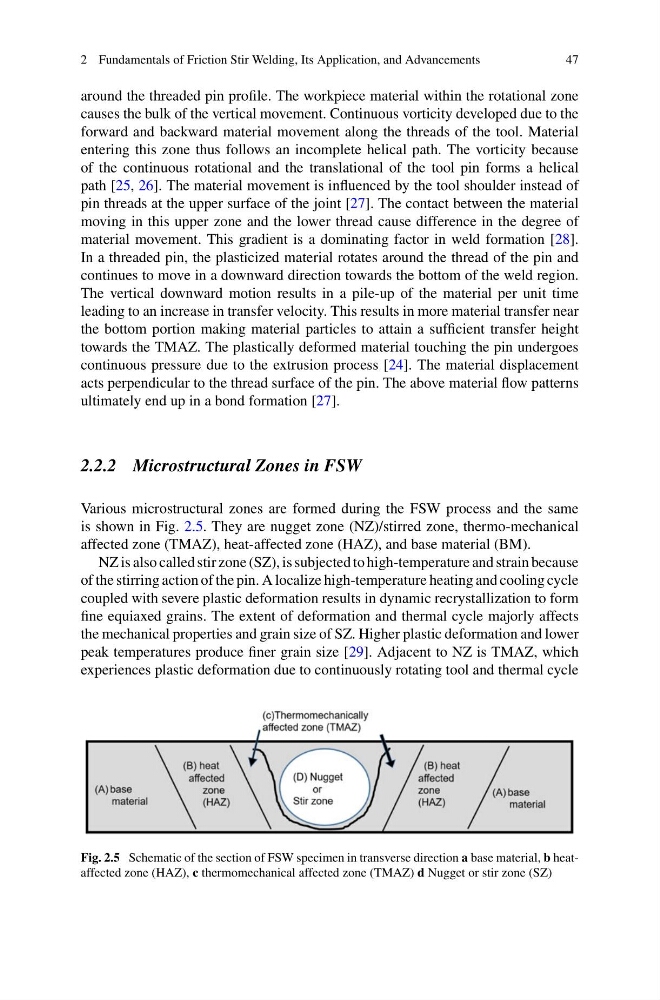
Various microstructural zones are formed during the FSW process and the same
is shown in Fig. 2.5. They are nugget zone (NZ)/stirred zone, thermo-mechanical
affected zone (TMAZ), heat-affected zone (HAZ), and base material (BM).
NZ is also called stir zone (SZ), is subjected to high-temperature and strain because
of the stirring action of the pin. A localize high-temperature heating and cooling cycle
coupled with severe plastic deformation results in dynamic recrystallization to form
fine equiaxed grains. The extent of deformation and thermal cycle majorly affects
the mechanical properties and grain size of SZ. Higher plastic deformation and lower
peak temperatures produce finer grain size [29]. Adjacent to NZ is TMAZ, which
experiences plastic deformation due to continuously rotating tool and thermal cycle
Fig. 2.5 Schematic of the section of FSW specimen in transverse direction a base material, b heataffected zone (HAZ), c thermomechanical affected zone (TMAZ) d Nugget or stir zone (SZ)
47
around the threaded pin profile. The workpiece material within the rotational zone
causes the bulk of the vertical movement. Continuous vorticity developed due to the
forward and backward material movement along the threads of the tool. Material
entering this zone thus follows an incomplete helical path. The vorticity because
of the continuous rotational and the translational of the tool pin forms a helical
path [25, 26]. The material movement is influenced by the tool shoulder instead of
pin threads at the upper surface of the joint [27]. The contact between the material
moving in this upper zone and the lower thread cause difference in the degree of
material movement. This gradient is a dominating factor in weld formation [28].
In a threaded pin, the plasticized material rotates around the thread of the pin and
continues to move in a downward direction towards the bottom of the weld region.
The vertical downward motion results in a pile-up of the material per unit time
leading to an increase in transfer velocity. This results in more material transfer near
the bottom portion making material particles to attain a sufficient transfer height
towards the TMAZ. The plastically deformed material touching the pin undergoes
continuous pressure due to the extrusion process [24]. The material displacement
acts perpendicular to the thread surface of the pin. The above material flow patterns
ultimately end up in a bond formation [27].
2.2.2 Microstructural Zones in FSW
Various microstructural zones are formed during the FSW process and the same
is shown in Fig. 2.5. They are nugget zone (NZ)/stirred zone, thermo-mechanical
affected zone (TMAZ), heat-affected zone (HAZ), and base material (BM).
NZ is also called stir zone (SZ), is subjected to high-temperature and strain because
of the stirring action of the pin. A localize high-temperature heating and cooling cycle
coupled with severe plastic deformation results in dynamic recrystallization to form
fine equiaxed grains. The extent of deformation and thermal cycle majorly affects
the mechanical properties and grain size of SZ. Higher plastic deformation and lower
peak temperatures produce finer grain size [29]. Adjacent to NZ is TMAZ, which
experiences plastic deformation due to continuously rotating tool and thermal cycle
Fig. 2.5 Schematic of the section of FSW specimen in transverse direction a base material, b heataffected zone (HAZ), c thermomechanical affected zone (TMAZ) d Nugget or stir zone (SZ)