

44
A. K. Choudhary and R. Jain
• Advancing side (AS): Side of the workpiece, where the direction of tool welding
and rotation speed is identical.
• Retreating side (RS): The other side of the workpiece, where the direction of
tool rotation and welding is the opposite. The differences in the relative velocity
on either side of the workpiece make the FSW process an asymmetric process.
This is the reason for higher plastic deformation and temperatures towards AS as
compared with RS.
• Leading-edge (LE) and trailing edge (TE): The front and back portion of the
tool is called LE and TE, respectively.
• Plunge depth: After plunging, it is the distance between the top surface of the
material and tool shoulder. It increases the contact area in more heat generation
on the workpiece. Plunge depth normally ranges between 0.05–0.5 mm.
• Tilt angle (β): Angle by which the tool is tilted towards the backside as shown
in Fig. 2.2. It is provided to increase the compressive force on the material and
reduces defect and flash formation. Its range is generally 0°–3°.
2.1.3 Stages of FSW
FSW is completed in three different stages. A detailed explanation of each stage is
explained below.
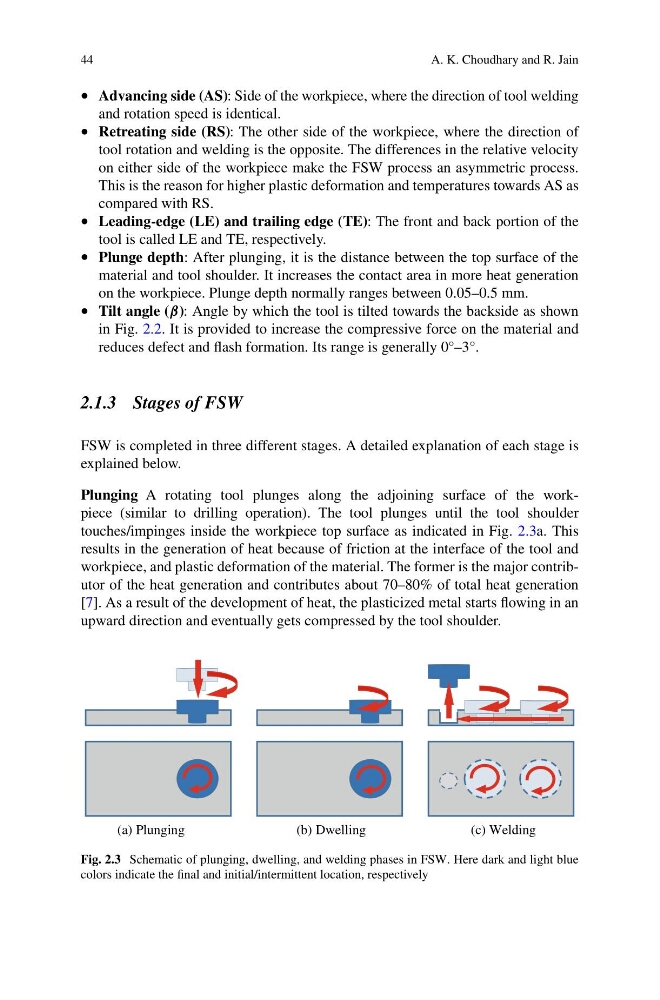
Plunging A rotating tool plunges along the adjoining surface of the workpiece (similar to drilling operation). The tool plunges until the tool shoulder
touches/impinges inside the workpiece top surface as indicated in Fig. 2.3a. This
results in the generation of heat because of friction at the interface of the tool and
workpiece, and plastic deformation of the material. The former is the major contributor of the heat generation and contributes about 70–80% of total heat generation
[7]. As a result of the development of heat, the plasticized metal starts flowing in an
upward direction and eventually gets compressed by the tool shoulder.
(a) Plunging
(b) Dwelling
(c) Welding
Fig. 2.3 Schematic of plunging, dwelling, and welding phases in FSW. Here dark and light blue
colors indicate the final and initial/intermittent location, respectively
A. K. Choudhary and R. Jain
• Advancing side (AS): Side of the workpiece, where the direction of tool welding
and rotation speed is identical.
• Retreating side (RS): The other side of the workpiece, where the direction of
tool rotation and welding is the opposite. The differences in the relative velocity
on either side of the workpiece make the FSW process an asymmetric process.
This is the reason for higher plastic deformation and temperatures towards AS as
compared with RS.
• Leading-edge (LE) and trailing edge (TE): The front and back portion of the
tool is called LE and TE, respectively.
• Plunge depth: After plunging, it is the distance between the top surface of the
material and tool shoulder. It increases the contact area in more heat generation
on the workpiece. Plunge depth normally ranges between 0.05–0.5 mm.
• Tilt angle (β): Angle by which the tool is tilted towards the backside as shown
in Fig. 2.2. It is provided to increase the compressive force on the material and
reduces defect and flash formation. Its range is generally 0°–3°.
2.1.3 Stages of FSW
FSW is completed in three different stages. A detailed explanation of each stage is
explained below.
Plunging A rotating tool plunges along the adjoining surface of the workpiece (similar to drilling operation). The tool plunges until the tool shoulder
touches/impinges inside the workpiece top surface as indicated in Fig. 2.3a. This
results in the generation of heat because of friction at the interface of the tool and
workpiece, and plastic deformation of the material. The former is the major contributor of the heat generation and contributes about 70–80% of total heat generation
[7]. As a result of the development of heat, the plasticized metal starts flowing in an
upward direction and eventually gets compressed by the tool shoulder.
(a) Plunging
(b) Dwelling
(c) Welding
Fig. 2.3 Schematic of plunging, dwelling, and welding phases in FSW. Here dark and light blue
colors indicate the final and initial/intermittent location, respectively