

42
A. K. Choudhary and R. Jain
2.1 FSW Introduction
2.1.1 History and Background
Human needs and aspirations are increasing and this has led to an increase in the
demand for fuel. Further, the growing population and human ambition of luxurious
life have made the use of the automobile, and air travel a necessity. These have
triggered research to explore the possibility of using material with a lower density
such as aluminum, magnesium, etc. for the manufacturing of components instead
of a high-density material such as steel to improve fuel efficiency. This will reduce
the mass of the component and improve fuel efficiency without compromising on
the quality of the product. Working with aluminum/magnesium and its alloy is
challenging, as its weldability is poor with conventional fusion welding methods
such as MIG, TIG, EBW and Laser welding, etc. [1]. Problems associated with fusion
welding of Al/Mg are high distortion and residual stress because of the expansion
and contraction of the material due to the thermal cycle. This phenomenon is more
severe in aluminum as the coefficient of thermal expansion is twice the steel and
thrice of titanium. Also, hydrogen entrapment in the molten pool is a serious issue
which reduces strength due to the formation of brittle hydrides. Besides Mg and its
alloy are highly flammable which restricts it from fusion welding.
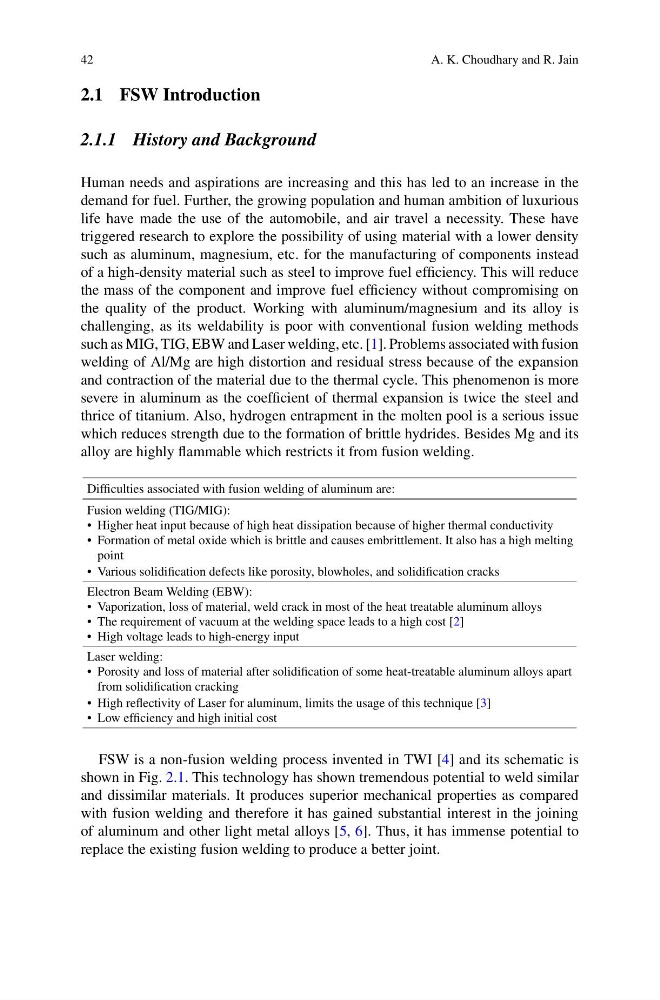
Difficulties associated with fusion welding of aluminum are:
Fusion welding (TIG/MIG):
• Higher heat input because of high heat dissipation because of higher thermal conductivity
• Formation of metal oxide which is brittle and causes embrittlement. It also has a high melting
point
• Various solidification defects like porosity, blowholes, and solidification cracks
Electron Beam Welding (EBW):
• Vaporization, loss of material, weld crack in most of the heat treatable aluminum alloys
• The requirement of vacuum at the welding space leads to a high cost [2]
• High voltage leads to high-energy input
Laser welding:
• Porosity and loss of material after solidification of some heat-treatable aluminum alloys apart
from solidification cracking
• High reflectivity of Laser for aluminum, limits the usage of this technique [3]
• Low efficiency and high initial cost
FSW is a non-fusion welding process invented in TWI [4] and its schematic is
shown in Fig. 2.1. This technology has shown tremendous potential to weld similar
and dissimilar materials. It produces superior mechanical properties as compared
with fusion welding and therefore it has gained substantial interest in the joining
of aluminum and other light metal alloys [5, 6]. Thus, it has immense potential to
replace the existing fusion welding to produce a better joint.
A. K. Choudhary and R. Jain
2.1 FSW Introduction
2.1.1 History and Background
Human needs and aspirations are increasing and this has led to an increase in the
demand for fuel. Further, the growing population and human ambition of luxurious
life have made the use of the automobile, and air travel a necessity. These have
triggered research to explore the possibility of using material with a lower density
such as aluminum, magnesium, etc. for the manufacturing of components instead
of a high-density material such as steel to improve fuel efficiency. This will reduce
the mass of the component and improve fuel efficiency without compromising on
the quality of the product. Working with aluminum/magnesium and its alloy is
challenging, as its weldability is poor with conventional fusion welding methods
such as MIG, TIG, EBW and Laser welding, etc. [1]. Problems associated with fusion
welding of Al/Mg are high distortion and residual stress because of the expansion
and contraction of the material due to the thermal cycle. This phenomenon is more
severe in aluminum as the coefficient of thermal expansion is twice the steel and
thrice of titanium. Also, hydrogen entrapment in the molten pool is a serious issue
which reduces strength due to the formation of brittle hydrides. Besides Mg and its
alloy are highly flammable which restricts it from fusion welding.
Difficulties associated with fusion welding of aluminum are:
Fusion welding (TIG/MIG):
• Higher heat input because of high heat dissipation because of higher thermal conductivity
• Formation of metal oxide which is brittle and causes embrittlement. It also has a high melting
point
• Various solidification defects like porosity, blowholes, and solidification cracks
Electron Beam Welding (EBW):
• Vaporization, loss of material, weld crack in most of the heat treatable aluminum alloys
• The requirement of vacuum at the welding space leads to a high cost [2]
• High voltage leads to high-energy input
Laser welding:
• Porosity and loss of material after solidification of some heat-treatable aluminum alloys apart
from solidification cracking
• High reflectivity of Laser for aluminum, limits the usage of this technique [3]
• Low efficiency and high initial cost
FSW is a non-fusion welding process invented in TWI [4] and its schematic is
shown in Fig. 2.1. This technology has shown tremendous potential to weld similar
and dissimilar materials. It produces superior mechanical properties as compared
with fusion welding and therefore it has gained substantial interest in the joining
of aluminum and other light metal alloys [5, 6]. Thus, it has immense potential to
replace the existing fusion welding to produce a better joint.