

408
S. Papaefthymiou
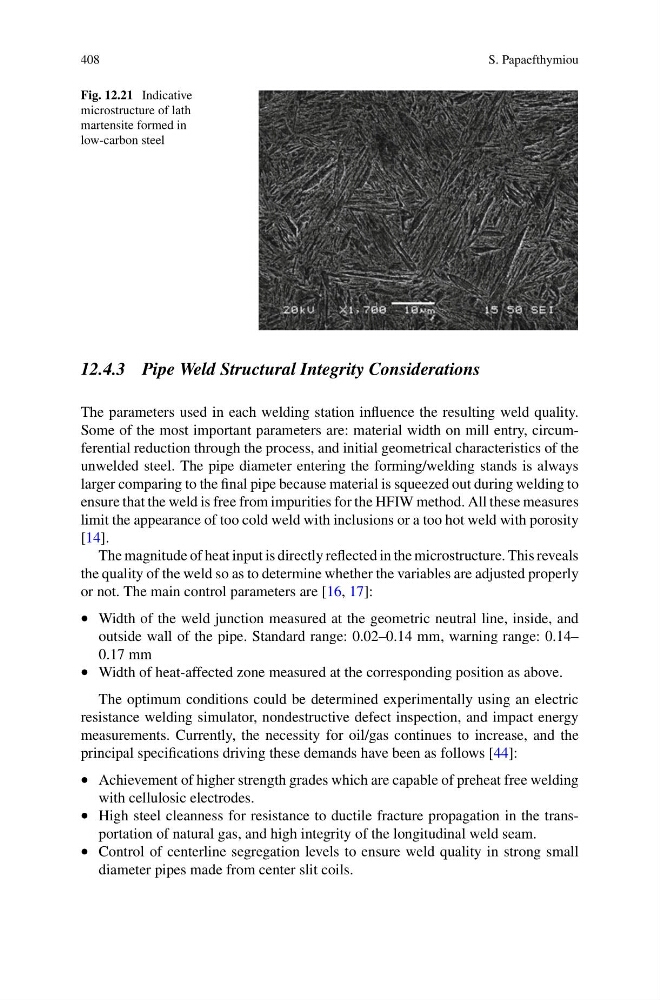
Fig. 12.21 Indicative
microstructure of lath
martensite formed in
low-carbon steel
12.4.3 Pipe Weld Structural Integrity Considerations
The parameters used in each welding station influence the resulting weld quality.
Some of the most important parameters are: material width on mill entry, circumferential reduction through the process, and initial geometrical characteristics of the
unwelded steel. The pipe diameter entering the forming/welding stands is always
larger comparing to the final pipe because material is squeezed out during welding to
ensure that the weld is free from impurities for the HFIW method. All these measures
limit the appearance of too cold weld with inclusions or a too hot weld with porosity
[14].
The magnitude of heat input is directly reflected in the microstructure. This reveals
the quality of the weld so as to determine whether the variables are adjusted properly
or not. The main control parameters are [16, 17]:
• Width of the weld junction measured at the geometric neutral line, inside, and
outside wall of the pipe. Standard range: 0.02–0.14 mm, warning range: 0.14–
0.17 mm
• Width of heat-affected zone measured at the corresponding position as above.
The optimum conditions could be determined experimentally using an electric
resistance welding simulator, nondestructive defect inspection, and impact energy
measurements. Currently, the necessity for oil/gas continues to increase, and the
principal specifications driving these demands have been as follows [44]:
• Achievement of higher strength grades which are capable of preheat free welding
with cellulosic electrodes.
• High steel cleanness for resistance to ductile fracture propagation in the transportation of natural gas, and high integrity of the longitudinal weld seam.
• Control of centerline segregation levels to ensure weld quality in strong small
diameter pipes made from center slit coils.
S. Papaefthymiou
Fig. 12.21 Indicative
microstructure of lath
martensite formed in
low-carbon steel
12.4.3 Pipe Weld Structural Integrity Considerations
The parameters used in each welding station influence the resulting weld quality.
Some of the most important parameters are: material width on mill entry, circumferential reduction through the process, and initial geometrical characteristics of the
unwelded steel. The pipe diameter entering the forming/welding stands is always
larger comparing to the final pipe because material is squeezed out during welding to
ensure that the weld is free from impurities for the HFIW method. All these measures
limit the appearance of too cold weld with inclusions or a too hot weld with porosity
[14].
The magnitude of heat input is directly reflected in the microstructure. This reveals
the quality of the weld so as to determine whether the variables are adjusted properly
or not. The main control parameters are [16, 17]:
• Width of the weld junction measured at the geometric neutral line, inside, and
outside wall of the pipe. Standard range: 0.02–0.14 mm, warning range: 0.14–
0.17 mm
• Width of heat-affected zone measured at the corresponding position as above.
The optimum conditions could be determined experimentally using an electric
resistance welding simulator, nondestructive defect inspection, and impact energy
measurements. Currently, the necessity for oil/gas continues to increase, and the
principal specifications driving these demands have been as follows [44]:
• Achievement of higher strength grades which are capable of preheat free welding
with cellulosic electrodes.
• High steel cleanness for resistance to ductile fracture propagation in the transportation of natural gas, and high integrity of the longitudinal weld seam.
• Control of centerline segregation levels to ensure weld quality in strong small
diameter pipes made from center slit coils.