

12 Industrial Pipeline Welding
407
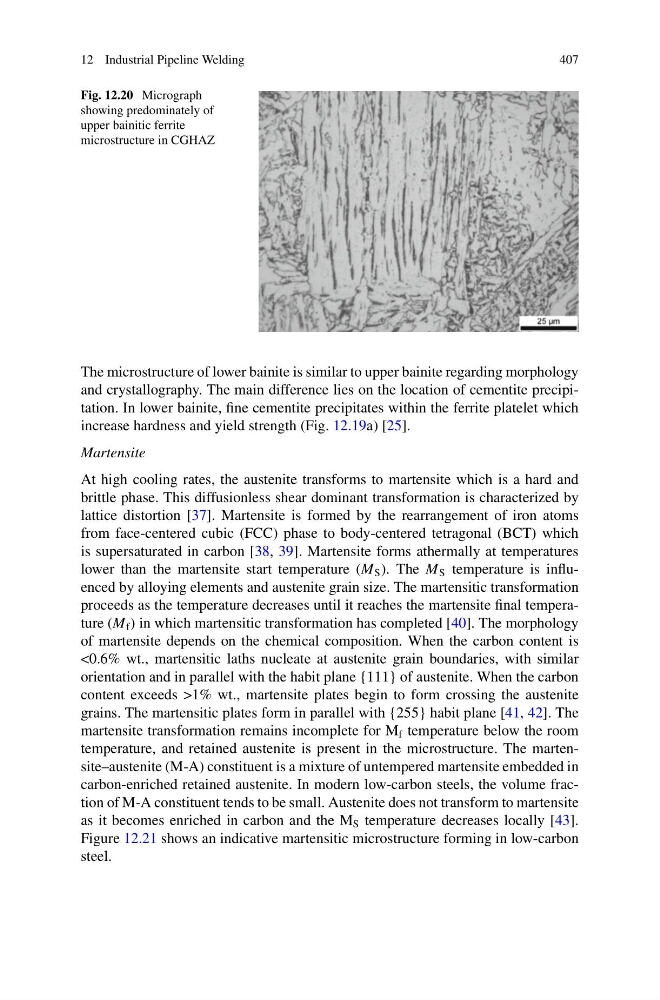
Fig. 12.20 Micrograph
showing predominately of
upper bainitic ferrite
microstructure in CGHAZ
The microstructure of lower bainite is similar to upper bainite regarding morphology
and crystallography. The main difference lies on the location of cementite precipitation. In lower bainite, fine cementite precipitates within the ferrite platelet which
increase hardness and yield strength (Fig. 12.19a) [25].
Martensite
At high cooling rates, the austenite transforms to martensite which is a hard and
brittle phase. This diffusionless shear dominant transformation is characterized by
lattice distortion [37]. Martensite is formed by the rearrangement of iron atoms
from face-centered cubic (FCC) phase to body-centered tetragonal (BCT) which
is supersaturated in carbon [38, 39]. Martensite forms athermally at temperatures
lower than the martensite start temperature (M S ). The M S temperature is influenced by alloying elements and austenite grain size. The martensitic transformation
proceeds as the temperature decreases until it reaches the martensite final temperature (M f ) in which martensitic transformation has completed [40]. The morphology
of martensite depends on the chemical composition. When the carbon content is
<0.6% wt., martensitic laths nucleate at austenite grain boundaries, with similar
orientation and in parallel with the habit plane {111} of austenite. When the carbon
content exceeds >1% wt., martensite plates begin to form crossing the austenite
grains. The martensitic plates form in parallel with {255} habit plane [41, 42]. The
martensite transformation remains incomplete for M f temperature below the room
temperature, and retained austenite is present in the microstructure. The martensite–austenite (M-A) constituent is a mixture of untempered martensite embedded in
carbon-enriched retained austenite. In modern low-carbon steels, the volume fraction of M-A constituent tends to be small. Austenite does not transform to martensite
as it becomes enriched in carbon and the M S temperature decreases locally [43].
Figure 12.21 shows an indicative martensitic microstructure forming in low-carbon
steel.
407
Fig. 12.20 Micrograph
showing predominately of
upper bainitic ferrite
microstructure in CGHAZ
The microstructure of lower bainite is similar to upper bainite regarding morphology
and crystallography. The main difference lies on the location of cementite precipitation. In lower bainite, fine cementite precipitates within the ferrite platelet which
increase hardness and yield strength (Fig. 12.19a) [25].
Martensite
At high cooling rates, the austenite transforms to martensite which is a hard and
brittle phase. This diffusionless shear dominant transformation is characterized by
lattice distortion [37]. Martensite is formed by the rearrangement of iron atoms
from face-centered cubic (FCC) phase to body-centered tetragonal (BCT) which
is supersaturated in carbon [38, 39]. Martensite forms athermally at temperatures
lower than the martensite start temperature (M S ). The M S temperature is influenced by alloying elements and austenite grain size. The martensitic transformation
proceeds as the temperature decreases until it reaches the martensite final temperature (M f ) in which martensitic transformation has completed [40]. The morphology
of martensite depends on the chemical composition. When the carbon content is
<0.6% wt., martensitic laths nucleate at austenite grain boundaries, with similar
orientation and in parallel with the habit plane {111} of austenite. When the carbon
content exceeds >1% wt., martensite plates begin to form crossing the austenite
grains. The martensitic plates form in parallel with {255} habit plane [41, 42]. The
martensite transformation remains incomplete for M f temperature below the room
temperature, and retained austenite is present in the microstructure. The martensite–austenite (M-A) constituent is a mixture of untempered martensite embedded in
carbon-enriched retained austenite. In modern low-carbon steels, the volume fraction of M-A constituent tends to be small. Austenite does not transform to martensite
as it becomes enriched in carbon and the M S temperature decreases locally [43].
Figure 12.21 shows an indicative martensitic microstructure forming in low-carbon
steel.