

12 Industrial Pipeline Welding
405
The presence of precipitates favors the nucleation and growth of polygonal ferrite
[31].
Widmanstätten Ferrite
Widmanstätten ferrite forms at austenite grain boundaries having needle/plate like
morphology at slightly higher cooling rates at temperatures close to A 3 temperature.
Widmanstätten ferritic needle grows at {558} γ habit plane having coherency with
austenitic matrix. Two distinctive morphologies of Widmanstätten ferrite (primary
and secondary WF) have been observed: Primary WF grows from austenite, whereas
secondary WF grows at ferrite grain boundaries. Since WF grows under low undercooling, carbon is distributed to austenite during its formation. Carbon diffusion is
controlled by paraequilibrium conditions [32, 33]. Widmanstätten ferrite presents
higher hardness compared to grain boundary ferrite and low toughness, therefore, it
must be avoided [34, 35].
Acicular Ferrite
Acicular ferrite is a microstructure nucleating preferably at inclusions or defects at
the interior of austenite grains. At temperatures below A 1 at high undercoolings,
needles of acicular ferrite begin to form at inclusions. Needles of acicular ferrite are
supersaturated in carbon since at high cooling rates the time for diffusion is restricted.
The resulting microstructure is less oriented with multiple grain boundaries than
Widmanstätten ferrite hence the increase in yield strength and toughness [36].
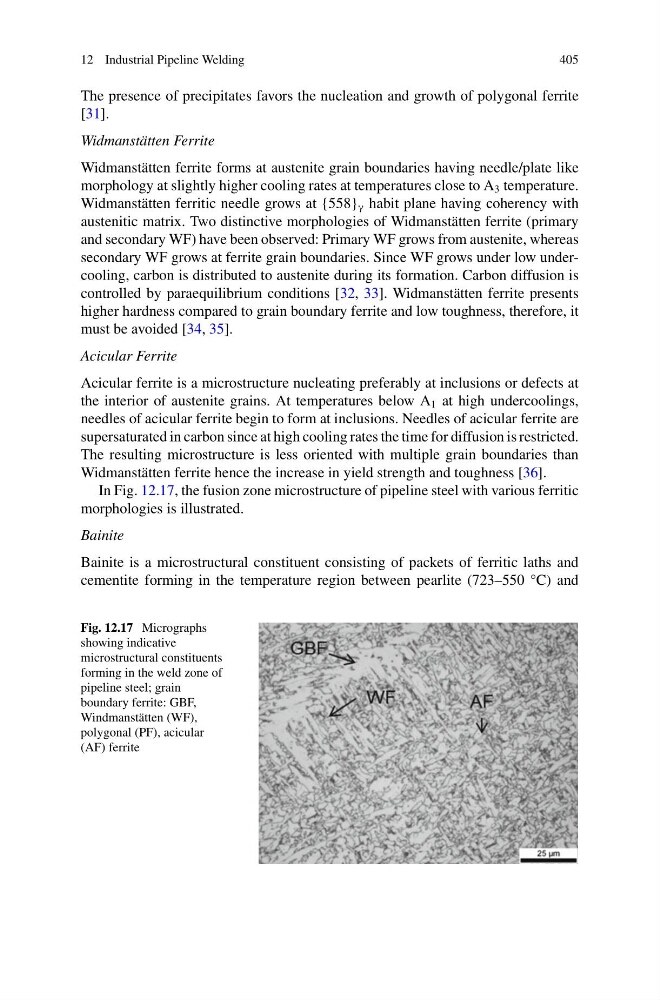
In Fig. 12.17, the fusion zone microstructure of pipeline steel with various ferritic
morphologies is illustrated.
Bainite
Bainite is a microstructural constituent consisting of packets of ferritic laths and
cementite forming in the temperature region between pearlite (723–550 °C) and
Fig. 12.17 Micrographs
showing indicative
microstructural constituents
forming in the weld zone of
pipeline steel; grain
boundary ferrite: GBF,
Windmanstätten (WF),
polygonal (PF), acicular
(AF) ferrite
405
The presence of precipitates favors the nucleation and growth of polygonal ferrite
[31].
Widmanstätten Ferrite
Widmanstätten ferrite forms at austenite grain boundaries having needle/plate like
morphology at slightly higher cooling rates at temperatures close to A 3 temperature.
Widmanstätten ferritic needle grows at {558} γ habit plane having coherency with
austenitic matrix. Two distinctive morphologies of Widmanstätten ferrite (primary
and secondary WF) have been observed: Primary WF grows from austenite, whereas
secondary WF grows at ferrite grain boundaries. Since WF grows under low undercooling, carbon is distributed to austenite during its formation. Carbon diffusion is
controlled by paraequilibrium conditions [32, 33]. Widmanstätten ferrite presents
higher hardness compared to grain boundary ferrite and low toughness, therefore, it
must be avoided [34, 35].
Acicular Ferrite
Acicular ferrite is a microstructure nucleating preferably at inclusions or defects at
the interior of austenite grains. At temperatures below A 1 at high undercoolings,
needles of acicular ferrite begin to form at inclusions. Needles of acicular ferrite are
supersaturated in carbon since at high cooling rates the time for diffusion is restricted.
The resulting microstructure is less oriented with multiple grain boundaries than
Widmanstätten ferrite hence the increase in yield strength and toughness [36].
In Fig. 12.17, the fusion zone microstructure of pipeline steel with various ferritic
morphologies is illustrated.
Bainite
Bainite is a microstructural constituent consisting of packets of ferritic laths and
cementite forming in the temperature region between pearlite (723–550 °C) and
Fig. 12.17 Micrographs
showing indicative
microstructural constituents
forming in the weld zone of
pipeline steel; grain
boundary ferrite: GBF,
Windmanstätten (WF),
polygonal (PF), acicular
(AF) ferrite