

404
S. Papaefthymiou
The morphology of the solidified metal depends on the solidification rate, thermodynamic considerations, and heat flow. The planar interface of solid/liquid can be
planar, cellular, or dendritic. The liquidus temperature (T L ) distribution depends on
composition distribution based on the phase diagram. From thermodynamic point of
view, the liquid becomes enriched in alloying elements. Therefore, the T L temperature decreases, and subsequently, the freezing range (T = T L – T S ) decreases as
well. In addition, as the temperature decreases, the diffusion coefficient D lowers
indicating that the diffusion becomes sluggish. In order to establish a stable planar
growth S/L interface, the following equation must be satisfied:
G
R
≥
T
D
(12.5)
in which G is the thermal gradient, R is the growth rate, T is the solidification range,
and D is the diffusion coefficient of alloying elements. In the fusion zone, the freezing
range increases rapidly due to high cooling rate and the alloying element diffusion
coefficient decreases. Liquid phase is enriched in alloying elements; therefore, the
T L temperatures decrease locally, and liquid phase can be stable at temperatures
lower than the actual T L of the material. This condition is referred as constitutional
supercooling. It can be increased by cooling rate and segregation. In this case, the
planar interface alters to cellular and dendritic solidification. The region in the weld
in which dendrites and liquid coexist is called “Mushy zone” [29].
Post-solidification transformations can alter the final microstructure and properties in the fusion zone. Post-solidification transformations in HSLA steels are related
to the austenite-to-ferrite transformation which is affected by cooling rate, alloying
additions, and grain size (Fig. 12.13).
Allotriomorphic Ferrite
Austenite-to-ferrite transformation at low cooling rates starts at austenite grain
boundaries. Ferritic nucleus begins to form at austenite grain boundaries and grow
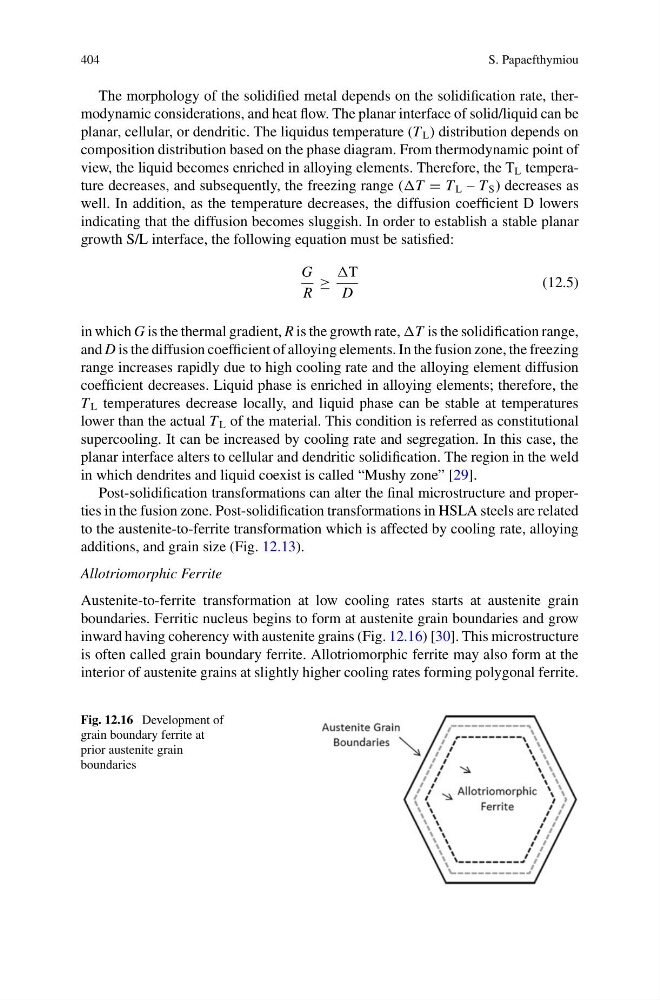
inward having coherency with austenite grains (Fig. 12.16) [30]. This microstructure
is often called grain boundary ferrite. Allotriomorphic ferrite may also form at the
interior of austenite grains at slightly higher cooling rates forming polygonal ferrite.
Fig. 12.16 Development of
grain boundary ferrite at
prior austenite grain
boundaries
S. Papaefthymiou
The morphology of the solidified metal depends on the solidification rate, thermodynamic considerations, and heat flow. The planar interface of solid/liquid can be
planar, cellular, or dendritic. The liquidus temperature (T L ) distribution depends on
composition distribution based on the phase diagram. From thermodynamic point of
view, the liquid becomes enriched in alloying elements. Therefore, the T L temperature decreases, and subsequently, the freezing range (T = T L – T S ) decreases as
well. In addition, as the temperature decreases, the diffusion coefficient D lowers
indicating that the diffusion becomes sluggish. In order to establish a stable planar
growth S/L interface, the following equation must be satisfied:
G
R
≥
T
D
(12.5)
in which G is the thermal gradient, R is the growth rate, T is the solidification range,
and D is the diffusion coefficient of alloying elements. In the fusion zone, the freezing
range increases rapidly due to high cooling rate and the alloying element diffusion
coefficient decreases. Liquid phase is enriched in alloying elements; therefore, the
T L temperatures decrease locally, and liquid phase can be stable at temperatures
lower than the actual T L of the material. This condition is referred as constitutional
supercooling. It can be increased by cooling rate and segregation. In this case, the
planar interface alters to cellular and dendritic solidification. The region in the weld
in which dendrites and liquid coexist is called “Mushy zone” [29].
Post-solidification transformations can alter the final microstructure and properties in the fusion zone. Post-solidification transformations in HSLA steels are related
to the austenite-to-ferrite transformation which is affected by cooling rate, alloying
additions, and grain size (Fig. 12.13).
Allotriomorphic Ferrite
Austenite-to-ferrite transformation at low cooling rates starts at austenite grain
boundaries. Ferritic nucleus begins to form at austenite grain boundaries and grow
inward having coherency with austenite grains (Fig. 12.16) [30]. This microstructure
is often called grain boundary ferrite. Allotriomorphic ferrite may also form at the
interior of austenite grains at slightly higher cooling rates forming polygonal ferrite.
Fig. 12.16 Development of
grain boundary ferrite at
prior austenite grain
boundaries