

12 Industrial Pipeline Welding
391
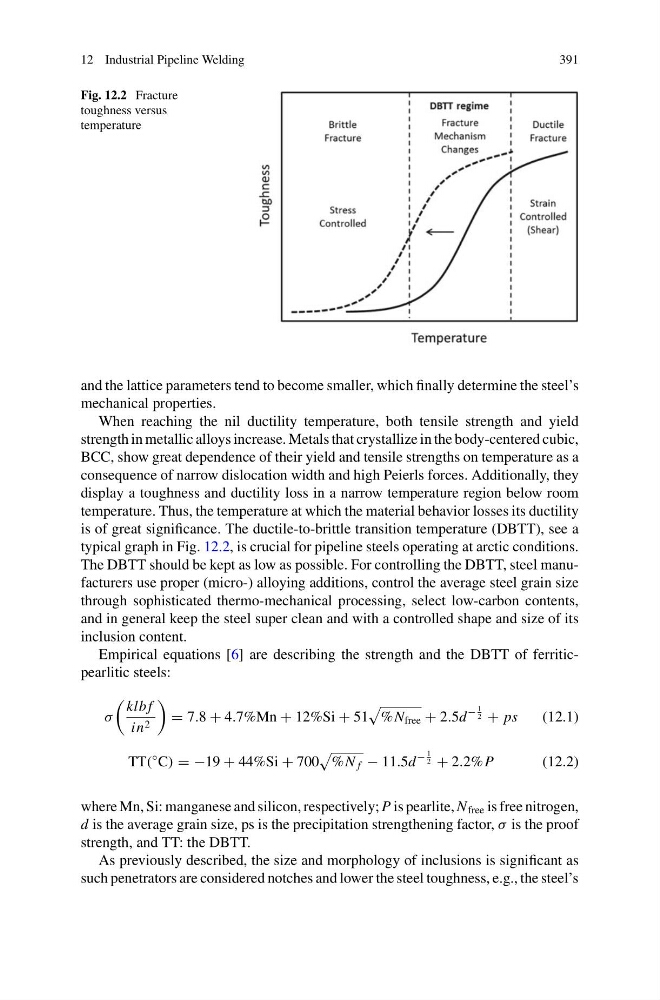
Fig. 12.2 Fracture
toughness versus
temperature
and the lattice parameters tend to become smaller, which finally determine the steel’s
mechanical properties.
When reaching the nil ductility temperature, both tensile strength and yield
strength in metallic alloys increase. Metals that crystallize in the body-centered cubic,
BCC, show great dependence of their yield and tensile strengths on temperature as a
consequence of narrow dislocation width and high Peierls forces. Additionally, they
display a toughness and ductility loss in a narrow temperature region below room
temperature. Thus, the temperature at which the material behavior losses its ductility
is of great significance. The ductile-to-brittle transition temperature (DBTT), see a
typical graph in Fig. 12.2, is crucial for pipeline steels operating at arctic conditions.
The DBTT should be kept as low as possible. For controlling the DBTT, steel manufacturers use proper (micro-) alloying additions, control the average steel grain size
through sophisticated thermo-mechanical processing, select low-carbon contents,
and in general keep the steel super clean and with a controlled shape and size of its
inclusion content.
Empirical equations [6] are describing the strength and the DBTT of ferriticpearlitic steels:
σ
klb f
in 2
= 7.8 + 4.7%Mn + 12%Si + 51
%N free + 2.5d
−
1
2 + ps
(12.1)
TT(
◦ C) = −19 + 44%Si + 700
%N f − 11.5d
−
1
2 + 2.2%P
(12.2)
where Mn, Si: manganese and silicon, respectively; P is pearlite, N free is free nitrogen,
d is the average grain size, ps is the precipitation strengthening factor, σ is the proof
strength, and TT: the DBTT.
As previously described, the size and morphology of inclusions is significant as
such penetrators are considered notches and lower the steel toughness, e.g., the steel’s
391
Fig. 12.2 Fracture
toughness versus
temperature
and the lattice parameters tend to become smaller, which finally determine the steel’s
mechanical properties.
When reaching the nil ductility temperature, both tensile strength and yield
strength in metallic alloys increase. Metals that crystallize in the body-centered cubic,
BCC, show great dependence of their yield and tensile strengths on temperature as a
consequence of narrow dislocation width and high Peierls forces. Additionally, they
display a toughness and ductility loss in a narrow temperature region below room
temperature. Thus, the temperature at which the material behavior losses its ductility
is of great significance. The ductile-to-brittle transition temperature (DBTT), see a
typical graph in Fig. 12.2, is crucial for pipeline steels operating at arctic conditions.
The DBTT should be kept as low as possible. For controlling the DBTT, steel manufacturers use proper (micro-) alloying additions, control the average steel grain size
through sophisticated thermo-mechanical processing, select low-carbon contents,
and in general keep the steel super clean and with a controlled shape and size of its
inclusion content.
Empirical equations [6] are describing the strength and the DBTT of ferriticpearlitic steels:
σ
klb f
in 2
= 7.8 + 4.7%Mn + 12%Si + 51
%N free + 2.5d
−
1
2 + ps
(12.1)
TT(
◦ C) = −19 + 44%Si + 700
%N f − 11.5d
−
1
2 + 2.2%P
(12.2)
where Mn, Si: manganese and silicon, respectively; P is pearlite, N free is free nitrogen,
d is the average grain size, ps is the precipitation strengthening factor, σ is the proof
strength, and TT: the DBTT.
As previously described, the size and morphology of inclusions is significant as
such penetrators are considered notches and lower the steel toughness, e.g., the steel’s