

10 A Novel High-Efficiency Keyhole Tungsten Inert Gas …
363
(a)
(b)
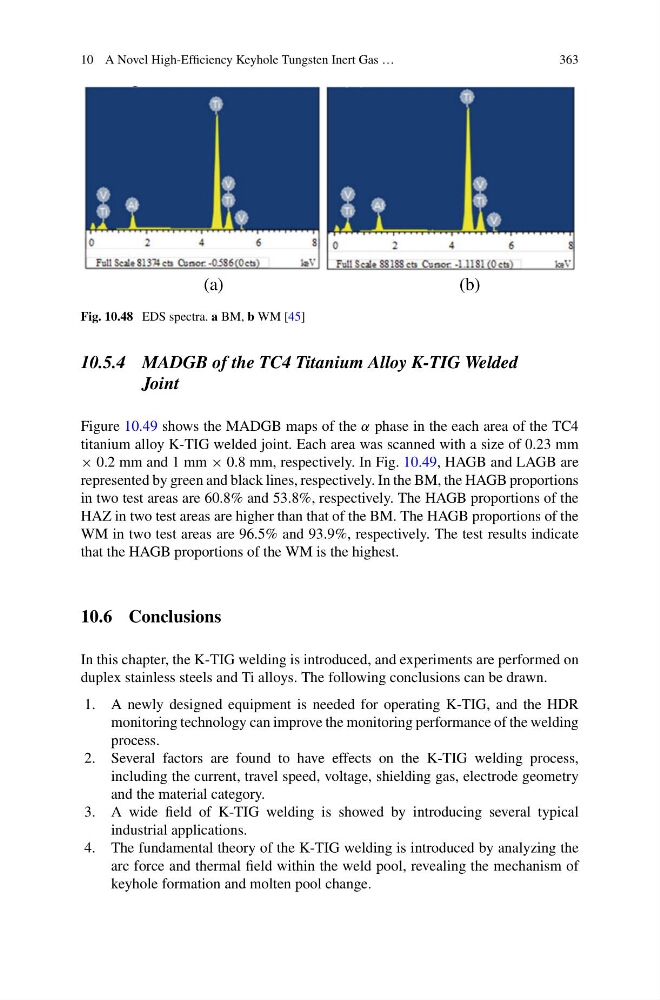
Fig. 10.48 EDS spectra. a BM, b WM [45]
10.5.4 MADGB of the TC4 Titanium Alloy K-TIG Welded
Joint
Figure 10.49 shows the MADGB maps of the α phase in the each area of the TC4
titanium alloy K-TIG welded joint. Each area was scanned with a size of 0.23 mm
× 0.2 mm and 1 mm × 0.8 mm, respectively. In Fig. 10.49, HAGB and LAGB are
represented by green and black lines, respectively. In the BM, the HAGB proportions
in two test areas are 60.8% and 53.8%, respectively. The HAGB proportions of the
HAZ in two test areas are higher than that of the BM. The HAGB proportions of the
WM in two test areas are 96.5% and 93.9%, respectively. The test results indicate
that the HAGB proportions of the WM is the highest.
10.6 Conclusions
In this chapter, the K-TIG welding is introduced, and experiments are performed on
duplex stainless steels and Ti alloys. The following conclusions can be drawn.
1. A newly designed equipment is needed for operating K-TIG, and the HDR
monitoring technology can improve the monitoring performance of the welding
process.
2. Several factors are found to have effects on the K-TIG welding process,
including the current, travel speed, voltage, shielding gas, electrode geometry
and the material category.
3. A wide field of K-TIG welding is showed by introducing several typical
industrial applications.
4. The fundamental theory of the K-TIG welding is introduced by analyzing the
arc force and thermal field within the weld pool, revealing the mechanism of
keyhole formation and molten pool change.
363
(a)
(b)
Fig. 10.48 EDS spectra. a BM, b WM [45]
10.5.4 MADGB of the TC4 Titanium Alloy K-TIG Welded
Joint
Figure 10.49 shows the MADGB maps of the α phase in the each area of the TC4
titanium alloy K-TIG welded joint. Each area was scanned with a size of 0.23 mm
× 0.2 mm and 1 mm × 0.8 mm, respectively. In Fig. 10.49, HAGB and LAGB are
represented by green and black lines, respectively. In the BM, the HAGB proportions
in two test areas are 60.8% and 53.8%, respectively. The HAGB proportions of the
HAZ in two test areas are higher than that of the BM. The HAGB proportions of the
WM in two test areas are 96.5% and 93.9%, respectively. The test results indicate
that the HAGB proportions of the WM is the highest.
10.6 Conclusions
In this chapter, the K-TIG welding is introduced, and experiments are performed on
duplex stainless steels and Ti alloys. The following conclusions can be drawn.
1. A newly designed equipment is needed for operating K-TIG, and the HDR
monitoring technology can improve the monitoring performance of the welding
process.
2. Several factors are found to have effects on the K-TIG welding process,
including the current, travel speed, voltage, shielding gas, electrode geometry
and the material category.
3. A wide field of K-TIG welding is showed by introducing several typical
industrial applications.
4. The fundamental theory of the K-TIG welding is introduced by analyzing the
arc force and thermal field within the weld pool, revealing the mechanism of
keyhole formation and molten pool change.