

10 A Novel High-Efficiency Keyhole Tungsten Inert Gas …
345
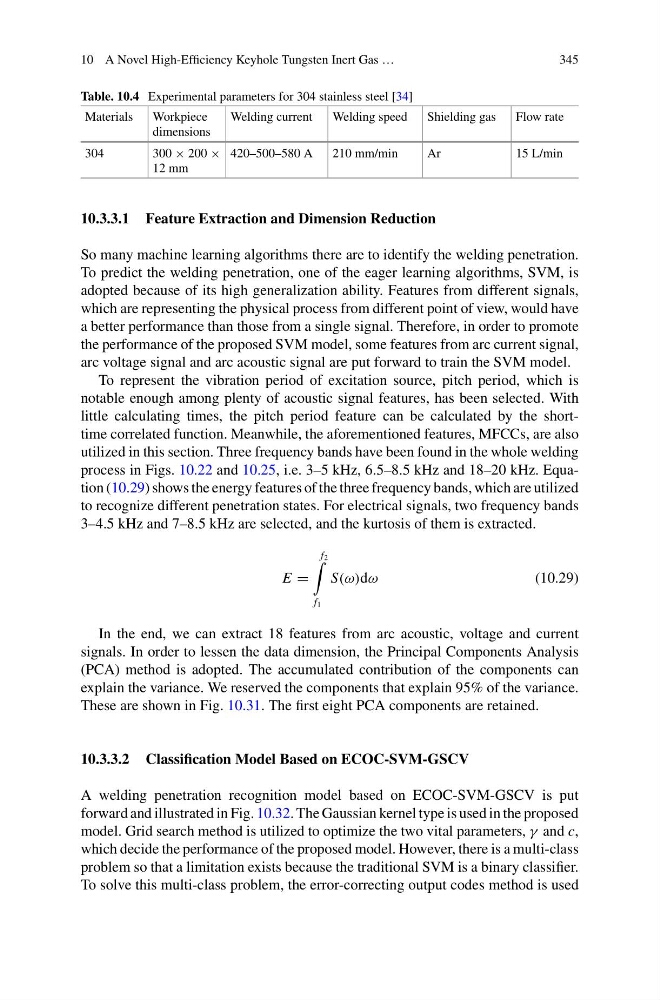
Table. 10.4 Experimental parameters for 304 stainless steel [34]
Materials
Workpiece
dimensions
Welding current
Welding speed
Shielding gas
Flow rate
304
300 × 200 ×
12 mm
420–500–580 A
210 mm/min
Ar
15 L/min
10.3.3.1 Feature Extraction and Dimension Reduction
So many machine learning algorithms there are to identify the welding penetration.
To predict the welding penetration, one of the eager learning algorithms, SVM, is
adopted because of its high generalization ability. Features from different signals,
which are representing the physical process from different point of view, would have
a better performance than those from a single signal. Therefore, in order to promote
the performance of the proposed SVM model, some features from arc current signal,
arc voltage signal and arc acoustic signal are put forward to train the SVM model.
To represent the vibration period of excitation source, pitch period, which is
notable enough among plenty of acoustic signal features, has been selected. With
little calculating times, the pitch period feature can be calculated by the shorttime correlated function. Meanwhile, the aforementioned features, MFCCs, are also
utilized in this section. Three frequency bands have been found in the whole welding
process in Figs. 10.22 and 10.25, i.e. 3–5 kHz, 6.5–8.5 kHz and 18–20 kHz. Equation (10.29) shows the energy features of the three frequency bands, which are utilized
to recognize different penetration states. For electrical signals, two frequency bands
3–4.5 kHz and 7–8.5 kHz are selected, and the kurtosis of them is extracted.
E =
f 2
f 1
S(ω)dω
(10.29)
In the end, we can extract 18 features from arc acoustic, voltage and current
signals. In order to lessen the data dimension, the Principal Components Analysis
(PCA) method is adopted. The accumulated contribution of the components can
explain the variance. We reserved the components that explain 95% of the variance.
These are shown in Fig. 10.31. The first eight PCA components are retained.
10.3.3.2 Classification Model Based on ECOC-SVM-GSCV
A welding penetration recognition model based on ECOC-SVM-GSCV is put
forward and illustrated in Fig. 10.32. The Gaussian kernel type is used in the proposed
model. Grid search method is utilized to optimize the two vital parameters, γ and c,
which decide the performance of the proposed model. However, there is a multi-class
problem so that a limitation exists because the traditional SVM is a binary classifier.
To solve this multi-class problem, the error-correcting output codes method is used
345
Table. 10.4 Experimental parameters for 304 stainless steel [34]
Materials
Workpiece
dimensions
Welding current
Welding speed
Shielding gas
Flow rate
304
300 × 200 ×
12 mm
420–500–580 A
210 mm/min
Ar
15 L/min
10.3.3.1 Feature Extraction and Dimension Reduction
So many machine learning algorithms there are to identify the welding penetration.
To predict the welding penetration, one of the eager learning algorithms, SVM, is
adopted because of its high generalization ability. Features from different signals,
which are representing the physical process from different point of view, would have
a better performance than those from a single signal. Therefore, in order to promote
the performance of the proposed SVM model, some features from arc current signal,
arc voltage signal and arc acoustic signal are put forward to train the SVM model.
To represent the vibration period of excitation source, pitch period, which is
notable enough among plenty of acoustic signal features, has been selected. With
little calculating times, the pitch period feature can be calculated by the shorttime correlated function. Meanwhile, the aforementioned features, MFCCs, are also
utilized in this section. Three frequency bands have been found in the whole welding
process in Figs. 10.22 and 10.25, i.e. 3–5 kHz, 6.5–8.5 kHz and 18–20 kHz. Equation (10.29) shows the energy features of the three frequency bands, which are utilized
to recognize different penetration states. For electrical signals, two frequency bands
3–4.5 kHz and 7–8.5 kHz are selected, and the kurtosis of them is extracted.
E =
f 2
f 1
S(ω)dω
(10.29)
In the end, we can extract 18 features from arc acoustic, voltage and current
signals. In order to lessen the data dimension, the Principal Components Analysis
(PCA) method is adopted. The accumulated contribution of the components can
explain the variance. We reserved the components that explain 95% of the variance.
These are shown in Fig. 10.31. The first eight PCA components are retained.
10.3.3.2 Classification Model Based on ECOC-SVM-GSCV
A welding penetration recognition model based on ECOC-SVM-GSCV is put
forward and illustrated in Fig. 10.32. The Gaussian kernel type is used in the proposed
model. Grid search method is utilized to optimize the two vital parameters, γ and c,
which decide the performance of the proposed model. However, there is a multi-class
problem so that a limitation exists because the traditional SVM is a binary classifier.
To solve this multi-class problem, the error-correcting output codes method is used