

328
Y. Shi et al.
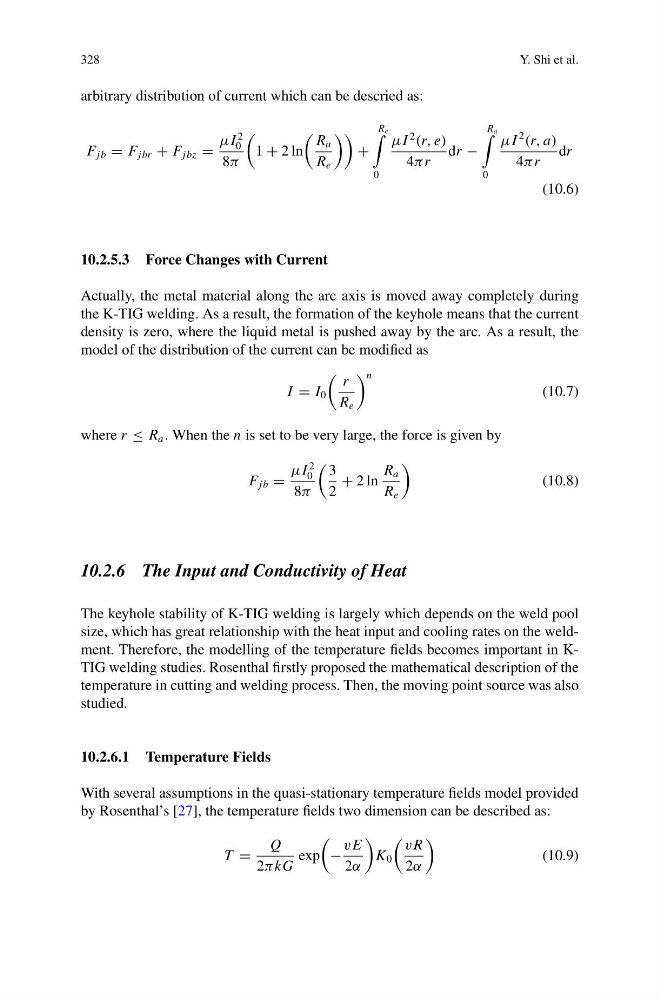
arbitrary distribution of current which can be descried as:
F jb = F jbr + F jbz =
μI
2
0
8π
1 + 2 ln
R a
R e
+
R e
0
μI
2
(r, e)
4πr
dr −
R a
0
μI
2
(r, a)
4πr
dr
(10.6)
10.2.5.3 Force Changes with Current
Actually, the metal material along the arc axis is moved away completely during
the K-TIG welding. As a result, the formation of the keyhole means that the current
density is zero, where the liquid metal is pushed away by the arc. As a result, the
model of the distribution of the current can be modified as
I = I 0
r
R e
n
(10.7)
where r ≤ R a . When the n is set to be very large, the force is given by
F jb =
μI
2
0
8π
3
2
+ 2 ln
R a
R e
(10.8)
10.2.6 The Input and Conductivity of Heat
The keyhole stability of K-TIG welding is largely which depends on the weld pool
size, which has great relationship with the heat input and cooling rates on the weldment. Therefore, the modelling of the temperature fields becomes important in KTIG welding studies. Rosenthal firstly proposed the mathematical description of the
temperature in cutting and welding process. Then, the moving point source was also
studied.
10.2.6.1 Temperature Fields
With several assumptions in the quasi-stationary temperature fields model provided
by Rosenthal’s [27], the temperature fields two dimension can be described as:
T =
Q
2π kG
exp
−
v E
2α
K 0
v R
2α
(10.9)
Y. Shi et al.
arbitrary distribution of current which can be descried as:
F jb = F jbr + F jbz =
μI
2
0
8π
1 + 2 ln
R a
R e
+
R e
0
μI
2
(r, e)
4πr
dr −
R a
0
μI
2
(r, a)
4πr
dr
(10.6)
10.2.5.3 Force Changes with Current
Actually, the metal material along the arc axis is moved away completely during
the K-TIG welding. As a result, the formation of the keyhole means that the current
density is zero, where the liquid metal is pushed away by the arc. As a result, the
model of the distribution of the current can be modified as
I = I 0
r
R e
n
(10.7)
where r ≤ R a . When the n is set to be very large, the force is given by
F jb =
μI
2
0
8π
3
2
+ 2 ln
R a
R e
(10.8)
10.2.6 The Input and Conductivity of Heat
The keyhole stability of K-TIG welding is largely which depends on the weld pool
size, which has great relationship with the heat input and cooling rates on the weldment. Therefore, the modelling of the temperature fields becomes important in KTIG welding studies. Rosenthal firstly proposed the mathematical description of the
temperature in cutting and welding process. Then, the moving point source was also
studied.
10.2.6.1 Temperature Fields
With several assumptions in the quasi-stationary temperature fields model provided
by Rosenthal’s [27], the temperature fields two dimension can be described as:
T =
Q
2π kG
exp
−
v E
2α
K 0
v R
2α
(10.9)